2026. 8. 6. 17:55ㆍ취미생활/축구


Hello,
Today I want to walk through one of the most argued-about calls in soccer: the handball rule.
If you've watched enough matches, you've probably seen a ball clearly brush a player's hand or arm, yet the referee waves play on without a whistle. Other times, what looks like the faintest touch gets called for a penalty.
So when exactly does a handball get called? The answer turns out to be more layered than most fans expect.
The handball offense sits inside Law 12, Fouls and Misconduct, part of the Laws of the Game maintained by IFAB, the International Football Association Board. That law has been rewritten several times over the years to reach its current form.
Origins and the Basic Standard
First, it helps to know where the "hand" actually starts. Under IFAB's definition, the arm counts from the fingertips down to the bottom of the armpit.
That means a ball hitting the shoulder or upper arm is not considered handball, but anything from the lower arm down to the fingertips falls under the rule. The zone is actually wider than many fans assume.
The second key standard is whether the player made their body "unnaturally bigger." If the arm's position is simply a natural consequence of body movement in that moment, it's not called. But if the arm was positioned to make the body bigger than it naturally would be, it's judged a foul.
For example, a defender standing with arms tucked close to the body near goal is unlikely to be penalized if the ball strikes the arm. But a player who spreads their arms out to block space is more likely to be judged as acting deliberately.
How Referees Actually Decide
If the handball happens outside the penalty area, the opposing team gets a direct free kick. If it happens inside the box, it's a penalty kick.
Here's an interesting wrinkle: the same rule applies to attackers too. If the ball deflects off an attacker's arm or body and they score, the goal is disallowed even if it wasn't deliberate. This clause alone has decided the outcome of more than a few matches.
A defender's accidental handball is treated a bit differently. If the arm was in a natural position and the ball struck it from very close range, it's often ruled not a foul, even if it leads to a goal for the opposing team.
Whether a yellow card follows also depends on context. A caution is given if the handball denies the opponent a promising attack, but when a penalty is awarded for an accidental handball, the kick alone is usually given without a card.
Good to Know
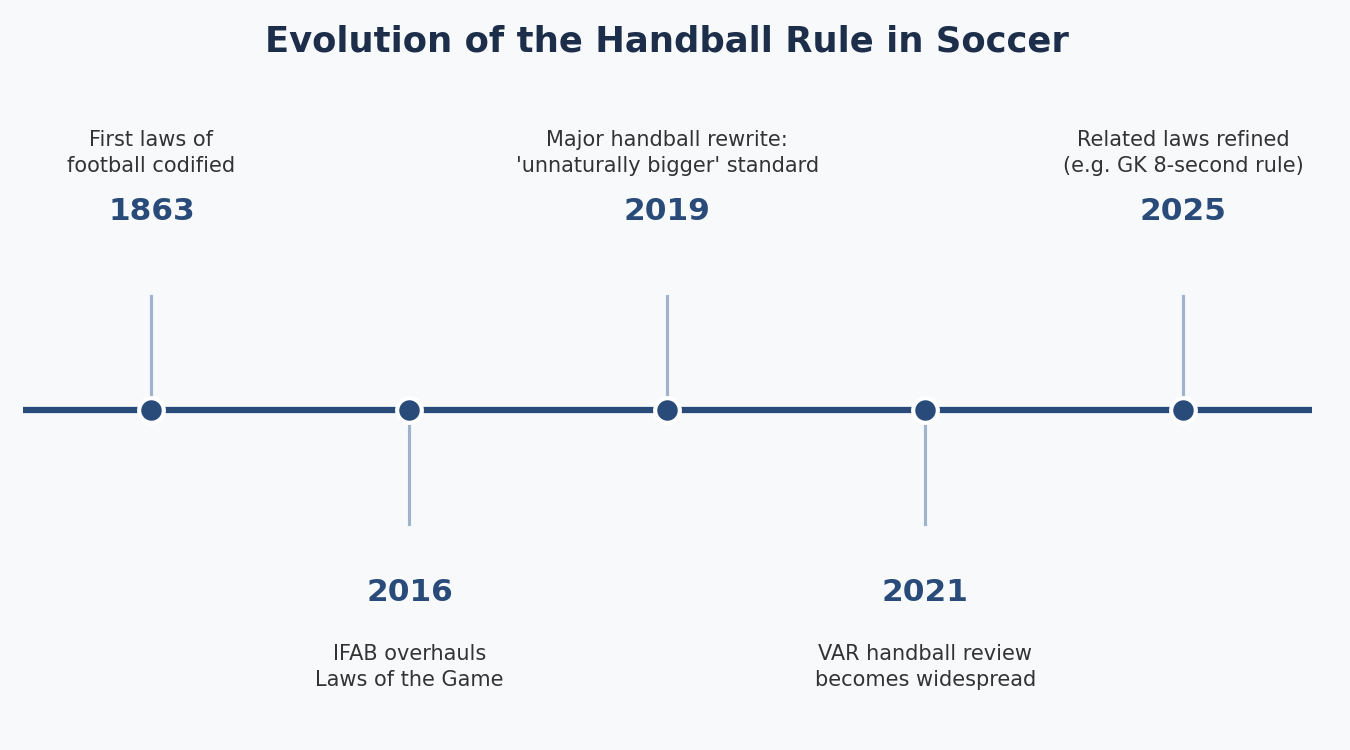
Getting to today's handball rule took a fair amount of trial and error. Ahead of the 2019/20 season, IFAB overhauled Law 12's handball clause. Before that, the rule leaned heavily on judging "intent" alone, and referees were criticized for inconsistent calls.
That's when the "unnaturally bigger" standard was introduced as a concrete test, forming the backbone of the rule we know today.
Since then, the spread of VAR, the Video Assistant Referee, has made handball decisions noticeably more precise. Camera angles that the human eye might miss, like the exact angle of an arm or the distance from the ball, can now be reviewed frame by frame.
That said, VAR doesn't step in for every handball situation. The principle is that it only intervenes for clear and obvious errors, so in genuinely borderline cases, the on-field referee's judgment is still respected.
Worth noting: the 2025/26 season brought related law tweaks too, though mostly outside the handball clause itself, such as a new rule limiting goalkeepers to eight seconds of ball possession before conceding a corner kick. Soccer's laws keep getting refined season after season, so following the changes can add a whole new layer of enjoyment to watching the game.