2026. 8. 1. 20:36ㆍ자산관리
Hello everyone.
Today I want to talk about one of the hottest topics in finance right now: stablecoins.
How can a cryptocurrency barely move in price at all?
If you're used to watching Bitcoin or Ethereum swing by double-digit percentages in a single day, hearing about a coin designed to hold "1 coin = 1 dollar" might sound strange. Yet stablecoins are often called "digital dollars," and they're already widely used for payments, remittances, and as the base currency inside crypto exchanges.
Lately this topic has become even more relevant, as South Korea has ramped up legislative discussion around bringing won-denominated stablecoins into a formal regulatory framework. That makes stablecoins worth understanding from an asset management perspective, not just a crypto-trading one. Today we'll walk through exactly what a stablecoin is and how it keeps its value, how Tether (USDT) and USD Coin (USDC) differ, and where Korea's regulatory push currently stands.
How Do Stablecoins Actually Hold Their Value?
A stablecoin is, quite literally, a cryptocurrency built to stay stable in price. The most common design is the "fiat-collateralized" model, in which the issuer holds real dollars in a bank account or in short-term treasuries and mints coins on a 1:1 basis against that reserve.
In simple terms, when a user deposits one dollar with the issuer, the issuer keeps that dollar as a reserve asset and hands back one coin of equivalent value. Because that reserve backs the coin, its price doesn't swing the way other cryptocurrencies do.
Beyond fiat-collateralized coins, there are also "crypto-collateralized" stablecoins backed by other digital assets like Bitcoin or Ethereum, and "algorithmic" stablecoins that rely on code to adjust supply and keep the price steady. Algorithmic designs, however, are widely seen as riskier — the collapse of Terra/Luna is the case most people point to when a peg broke down entirely.
Because of this price stability, stablecoins have become the go-to tool for cross-border transfers, moving funds between exchanges, and serving as a trading pair when buying or selling other coins. In a market known for volatility, they function almost like a parking spot for cash.
USDT vs. USDC: What Sets Them Apart
In the dollar-stablecoin market, Tether (USDT) and Circle's USD Coin (USDC) have long dominated trading volume. Both aim to hold a steady $1 value, but the way each backs that value looks quite different.
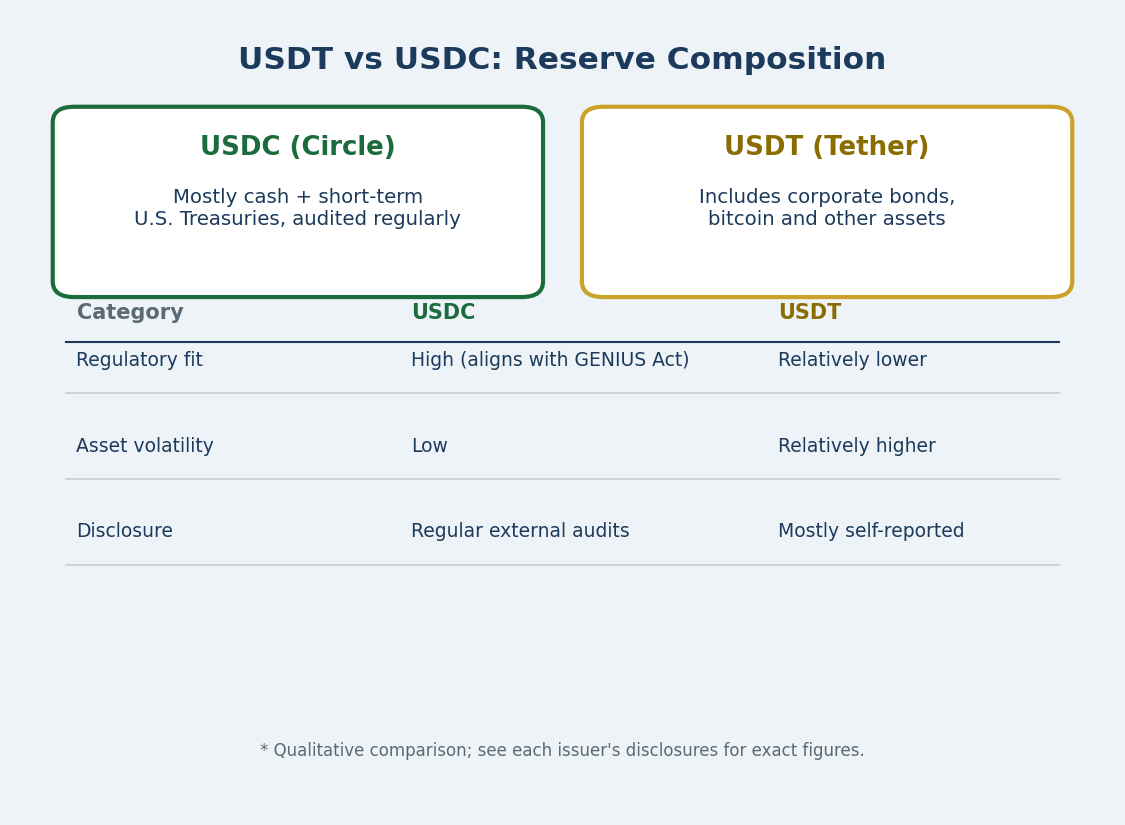
USDC's stated policy is to hold reserves almost entirely in cash and short-term U.S. Treasuries maturing within three months, and Circle publishes regular third-party audits of those holdings. That's a big reason USDC is often described as the more conservative, more transparent option.
Tether (USDT), on the other hand, is reported to hold a broader mix of reserve assets that includes corporate bonds and even bitcoin alongside cash-equivalents. That means the reserve itself can carry more price risk than a pure cash-and-Treasuries model.
The recent rollout of the U.S. GENIUS Act has tightened transparency and collateral requirements for stablecoin issuers. Because USDC's cash-and-Treasuries structure already resembles what the law requires, it's viewed as more regulation-friendly, while Tether — long the market leader — has reportedly seen its share shift as a result.

Where Does Korea's Won-Stablecoin Regulation Stand?
Momentum has been building in 2026 to bring stablecoins into Korea's formal financial system. The government is pushing to enact a Digital Asset Basic Act later this year, aiming to set up a rulebook for the digital asset industry as a whole while formally institutionalizing won-denominated stablecoins.
The proposal reportedly centers on a licensing system so not just anyone can issue a stablecoin, a requirement to hold reserves matching the amount issued, redemption rights so users can convert coins back to cash, and a disclosure framework covering reserve holdings — a structure that looks a lot like what USDC already does.
Industry watchers describe Korea's stablecoin market as having moved from "regulatory debate" into "pilot preparation" and now "competition among would-be issuers." No won-stablecoin has been officially issued yet, but with the government, the Bank of Korea, commercial banks, and fintech firms all engaged, it's shaping up to be one of the year's biggest financial storylines.
Part of the urgency comes from concern that, following the GENIUS Act's implementation in the U.S., dollar-backed stablecoins could expand their reach even further. Without a local-currency alternative in place, payment infrastructure could end up leaning more heavily on dollar stablecoins by default.

What to Keep in Mind Before Investing in Crypto
Being called "stable" doesn't mean a stablecoin carries zero risk. If an issuer fails to hold adequate reserves, or if the reserve assets themselves lose value, the coin can "de-peg" and trade away from its $1 target. There have already been real-world cases where a stablecoin's peg broke, at least temporarily.
More broadly, crypto assets — stablecoins included — still operate in a space where regulation and investor protections are far less mature than in traditional finance. Algorithmic stablecoins and coins from smaller issuers are generally considered riskier, so it's worth checking how an issuer manages and discloses its reserves before relying on any particular coin.
This article is meant to help you understand how stablecoins work and where regulation is headed — it is general information, not investment advice, and it is not a recommendation to buy or sell any specific coin. Any investment decision, and the responsibility that comes with it, ultimately rests with you.
'자산관리' 카테고리의 다른 글
| Real Estate :: Why Is Jeonse Turning Into Monthly Rent So Fast? Understanding th (0) | 2026.08.03 |
|---|---|
| 부동산 :: 전세의 월세화, 왜 이렇게 빨라졌을까? 전월세전환율 총정리 (0) | 2026.08.03 |
| 자산관리 :: 스테이블코인이 뭐길래 이렇게 화제일까요? 코인 투자 기초 총정리 (1) | 2026.08.01 |
| Asset Management :: How Exactly Do Options Trading Profits Work? A Beginner's Guide (0) | 2026.08.01 |
| 자산관리 :: 옵션 거래, 대체 어떻게 돈을 버는 구조일까요? 옵션 투자 기초 총정리 (0) | 2026.08.01 |