2026. 8. 1. 14:14ㆍ자산관리

Hi everyone.
Today's post continues the asset management series, and this time we're covering the basics of options trading.
In an earlier post we looked at the basic structure of futures trading. Futures and options are both classified as derivatives, but they work quite differently. A futures contract is an obligation to buy or sell at a set price, while an option is a right that the holder can choose to use or simply let expire.
The moment terms like call, put, strike price, and premium show up, options can start to feel intimidating. In reality the core idea is fairly simple, but a lot of people get discouraged by the vocabulary before they even get to the concept itself.
So what does it actually mean to buy and sell a "right"? Let's break it down step by step in today's post.
What Is an Option, Exactly
An option is a contract that gives the holder the right, but not the obligation, to buy or sell a specific underlying asset at a predetermined price (the strike price) on or before a set future date (expiration). The key word here is "right," not "obligation." The buyer can exercise that right, or simply walk away if it no longer makes sense.
To obtain that right, the option buyer pays the seller a price known as the premium. This premium is the actual amount that changes hands in an options trade, and it fluctuates constantly based on market conditions.
The underlying asset behind an option can be an individual stock, a stock index like the KOSPI 200, a commodity, or a currency. In Korea, KOSPI 200 index options are the most actively traded index option product.
The name "option" itself reflects this idea. Whether to exercise or not is entirely the buyer's choice, and that flexibility is baked right into the product's name.
Calls vs. Puts
Options fall into two broad categories: call options and put options. A call gives the holder the right to buy the underlying asset, while a put gives the holder the right to sell it.
If you expect the price to rise, you'd buy a call. If the underlying price at expiration is above the strike price, you can effectively buy low and the position is profitable. If the price moves the other way, you simply let the option expire worthless, and your loss is limited to the premium you paid.
If you expect the price to fall, you'd buy a put instead. If the market price at expiration is below the strike price, exercising the right to sell at the higher strike price generates a profit.
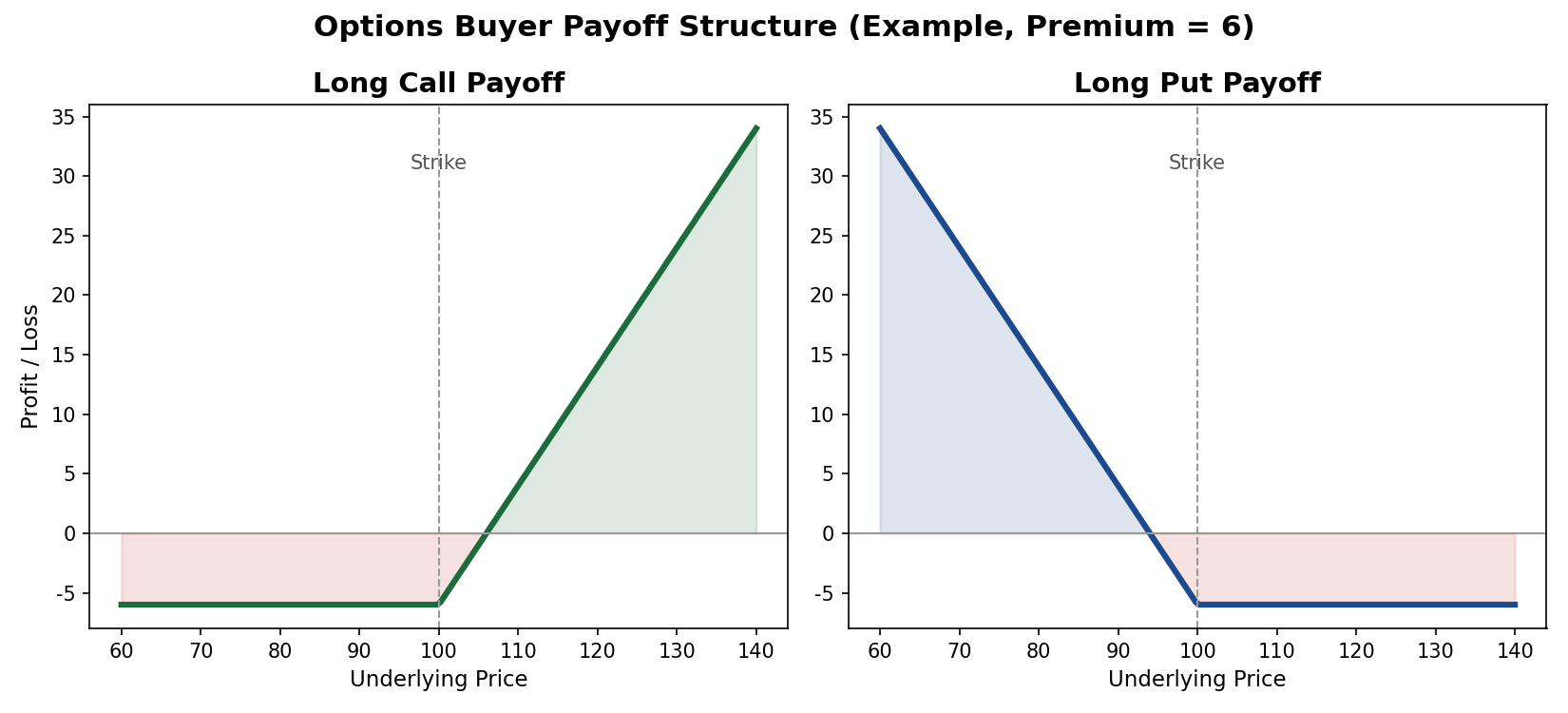
It's worth remembering the other side of the trade: the option seller. In exchange for receiving the premium upfront, the seller takes on the obligation to fulfill the contract if the buyer chooses to exercise. The asymmetry between buyer and seller is one of the most important things to understand about options.
Risks and Key Characteristics
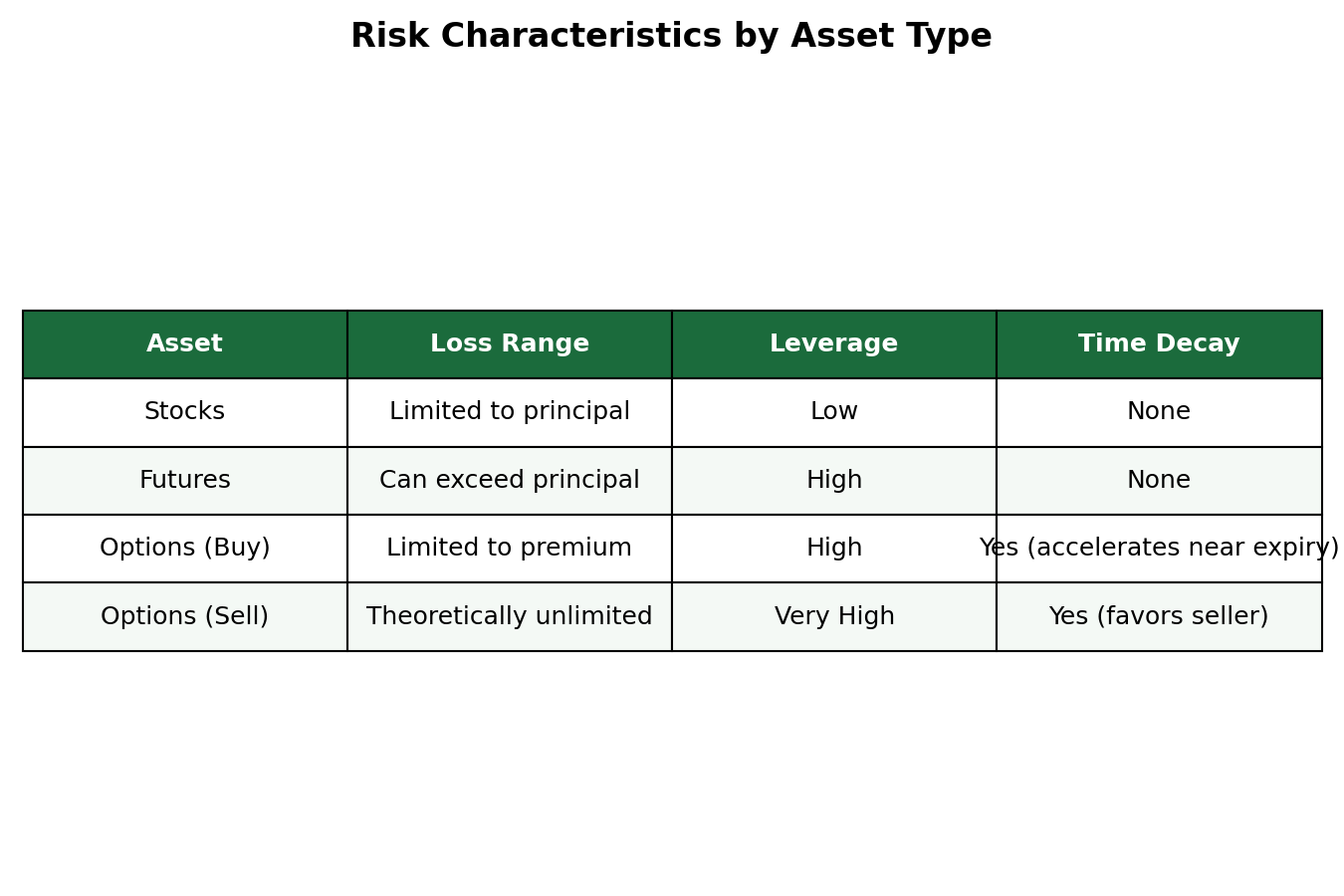
One of the defining features of options is leverage. A relatively small premium can give you exposure to a much larger move in the underlying asset, which means gains can be amplified when the trade works out, but losses can grow just as quickly when it doesn't.
Another key feature is time decay. Because every option has an expiration date, its value tends to erode gradually over time, all else being equal. That decay accelerates as expiration approaches.
The loss profile also differs between buyers and sellers. A buyer's maximum loss is capped at the premium paid, but a seller can face theoretically much larger losses if the market moves sharply against the position. This is why selling options is generally considered a higher-risk strategy than buying them.
Because of these characteristics, options are typically classified as a higher-risk, higher-complexity product compared to traditional assets like stocks or bonds. Approaching them without a solid understanding of the mechanics can lead to losses far larger than expected.
Good to Know
Options aren't only used for speculation. Buying a put to protect an existing stock position from downside risk is a common hedging strategy, and institutional investors frequently use options this way as part of broader portfolio risk management.
In Korea, KOSPI 200 options and other derivatives trade through the Korea Exchange (KRX), and individual investors are generally required to complete derivatives-specific education and meet deposit requirements before they can trade. That entry bar reflects just how important a solid understanding of the product and disciplined risk management really are.
If you're new to options, it's worth practicing on a paper-trading or simulated platform before committing real money. Understanding the concept on paper and actually reacting to live price swings are two very different experiences.
This post is intended as general educational information to help you understand how options work, not as investment advice regarding any specific security or trade timing. Any investment decision, and its outcome, remains solely the responsibility of the individual investor.
'자산관리' 카테고리의 다른 글
| Asset Management :: What Exactly Is a Stablecoin? A Beginner's Guide to Crypto's Digital Dollar (0) | 2026.08.01 |
|---|---|
| 자산관리 :: 스테이블코인이 뭐길래 이렇게 화제일까요? 코인 투자 기초 총정리 (1) | 2026.08.01 |
| 자산관리 :: 옵션 거래, 대체 어떻게 돈을 버는 구조일까요? 옵션 투자 기초 총정리 (0) | 2026.08.01 |
| Asset Management :: What Exactly Is Futures Trading, and Why Is It Considered So (0) | 2026.07.30 |
| 자산관리 :: 선물거래, 대체 뭐길래 이렇게 위험하다고 할까요? 선물 투자 기초 총정리 (0) | 2026.07.30 |