2026. 7. 28. 15:04ㆍ자동차
Hello!
Today I'm writing about one of the hottest topics in the EV world right now: bidirectional charging, also known as V2G (Vehicle-to-Grid) technology.
What if your car could sell electricity back to the grid instead of just consuming it?
Just a few years ago, an electric vehicle was simply something you charged and drove. But as battery capacity has grown and charging infrastructure has matured, a single EV can now power an entire home, or even feed electricity back into the grid.
As someone who actually develops charging systems for electrified equipment (EVs, electric excavators, electric wheel loaders, and more), I see V2G not as a passing trend but as a key that opens the next chapter of the charging infrastructure industry. Today, let's break down exactly what V2G is, how far it has come around the world, and what technical challenges remain before it truly goes mainstream.

What Exactly Is V2G?
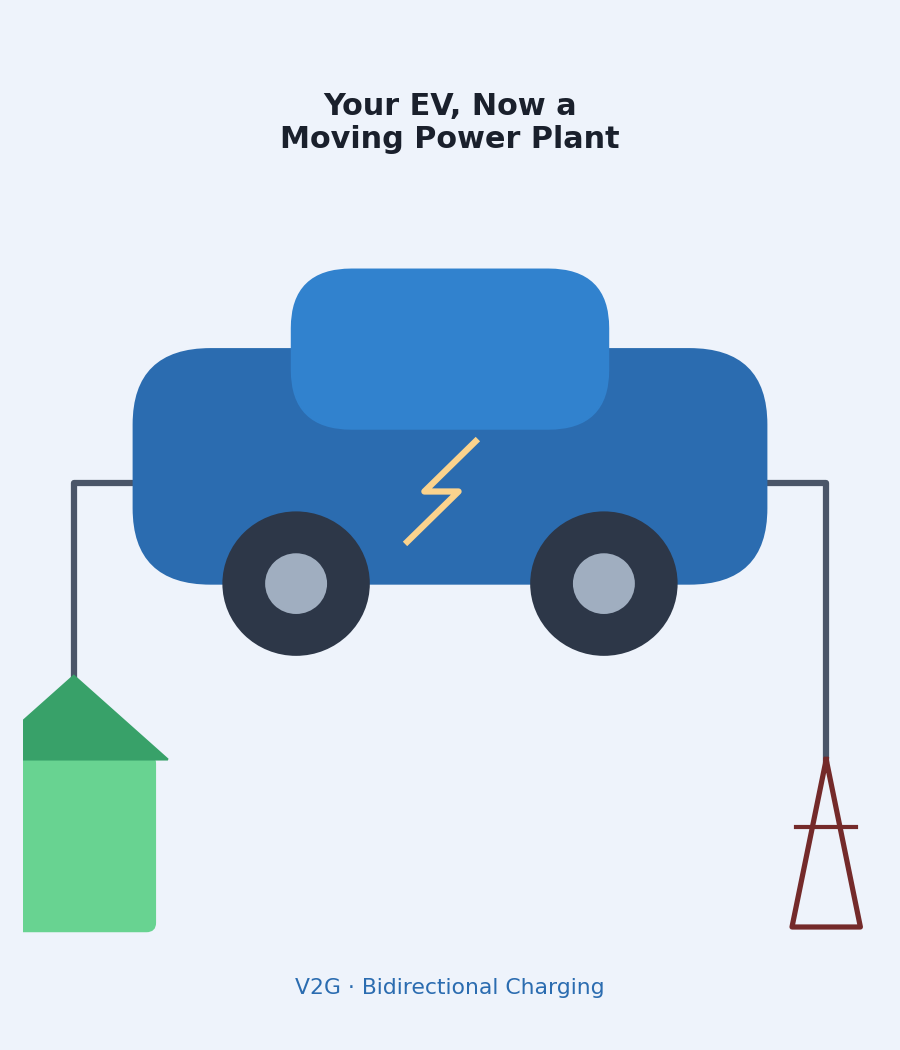
V2G stands for Vehicle-to-Grid, a bidirectional charging technology that lets electricity stored in an EV battery flow back into the power grid. Traditional charging only moves electricity from the grid to the car, a flow known as G2V (Grid-to-Vehicle). V2G makes the reverse flow possible too.
Related concepts include V2H (Vehicle-to-Home) and V2L (Vehicle-to-Load). V2H lets your EV power your entire house during a blackout, while V2L lets you plug devices directly into an outlet on the car, handy for camping or outdoor events. Together, these are often grouped under the umbrella term V2X (Vehicle-to-Everything).
On the technical side, a bidirectional inverter has to sit either in the vehicle or the charger. It converts the battery's stored DC power into AC power suitable for the grid, and doing that conversion while meeting power quality and safety standards is the real engineering challenge. Communication standards like ISO 15118 also matter, since the vehicle, the charger, and the grid operator all need to exchange information reliably.
In simple terms, V2G turns a single EV into a giant mobile battery, essentially a rolling energy storage system (ESS). You charge when electricity is cheap and plentiful, then discharge stored power back to the grid or your home when demand peaks.
Global Momentum in 2026
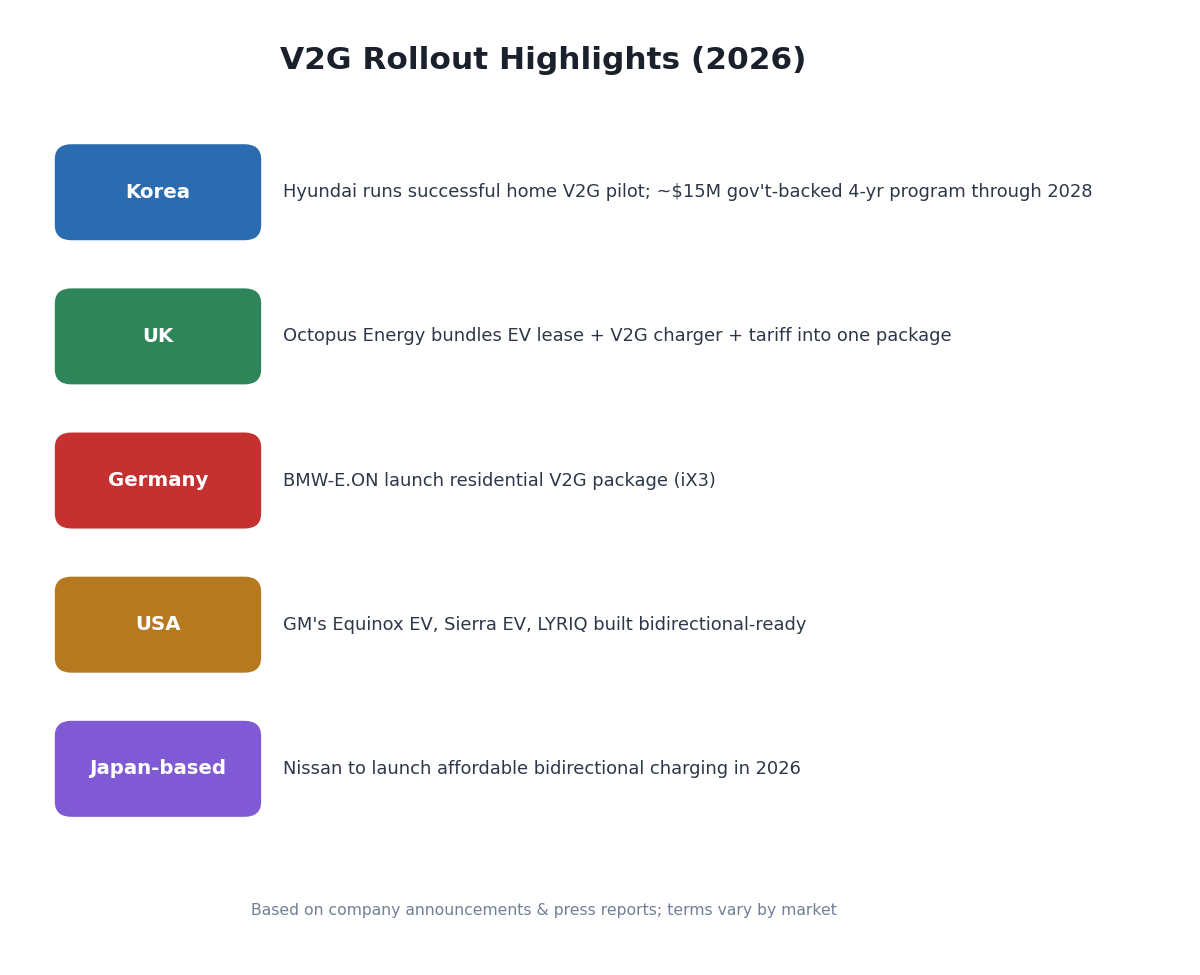
In Korea, Hyundai Motor Group reported a successful bidirectional charging and discharging demonstration inside an actual customer's home, not a lab or a dedicated test site. Pulling it off in a real residential setting suggests that many of the technical barriers to V2G have largely been cleared.
The Korean government has also gotten involved. A V2G demonstration program reportedly backed by about 20 billion won in government funding, plus private contributions bringing the total to roughly 38 billion won, is set to run through 2028, installing more than 1,500 bidirectional chargers over four years.
Some markets are moving even faster. In the UK, energy company Octopus Energy has rolled out a commercial V2G package that bundles an EV lease, a V2G charger installation, and a dedicated tariff into one offering. In Germany, BMW and energy company E.ON launched a residential V2G package built around the BMW iX3. In the US, several GM EV models are being built bidirectional-ready, and Nissan has announced plans to launch affordable bidirectional charging in 2026.
Taken together, these moves suggest V2G is no longer confined to research labs, it's becoming a real business area that automakers and energy companies are entering together. That said, grid regulations and rate structures differ from country to country, so the pace and shape of rollout still varies quite a bit.
A Charging Engineer's Take on the Challenges
Looking at V2G from the perspective of someone who builds charging systems, the first challenge that comes to mind is standardization. Vehicles, chargers, and grid operators from different companies all need to speak the same language, and that hasn't been fully unified yet. CHAdeMO has supported bidirectional charging since relatively early on, while the CCS (Combo) camp is still refining its own standards for this.
The second is battery degradation. More charge-discharge cycles naturally raise concerns about battery lifespan, and that worry keeps coming up. That said, recent research suggests that smart charge-discharge management software can significantly reduce degradation by carefully controlling battery state, which is why the battery management system (BMS) keeps growing in importance.
The third is grid safety. Sending power back from a home or a personal vehicle into the grid requires meeting strict interconnection safety standards, including anti-islanding protection that prevents malfunctions during a power outage. This piece actually falls more under energy-sector regulation than automotive regulation.
Finally, there's cost. Bidirectional chargers are more complex than standard Level 2 chargers, which pushes prices higher. How quickly the industry can bring that upfront cost down will likely determine how fast residential V2G actually spreads.
'자동차' 카테고리의 다른 글
| Car :: How Did Hyundai Go From the Pony to the Ioniq? A Brand History (0) | 2026.07.30 |
|---|---|
| 자동차 :: 현대자동차는 포니에서 아이오닉까지 어떻게 왔을까? 브랜드별 역사 총정리 (0) | 2026.07.30 |
| 자동차 :: 전기차, 이제 발전소가 된다? 양방향 충전(V2G) 신기술 총정리 (0) | 2026.07.28 |
| Car :: Why Are There So Many Types of EV Charging Connectors? Charging Basics Ex (0) | 2026.07.27 |
| 자동차 :: 전기차 충전 커넥터, 왜 이렇게 종류가 많을까? 충전 기초상식 총정리 (0) | 2026.07.27 |