2026. 7. 30. 22:25ㆍ자동차

Hi there.
Today I want to walk through the brand history of Hyundai Motor Company, from its very first car to today's electric lineup.
"How did a company that once assembled cars under license end up building its own dedicated EV platform?" That's the question I want to answer today.
Hyundai has built up nearly six decades of history since it was founded in 1967. It started out assembling cars with borrowed foreign technology, and today it develops its own dedicated EV platforms in-house.
As someone who works on charging systems for electrified equipment, I find Hyundai's shift toward EVs especially interesting to trace. So today I'll go through the company's history in order, from its earliest days to the current Ioniq lineup.
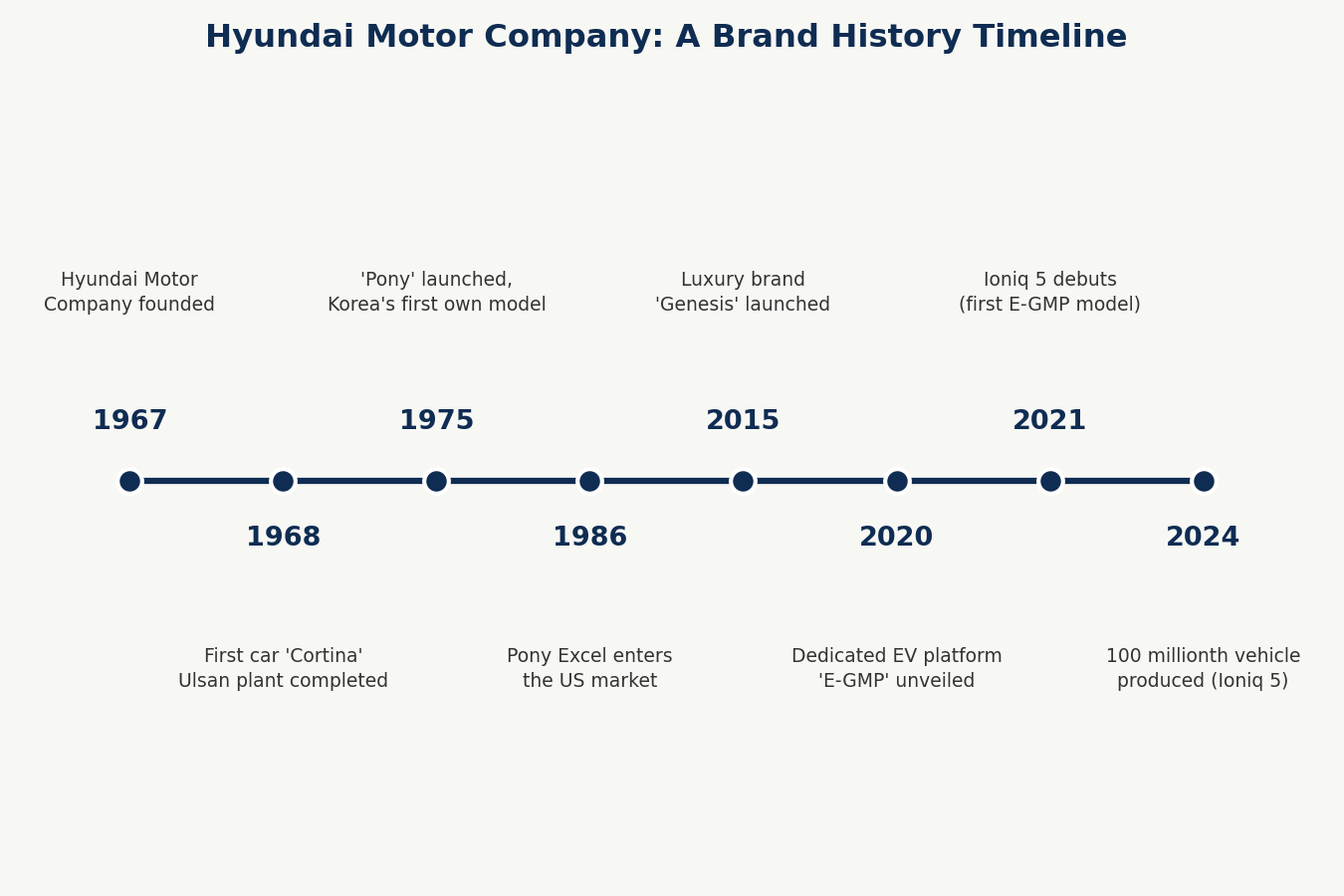
Origins: How the Pony Began
Hyundai Motor Company was founded in December 1967 by Chung Ju-yung. At the time, Korea had almost no capability to build cars on its own, so the company took its first steps through a technical partnership with Ford of America.
A year later, in 1968, Hyundai rolled out its first vehicle, the 'Cortina', from its Ulsan plant. It was an assembled model built through the Ford partnership, but it laid the foundation for Korea's domestic auto industry.
Then in 1975, Hyundai launched the 'Pony', Korea's first independently developed model. Italian designer Giorgetto Giugiaro is known to have contributed style sketches, which Hyundai used as the basis for the car's final design.

The Pony was more than just a new car launch. It proved that Korea could design and build its own vehicles, and it marked the beginning of mass car ownership in the country.
Going Global
The Pony didn't stay in the domestic market. In 1976, it was exported to Ecuador, marking the first time a Korean-made car reached an overseas market.
Hyundai kept expanding from there, and in 1986 it entered the US market in earnest with the 'Excel', based on the Pony. Its low price and practicality reportedly made it quite popular with American buyers at the time.
That experience in overseas markets became the foundation for Hyundai's growth into a global brand with a broad lineup, including the Sonata and Accent.
In 2015, Hyundai also launched a separate luxury brand, 'Genesis', aimed at the premium segment. A company that started as a mass-market brand had expanded into premium territory as well.
The Electric Era: E-GMP and Ioniq
As the center of the auto industry gradually shifted from internal combustion engines to electric vehicles, Hyundai faced a major turning point of its own. In 2020, the company unveiled 'E-GMP', a platform designed from the ground up exclusively for electric vehicles.
Since I work directly on charging systems for electrified equipment, this part was especially interesting to me. E-GMP is built around an 800V system, but it also supports a 'multi fast-charging' technology that lets it use the widely available 400V fast chargers as well. It does this by boosting 400V power up to 800V using the vehicle's own motor, a technique reportedly patented by Hyundai Motor Group.
Thanks to this, E-GMP based vehicles don't need to wait long at ultra-fast chargers to top up a meaningful amount of battery. In fact, they're reported to charge from 10 to 80 percent in under 18 minutes on an ultra-fast charger. That flexibility across different charging infrastructure makes it a genuinely practical piece of engineering.
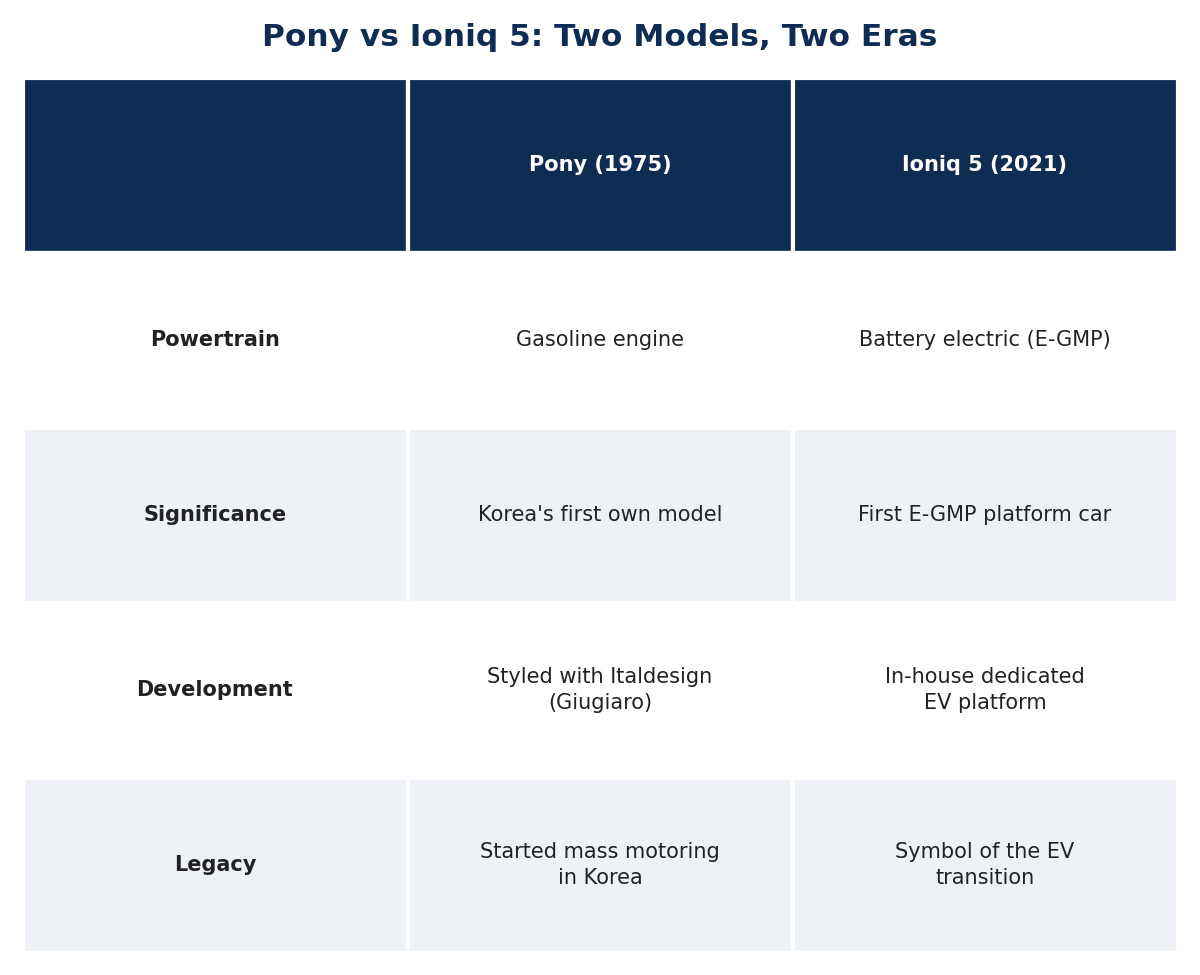
The first model built on E-GMP was the 'Ioniq 5', launched in 2021. Then in 2024, Hyundai reached a cumulative production milestone of 100 million vehicles since its founding, and fittingly, the 100 millionth car off the line was an Ioniq 5 - tying the story that began with the Pony directly to the electric era.
Good to Know
The Pony and the Ioniq 5 make for an interesting comparison. If the Pony marked the start of Korea's own automotive technology in the gasoline era, the Ioniq 5 marks the start of Hyundai's own dedicated platform in the electric era.
Hyundai's electrified lineup has kept expanding since the Ioniq 5. That said, specific product plans and launch timelines can change often, so it's a good idea to check Hyundai's official channels for the most current information.
In this way, Hyundai has moved step by step from assembled production, to developing its own models, to expanding overseas, to launching a premium brand, and finally to building a dedicated EV platform. For a single company, that's a fairly dynamic journey.
Final Thoughts
Today I went through Hyundai Motor Company's brand history, from the Pony all the way to the Ioniq 5. From its founding in 1967, to Korea's first independent model the Pony, to its overseas expansion, to the dedicated EV platform E-GMP - it's a story that compresses the growth of Korea's auto industry into one company's journey.
Working in electrification myself, I find I keep watching closely to see where charging and battery technology will head next. I'll be back soon with the history of another brand, or a topic related to EV charging.
#Hyundai #HyundaiMotor #HyundaiHistory #Pony #Ioniq5 #EGMP #EVPlatform #BrandHistory #AutomotiveHistory #ChungJuYung #UlsanPlant #Cortina #GiorgettoGiugiaro #PonyExcel #Genesis #ElectricVehicle #EV #Electrification #FastCharging #800VCharging #MultiFastCharging #BatteryEV #KoreanCarHistory #CarBrand #EVCharging
'자동차' 카테고리의 다른 글
| Car :: From DC Motors to SiC Inverters - The Evolution of EV Drive Motor Technology (0) | 2026.08.01 |
|---|---|
| 자동차 :: 전기차 구동모터, DC모터에서 SiC 인버터까지 기술의 변천사 (0) | 2026.08.01 |
| 자동차 :: 현대자동차는 포니에서 아이오닉까지 어떻게 왔을까? 브랜드별 역사 총정리 (0) | 2026.07.30 |
| Car :: Can Your EV Power Your House and the Grid? Bidirectional Charging (V2G) Explained (0) | 2026.07.28 |
| 자동차 :: 전기차, 이제 발전소가 된다? 양방향 충전(V2G) 신기술 총정리 (0) | 2026.07.28 |