2026. 7. 27. 18:59ㆍ자동차

Hello,
today's post is about the different types of EV charging connectors.
Have you ever wondered why EV charging plugs look so different depending on the car or the country?
If you're new to EVs, one of the first surprises is that even within the same country, the plug for a home Level 2 charger looks completely different from the plug on a DC fast charger. Rent an EV abroad and you'll likely run into yet another connector shape you've never seen before.
As someone who develops charging systems for electrified equipment, this is a question I get asked constantly. Today, let's walk through why there are so many EV charging connector standards in the first place, and what makes each one different.
Why So Many Connector Types Exist
EV charging connectors generally fall into two categories: AC (Level 2, slower) and DC (fast charging). With AC charging, household-style alternating current is converted to DC by the car's onboard charger (OBC) before it reaches the battery. With DC fast charging, the external charger itself does the AC-to-DC conversion, feeding direct current straight into the battery.
The complication is timing: as the EV industry scaled up in the early-to-mid 2010s, the US, Europe, Japan, and China each began developing their own standards almost simultaneously. Different countries have different regulatory bodies overseeing electrical safety, and each also had an interest in protecting its own domestic auto industry. Multiple standards ended up taking root at the same time as a result.
Today there are five major standards in use worldwide: CCS1, CCS2, CHAdeMO, NACS, and GB/T. Here's a quick table comparing which regions use which standard.
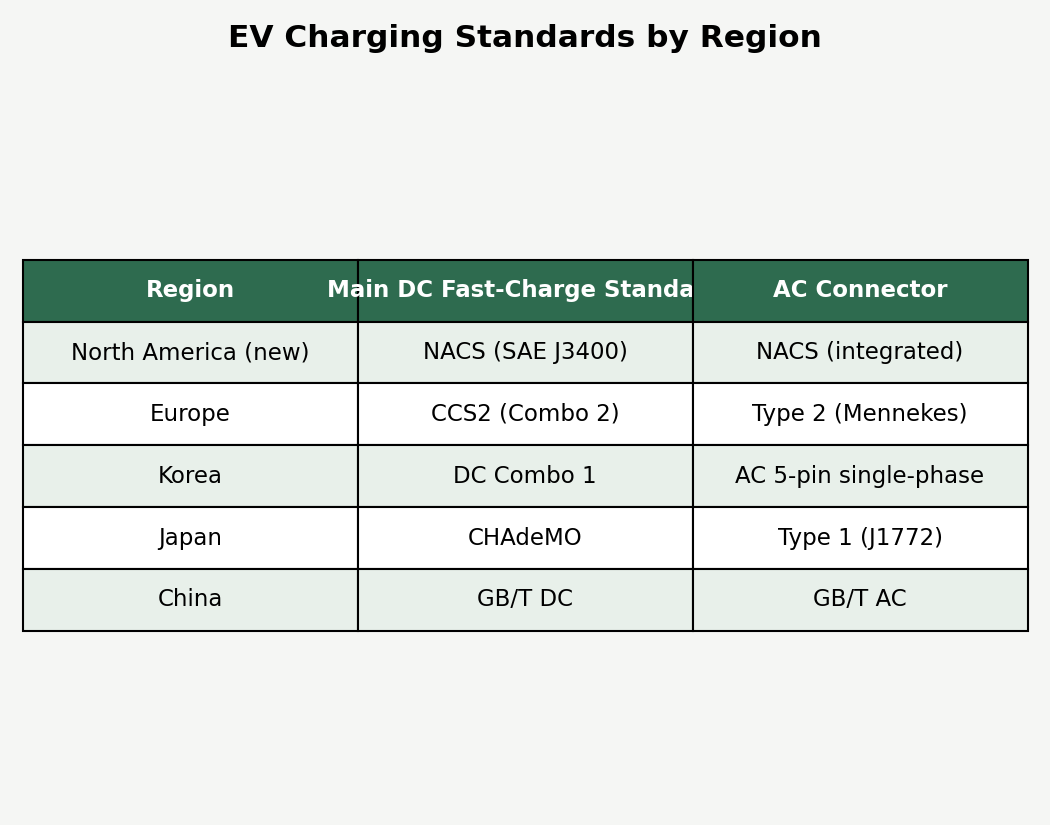
As the table shows, there isn't one single "correct" standard — each region settled on its own connector based on its own regulatory history. That's why it's worth checking which standard your car uses before you buy an EV, or before you charge one abroad.
Major Global Connector Types
CCS (Combined Charging System) adds two high-current DC pins below an AC connector. CCS1 extends the North American AC plug (J1772/Type 1), while CCS2 extends the European Type 2 (Mennekes) connector. South Korea also uses a CCS1-based standard, known locally as DC Combo 1, for DC fast charging.
CHAdeMO is a DC-only fast-charging standard developed in Japan. It was used on early EVs like the first-generation Nissan Leaf and helped lay the groundwork for DC fast charging as a concept, but it's reported to now be concentrated mainly in Japan and on older legacy vehicles, as momentum has shifted toward CCS and NACS.
NACS (North American Charging Standard, standardized as SAE J3400) grew out of Tesla opening up its proprietary connector to the industry. It's notable for handling both AC and DC fast charging through a single, compact five-pin port. As of 2026, a growing share of new vehicles sold in North America reportedly ship with NACS ports as the default.
GB/T is China's national standard, set by the Chinese government, and functions as essentially the only DC fast-charging protocol used domestically. Its detailed specifications differ enough from CCS and NACS that an adapter is required to mix and match standards.
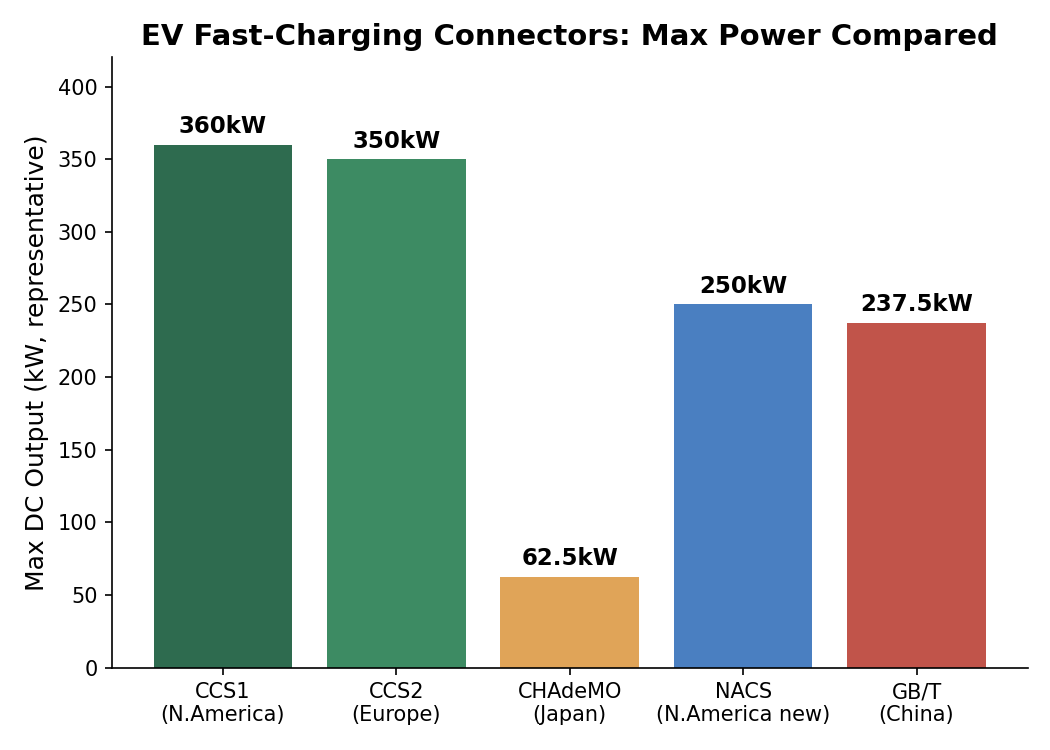
The chart below compares the commonly cited maximum DC output for each standard. Keep in mind actual charging speed always depends on the specific vehicle and charger hardware, so treat these as reference figures rather than guarantees.
Korea's Charging Standard and Good-to-Know Tips
In December 2017, Korea's national technology standards agency revised the national industrial standard (KS) to unify DC fast charging around DC Combo 1. Before that, CHAdeMO chargers were also installed alongside it for a period, but today most newly installed public DC fast chargers reportedly come equipped with DC Combo 1 as the default.
For AC (Level 2) charging, Korea uses a single-phase 5-pin connector. Most home chargers installed in apartments and houses, as well as the standard charging cable that comes with the car, follow this format.
As someone who works on charging system development, here's a tip worth knowing: the difference between AC and DC charging isn't just "slower vs. faster" — the internal circuitry the current actually travels through is different. With DC fast charging, current flows directly into the battery, so the Battery Management System (BMS) monitors temperature and voltage far more tightly to control charging speed.
That's why the same DC fast charger can automatically slow down in cold winter weather, or once the battery passes roughly 80% state of charge. This isn't a malfunction — it's a normal protective behavior designed to protect the battery, so there's no need to worry if you notice it.
If you're planning to charge a rental or local EV while traveling abroad, it's worth checking ahead of time which connector standard is used in that country, and whether you'll need to bring an adapter.
Automakers are increasingly moving to support multiple standards at once. Vehicles aimed at the North American market are now shipping with NACS adapters included, and there are more cases of manufacturers expanding supported standards through software updates alone.
Having several standards coexist can feel inconvenient in the short term, but it's easier to make peace with once you see it as each region evolving in step with its own charging infrastructure.
'자동차' 카테고리의 다른 글
| Car :: Can Your EV Power Your House and the Grid? Bidirectional Charging (V2G) Explained (0) | 2026.07.28 |
|---|---|
| 자동차 :: 전기차, 이제 발전소가 된다? 양방향 충전(V2G) 신기술 총정리 (0) | 2026.07.28 |
| 자동차 :: 전기차 충전 커넥터, 왜 이렇게 종류가 많을까? 충전 기초상식 총정리 (0) | 2026.07.27 |
| Car :: From 3.3kW to 750kW - The Evolution of EV Charging Power (0) | 2026.07.26 |
| 자동차 :: 전기차 충전 출력, 3.3kW에서 750kW까지 - 충전 기술의 변천사 (0) | 2026.07.26 |