2026. 7. 26. 13:33ㆍ자동차
Hello!
Today's post looks at one specific slice of EV technology: how charging power itself has evolved over the past decade or so.
"A decade ago, a full EV charge took over 8 hours. Today, some cars can hit 80% in 20 minutes. How did we get here?"
As someone who works on EV charging systems for a living, I'd argue the story of electric vehicles is, in large part, the story of charging power climbing higher and higher. Battery capacity and range get most of the attention, but how fast you can refill that battery has always mattered just as much.
In this post we'll walk through the timeline in order: the early days when slow AC charging was the only option, the arrival of DC fast charging, and finally today's ultra-fast era pushing past 350kW and even into the 700kW range. Looking at the actual numbers makes the scale of the change much easier to appreciate.
The Early Days: 3.3kW Level 2 Charging
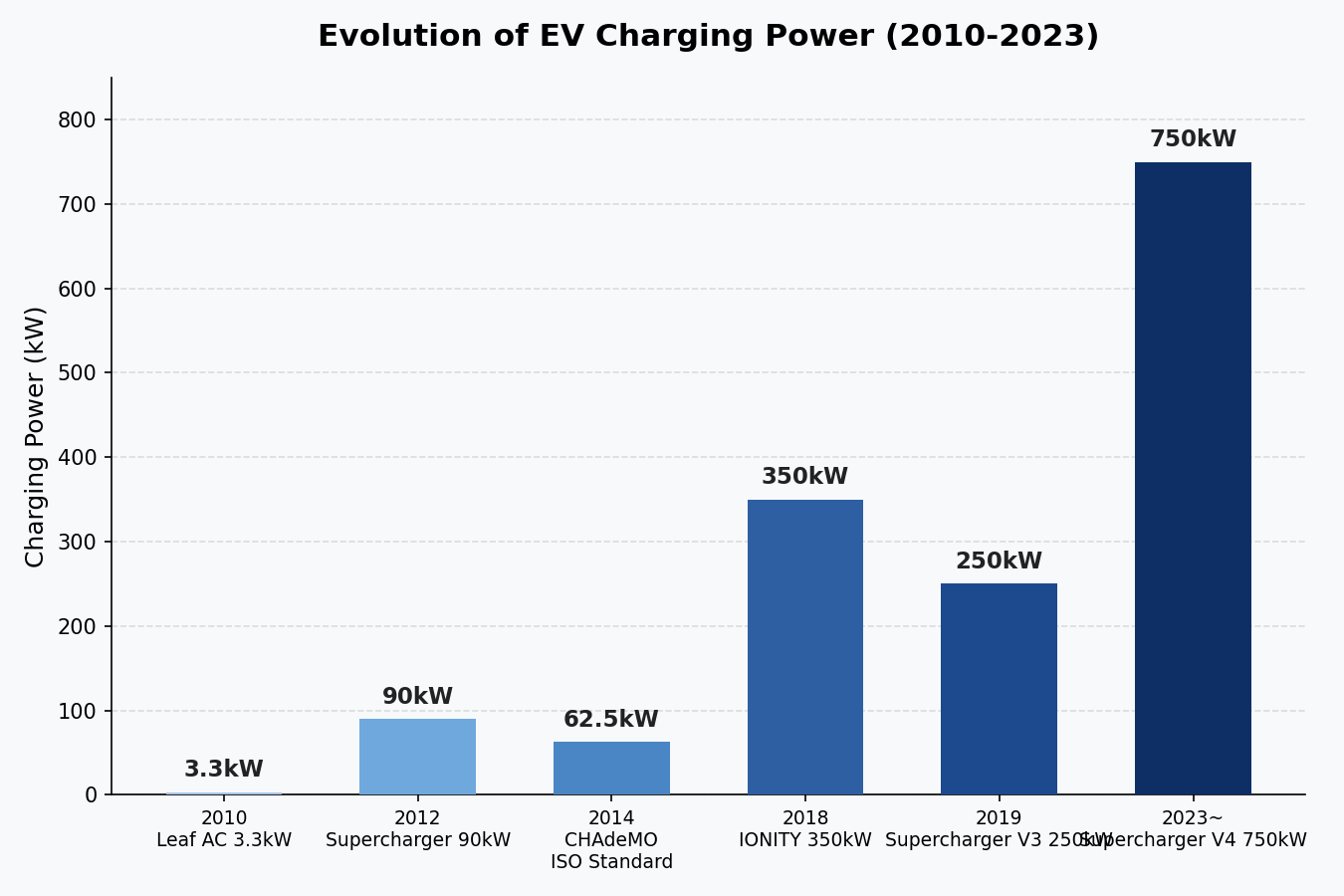
The original Nissan Leaf, launched in 2010, shipped with a 3.3kW onboard charger as standard. Charging from a home outlet took nearly 8 hours for a full charge — a very different rhythm of ownership than today.
Around 2013, 6.6kW onboard chargers started becoming common, cutting that charging time nearly in half. It sounds modest by today's standards, but at the time it was a meaningful step forward for everyday usability.
Charging in this era was almost entirely AC-based: the vehicle's onboard charger (OBC) converted AC power from the grid into DC to store in the battery. If Level 1/2 AC charging was about "topping up overnight at home," the DC fast charging that came next would introduce a completely different paradigm.
The Rise of DC Fast Charging: CHAdeMO and Tesla Superchargers
CHAdeMO, first commercialized in Japan in 2010, arrived supporting up to 62.5kW at 500V. That was several times faster than AC charging, and it made the idea of "topping up while you're out" a real option for the first time. CHAdeMO went on to become an officially recognized international standard in 2014.
Around the same time in the US, Tesla launched its own Supercharger network alongside the Model S in 2012. Early Superchargers started at 90kW and were later pushed up to 120kW — numbers that felt almost radical at the time.
In Europe and North America, the CCS (Combo) connector gradually took hold instead of CHAdeMO, combining an AC connector and DC pins into a single inlet. CCS would go on to become the de facto standard across both regions.
This is also when "charging power" started becoming a genuine competitive battleground for both automakers and charging network operators. A bigger battery didn't matter much if charging was still painfully slow — that realization really took hold during this period.
Into the Ultra-Fast Era: Past 150kW, 350kW, and Beyond
Tesla's Supercharger V2 pushed output up to 150kW, and in 2018, Europe's IONITY network sent shockwaves through the industry by rolling out 350kW DC ultra-fast chargers. A defining feature was the use of liquid-cooled cables, needed to safely handle the high current that 350kW-class charging demands.
Tesla's Supercharger V3, introduced in 2019, was upgraded to support up to 250kW, and as more automakers — Hyundai Motor Group's E-GMP platform among them — adopted 800V-class architectures, the number of vehicles actually capable of using 350kW-class ultra-fast charging grew right along with the infrastructure.
More recently, Tesla's Supercharger V4 is reported to support output in the 615-750kW range, though that spec is aimed less at passenger EVs and more at commercial vehicles like electric trucks with much larger battery packs. The CCS standard, meanwhile, is theoretically designed to support up to 500kW at 1000V, so the ceiling on charging power looks likely to keep climbing.
It's worth remembering, though, that no matter how high the charger's rated power goes, a battery can only accept so much current (its C-rate limit). Real-world charging speed still comes down to the vehicle's battery management system (BMS) and thermal management performance.

What Changed as Charging Got Faster
The biggest shift as charging power increased has been a noticeable drop in "range anxiety" among drivers. Going from an 8-hour full charge to getting to 80% in 20-30 minutes changes the whole psychological relationship people have with owning an EV.
At the same time, working on the infrastructure side, I've seen firsthand that high-power charging brings its own set of new challenges: battery degradation, added load on the grid, and cable thermal management, to name a few. Raising the kW number and handling that power safely and efficiently are two very different engineering problems.
Going forward, I'd expect the industry to move beyond a pure race for higher kW figures, toward "smart charging" approaches that charge quickly while protecting battery lifespan, and toward methods that put less strain on the electrical grid overall.
'자동차' 카테고리의 다른 글
| Car :: Why Are There So Many Types of EV Charging Connectors? Charging Basics Ex (0) | 2026.07.27 |
|---|---|
| 자동차 :: 전기차 충전 커넥터, 왜 이렇게 종류가 많을까? 충전 기초상식 총정리 (0) | 2026.07.27 |
| 자동차 :: 전기차 충전 출력, 3.3kW에서 750kW까지 - 충전 기술의 변천사 (0) | 2026.07.26 |
| Car :: How Did Tesla Change the Electric Vehicle Industry? A Brand History (0) | 2026.07.24 |
| 자동차 :: 테슬라는 어떻게 전기차 시장의 판을 바꿔놨을까? 브랜드별 역사 총정리 (0) | 2026.07.24 |