2026. 7. 24. 22:09ㆍ자동차

Hello,
today I'd like to continue our car brand history series with a company that probably comes to mind first when you think of electric vehicles: Tesla.
As someone who develops charging systems for electrified equipment, I find it hard to talk about the EV industry without mentioning Tesla. The company has driven a huge amount of change in both charging infrastructure and battery technology.
But Tesla wasn't always the giant we know today. It started as a small garage startup that survived several near-death moments before reaching where it is now, so I thought it would be worth walking through that story.
How did a small startup end up reshaping the direction of the entire automotive industry?

Origins
Tesla was founded in July 2003 by two engineers, Martin Eberhard and Marc Tarpenning, in San Carlos, California. The company's name is said to be a tribute to Nikola Tesla, the physicist famous for his work on alternating current systems.
From the start, the goal was clear: build an electric sports car powered by lithium-ion batteries, and become a company with in-house technology across the battery, software, and motor. The aim was a fully electric car that didn't compromise on range or comfort.
Elon Musk didn't join Tesla until 2004. He first invested around 6.5 million dollars, later increasing his stake to about 30 million dollars, and took on the role of Chairman of the Board. At this stage he was an investor and chairman, not yet CEO.
The result of that early work was the Roadster, Tesla's first production car, released in 2008. According to the company's own testing at the time, it could travel 245 miles on a single charge, a figure that was unusual for a production EV back then.
Crisis and Comeback
As it happens, 2008, the year the Roadster launched, was also the year of the global financial crisis. Tesla was hit hard, and its financing round reportedly closed on December 24th, just hours before payroll would have bounced.
During this period, Musk poured in roughly 20 million dollars of his own money, funds he had from the sale of PayPal, and reportedly came close to personal bankruptcy himself in the process. It was also around this time that Musk became Tesla's CEO.
The crisis didn't end there. In May 2009, German automaker Daimler invested 50 million dollars, and Tesla later secured a 465 million dollar loan from the U.S. Department of Energy. These rounds of outside support helped the company survive.
Perhaps because of that experience, Tesla has since become known for placing unusual emphasis on cash flow management and production speed. Having come close to bankruptcy more than once seems to have shaped how the company operates to this day.
Going Mainstream and Charging Infrastructure
Having survived the crisis, Tesla began its real turnaround with the launch of the Model S in 2012. It was praised as a premium sedan and is credited with changing public perception of electric cars. That same year, the Supercharger charging network also went live.
The Supercharger network launched on September 24, 2012 with six stations in California, offering charging speeds of around 120 to 150 kW even in its early days. It was unusual at the time for a car manufacturer to build its own charging infrastructure, and it made long-distance EV travel genuinely practical.
In 2016, Tesla began operating its first Gigafactory in Nevada. Built as a joint investment with battery maker Panasonic, the facility represented about 5 billion dollars in total investment and became a key site for mass-producing battery cells.
Then in 2017, production began on the Model 3, priced at around 35,000 dollars, a relatively accessible price point. Nearly 400,000 preorders came in when it was unveiled in 2016, and the car is often credited with moving EVs from early-adopter territory into the mainstream.
The Shift in Charging Standards
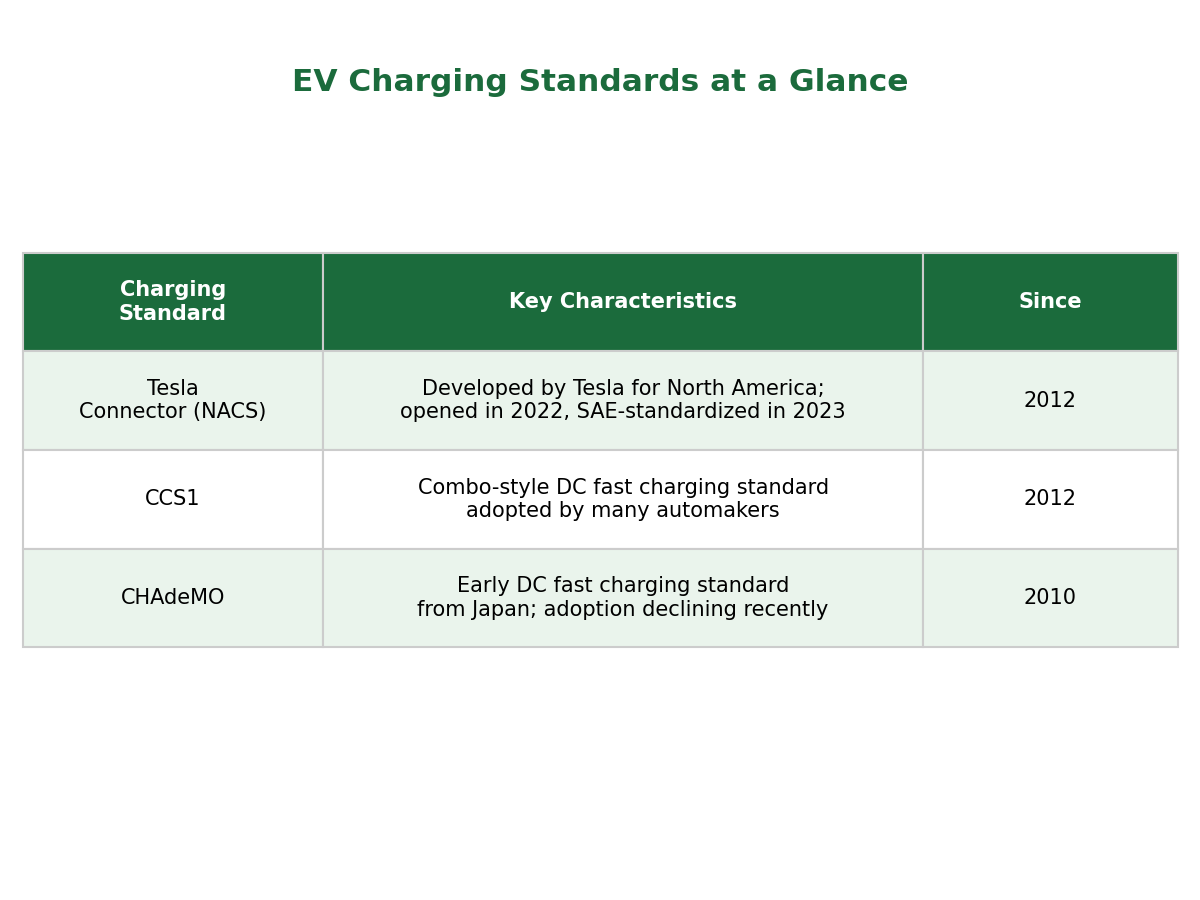
The Tesla connector was introduced alongside the Model S back in 2012. In its early years, though, it was a closed, proprietary system that only Tesla vehicles could use.
That began to change around 2021, when the communications protocol was expanded into what we now know as NACS, the North American Charging Standard. In 2022, Tesla opened the connector design to other automakers.
In 2023, SAE International formally standardized it, and between 2023 and 2024 most major automakers announced plans to adopt NACS starting with their 2025 model-year vehicles, reshaping the charging standard landscape across North America.
From my perspective as someone who works on charging systems, this wasn't just a change in connector shape. It involved communication protocols and authentication and payment systems all at once, and it's a space I plan to keep covering on this blog as things develop.
'자동차' 카테고리의 다른 글
| Car :: From 3.3kW to 750kW - The Evolution of EV Charging Power (0) | 2026.07.26 |
|---|---|
| 자동차 :: 전기차 충전 출력, 3.3kW에서 750kW까지 - 충전 기술의 변천사 (0) | 2026.07.26 |
| 자동차 :: 테슬라는 어떻게 전기차 시장의 판을 바꿔놨을까? 브랜드별 역사 총정리 (0) | 2026.07.24 |
| Car :: Could Your EV Charge Without a Cable? A Look at Wireless Charging Technology (0) | 2026.07.23 |
| 자동차 :: 케이블 없이 충전되는 전기차? 무선충전 미래기술 총정리 (1) | 2026.07.23 |