2026. 7. 24. 23:22ㆍ자산관리
Hello,
today's post continues our options series in the asset management category, looking at the four metrics that explain how option prices move: the "Greeks."
We've already covered the basics of calls and puts, how option premiums are built, and the dynamics around options expiration. This time I want to go one level deeper into delta, gamma, theta, and vega, the metrics that explain why options don't move in lockstep with the underlying asset.
The terms themselves can sound intimidating, but once you break each one down, the type of risk it represents is fairly intuitive. Even if you never trade options yourself, these concepts are useful for understanding derivatives news.
Why doesn't an option's price move by exactly as much as the underlying asset does?
Why the Greeks Matter
An option's price isn't determined by the underlying asset's price alone. It's shaped by several factors at once: the underlying price, time remaining until expiration, implied volatility, and interest rates. The Greeks are the metrics that isolate how sensitive the option's price is to each of these factors individually.
A quick disclaimer before we go further: this post is meant as educational information about how options work as a financial product, not investment advice. Options are leveraged, high-risk instruments, and this post isn't a recommendation to trade them.
With that said, understanding the Greeks helps explain a lot of things that otherwise seem confusing, like why an option's price barely moves even when the underlying jumps, or why some options lose value just from time passing with no price movement at all.
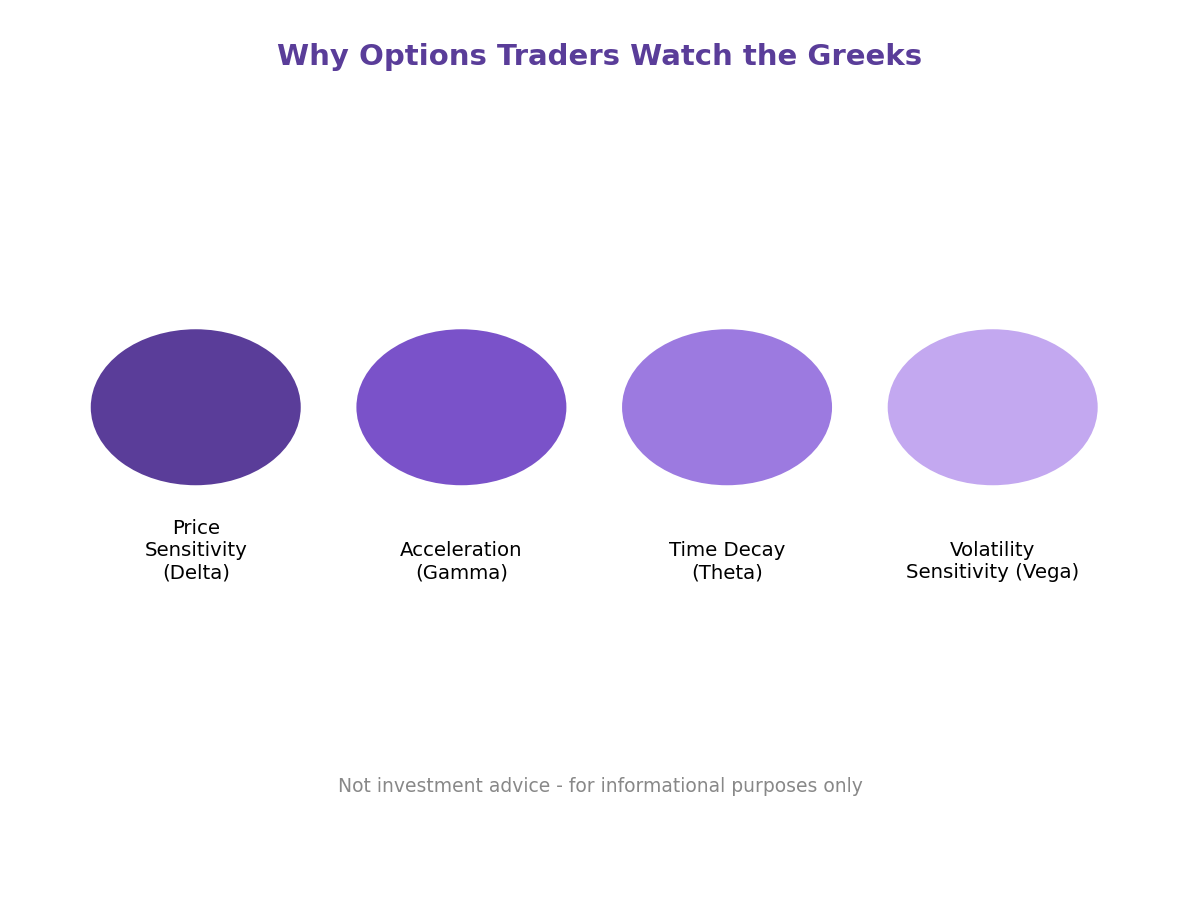
The four most commonly discussed Greeks are delta, gamma, theta, and vega. Each captures a different dimension of price risk, and together they give a fuller picture of what's actually driving an option's premium.
Delta and Gamma — Sensitivity to Price
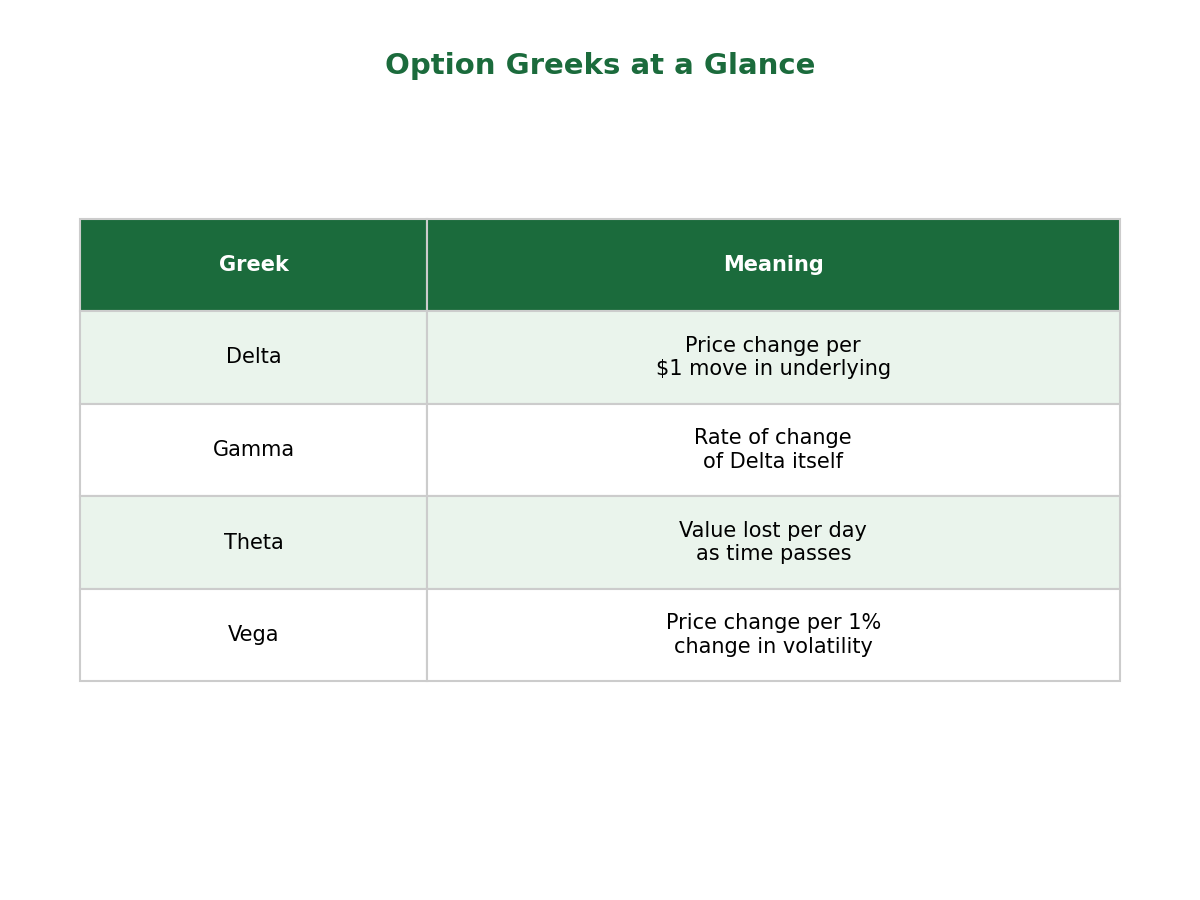
Delta measures how much an option's price is expected to change for a $1 move in the underlying asset. Call option deltas range from 0 to 1, while put option deltas range from -1 to 0.
A delta of 0.5 means the option's price should move roughly $0.50 for every $1 move in the underlying. Deltas closer to 1 (or -1) behave more like the underlying asset itself, while deltas closer to 0 barely move at all.
Gamma measures how much delta itself changes as the underlying price moves. It's often described as the "acceleration" to delta's "speed" — gamma tells you how quickly your directional exposure is changing.
Gamma tends to be highest for at-the-money options, and it increases as expiration approaches. This is part of why option positions can feel like they behave unpredictably in the final days before expiration.
Theta and Vega — Time and Volatility
Theta measures how much an option's value erodes as one day passes, all else being equal. Because options have a fixed expiration date, their time value shrinks every single day, and theta quantifies exactly how much.
This decay isn't linear. It stays relatively slow when there's plenty of time left before expiration, but accelerates sharply in the final few weeks. That's why option buyers are often described as racing against the clock, while option sellers can benefit from time decay working in their favor.
Vega measures sensitivity to changes in implied volatility. When the market expects bigger price swings ahead, option premiums tend to rise even if the underlying price hasn't moved at all, and vega captures that relationship.
Vega tends to be highest for at-the-money options with more time until expiration. This is why option prices can move noticeably around earnings announcements or major economic events, even without a corresponding move in the underlying asset.
Putting It Into Practice
Reading the Greeks together, rather than in isolation, is what makes them useful. A high delta with high gamma, for example, signals a position whose directional exposure could shift quickly, while a high theta signals a position that's losing value simply from the passage of time.
Options brokers and trading platforms typically display all four Greeks alongside the option chain, so you don't need to calculate them by hand. The value is in knowing what each number represents so the display actually means something.
One more disclaimer worth repeating: options are leveraged products, and losses can happen quickly, especially for option sellers, whose risk can be substantial. Nothing here should be taken as a suggestion to trade options, and anyone considering it should study the mechanics and risks thoroughly first, ideally with a licensed professional.
Even setting aside actual trading, having a working sense of delta, gamma, theta, and vega makes it much easier to follow financial news involving options and derivatives.
'자산관리' 카테고리의 다른 글
| Asset Management :: What Exactly Is a Stablecoin? Crypto Basics and Korea's New (0) | 2026.07.25 |
|---|---|
| 자산관리 :: 스테이블코인, 왜 요즘 이렇게 화제일까요? 코인 기초부터 규제까지 총정리 (0) | 2026.07.25 |
| 자산관리 :: 옵션 그릭스(델타·감마·세타·베가), 왜 알아야 할까? 옵션 리스크 관리 총정리 (0) | 2026.07.24 |
| Futures Trading Explained: Expiration, Margin, and the Rise of Perpetual Futures (0) | 2026.07.23 |
| 자산관리 :: 선물 거래, 만기와 증거금부터 요즘 화제인 무기한 선물까지 (0) | 2026.07.23 |