2026. 7. 25. 20:50ㆍ자산관리
Hello!
Today I want to write about stablecoins, a term that keeps popping up in financial news lately.
"Isn't a stablecoin just another crypto like Bitcoin?" You might think so, but stablecoins were actually built for a completely different purpose from the start.
With the Korean government recently announcing plans to push forward a new Digital Asset Basic Act later this year, stablecoins have become a hot topic in the news. So today, let's break down exactly what a stablecoin is, and why regulators are paying so much attention to it right now.
Quick note before we start: this post is meant to explain the concept and recent regulatory developments, not to recommend any specific coin or investment.
Origins: What Is a Stablecoin, Really?
A stablecoin is, quite literally, a coin designed to stay "stable." Unlike Bitcoin or Ethereum, which can swing by double-digit percentages in a single day, stablecoins are built to minimize volatility by pegging their price to another asset's value.
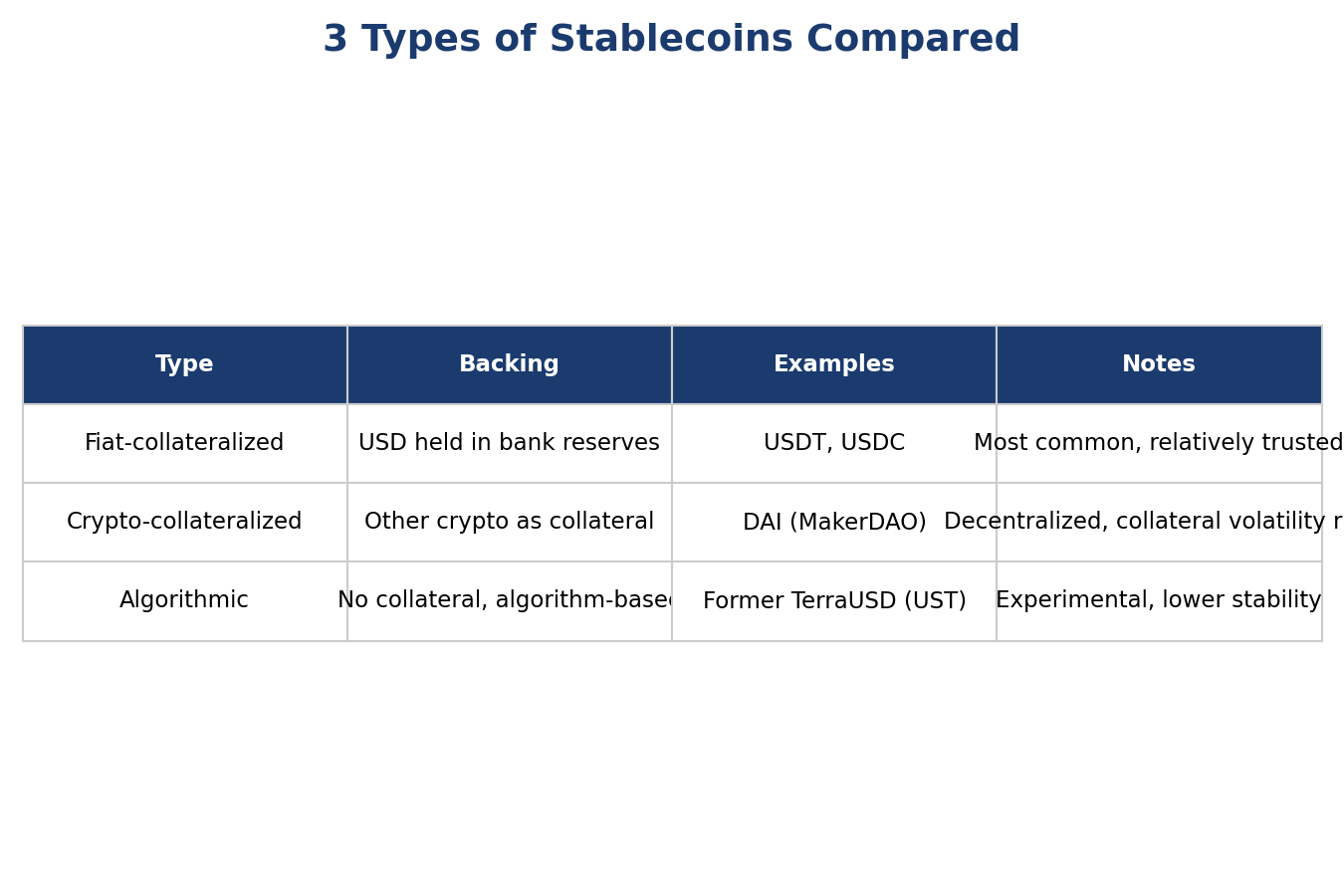
The most common approach is fiat-collateralized. The issuer holds real US dollars in a bank account and only mints coins matching that reserve. Tether's USDT and Circle's USDC are the best-known examples of this model.
The second approach is crypto-collateralized. Here, other cryptocurrencies like Ethereum are locked up as collateral to back the stablecoin, with MakerDAO's DAI being the most recognized example. It offers decentralization, but if the value of the collateral itself drops sharply, the peg can come under pressure too.
The third approach is algorithmic. These coins have no real-world collateral at all — an algorithm adjusts supply to keep the price steady. It's an experimental design, and as we'll see below, it's also the most fragile once confidence starts to slip.
The Terra-Luna Collapse: A Lesson in Risk
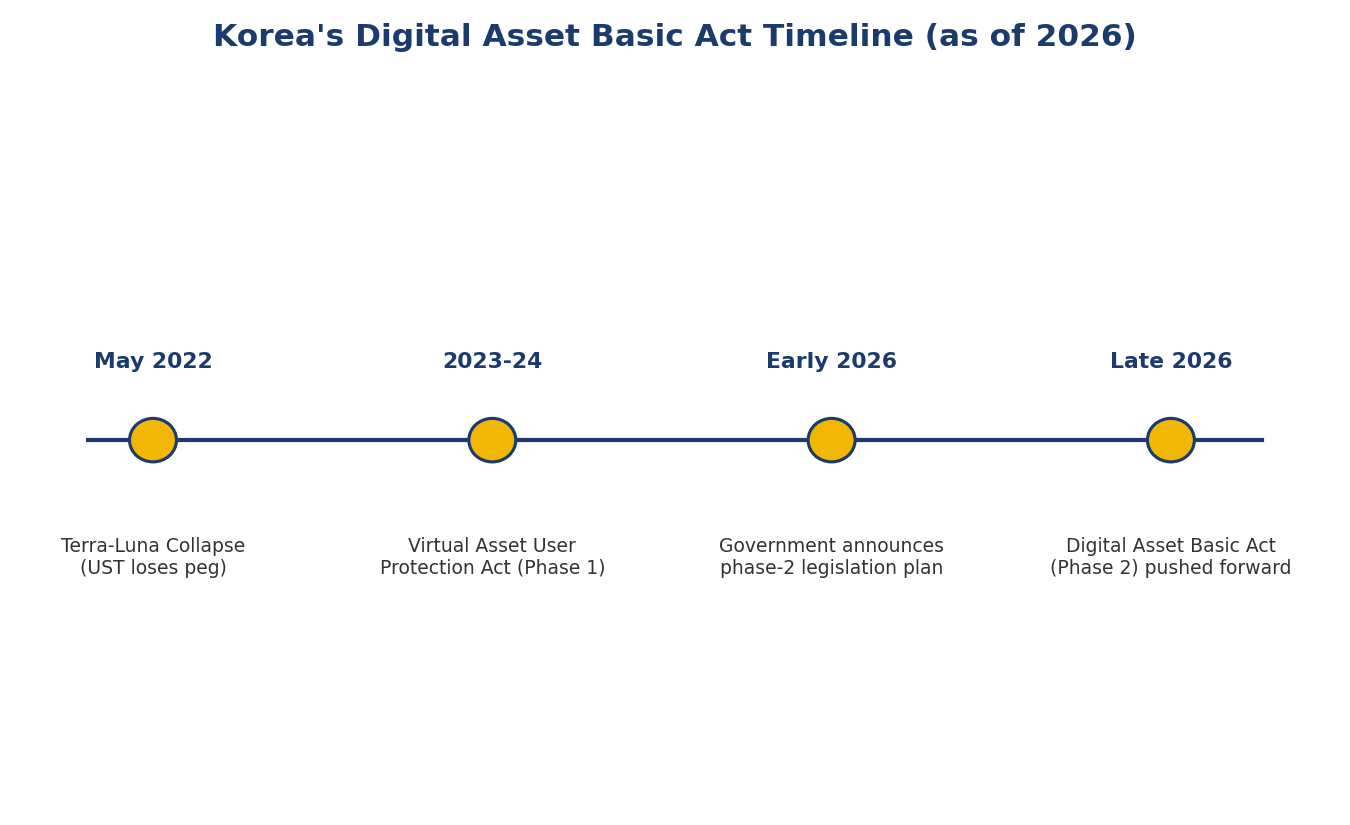
Being a "stablecoin" doesn't automatically mean being safe. The clearest example of that is the Terra-Luna collapse of May 2022.
TerraUSD (UST), an algorithmic stablecoin that was supposed to hold a fixed one-dollar peg, lost that peg and its value crashed almost overnight. Its sister token LUNA collapsed right alongside it, and investors around the world suffered massive losses.
The core problem was that the system relied purely on market confidence, with no real-world collateral backing it up. Once confidence started to crack, a wave of selling triggered more selling, and the peg broke down completely.
In the aftermath, financial regulators worldwide recognized the urgent need for clearer rules around how stablecoins are issued and how transparent their reserves need to be — a realization that's now driving new legislation in Korea and many other countries.
What Changes with the 2026 Digital Asset Basic Act
In its second-half 2026 economic policy plan, the Korean government announced it will push forward the Digital Asset Basic Act, often described as "phase two" of crypto regulation. While phase one, the Virtual Asset User Protection Act, focused on preventing unfair trading and protecting user assets, phase two aims to build out a full business-conduct framework by segmenting the industry itself.
Stablecoin institutionalization has emerged as a central issue. Regulators are reportedly discussing a structure where banks would hold a majority stake (50%+1) in stablecoin issuers, an approach meant to boost trust by putting banks in the driver's seat.
Rules for crypto exchanges are being discussed in parallel. One proposal would cap a major shareholder's stake in an exchange at roughly 20 to 34 percent, requiring any excess stake to be sold off after a grace period. The goal appears to be preventing any single individual or company from having outsized control over an exchange.
None of this is finalized yet, and the details could still shift as the bill moves through the National Assembly. Still, the overall direction is becoming clear: investor protection on one hand, and bringing the industry inside the regulatory perimeter on the other.
'자산관리' 카테고리의 다른 글
| 자산관리 :: 부동산 경매, 나도 도전할 수 있을까? 법원 경매 기초 총정리 (0) | 2026.07.28 |
|---|---|
| 자산관리 :: 전세와 월세, 전월세전환율은 어떻게 계산될까요? 부동산 임대차 기초 총정리 (0) | 2026.07.26 |
| 자산관리 :: 스테이블코인, 왜 요즘 이렇게 화제일까요? 코인 기초부터 규제까지 총정리 (0) | 2026.07.25 |
| Asset Management :: Option Greeks (Delta, Gamma, Theta, Vega) — Why Do They Matter? (0) | 2026.07.24 |
| 자산관리 :: 옵션 그릭스(델타·감마·세타·베가), 왜 알아야 할까? 옵션 리스크 관리 총정리 (0) | 2026.07.24 |