2026. 7. 23. 14:25ㆍ자산관리
Hello.
Today's post in the Asset Management category is about futures trading.
Have you ever wondered why futures trading has such a risky reputation? What exactly makes it different from simply buying a stock?
Most people are at least somewhat familiar with stocks, but futures still feel abstract and intimidating to many. Headlines about "futures market crash" or "forced liquidations" don't help either.
In reality, futures were originally created as a tool to hedge against price swings in commodities like crops or metals. In this post, we'll walk through the basic structure of futures contracts, and also touch on "perpetual futures," a concept that's been making headlines in the U.S. recently.
What Exactly Is a Futures Contract?
A futures contract is an agreement to buy or sell a specific asset at a predetermined price on a specific future date. Unlike a stock purchase, ownership doesn't change hands immediately — you're essentially trading a promise.
Consider a wheat farmer worried that prices might crash by harvest time. By locking in a price today through a futures contract, the farmer protects against that downside risk. This original purpose — hedging — is still the core function of futures markets.
These days, however, most futures market participants aren't hedgers looking to protect a real position; they're speculators trying to profit from price movements. Stock index futures, gold futures, oil futures, and increasingly crypto futures are all actively traded.
The defining feature of futures is leverage. Instead of paying the full contract value, traders only need to post a fraction of it as margin to control a much larger position. That amplifies gains, but it amplifies losses just as fast — which is exactly why futures carry a risky reputation.
Expiration, Margin, and Rollover
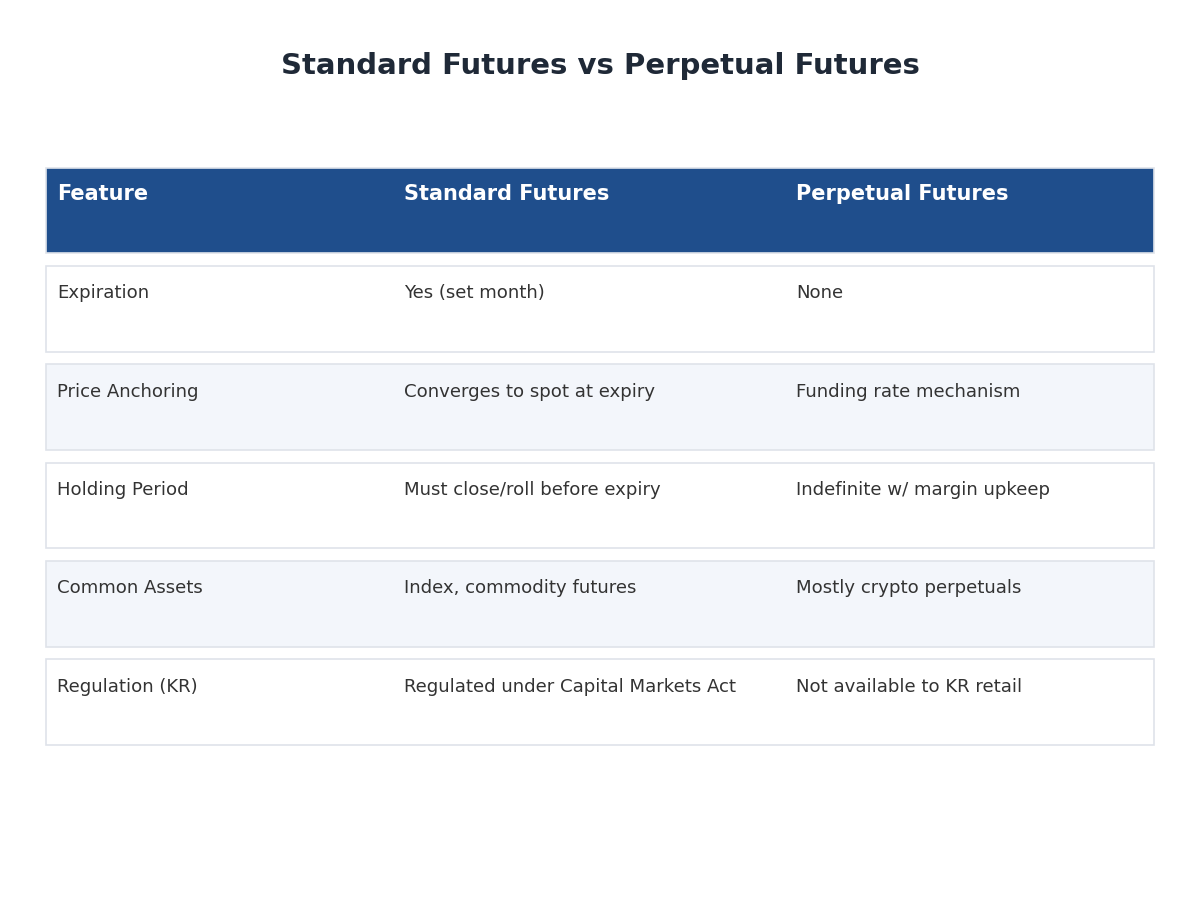
Every standard futures contract has an expiration date. For most index and commodity futures, that's a specific day in the contract month (often around the third Friday), by which time a trader must close the position or roll it into the next contract month.
This is where margin comes in. Traders post initial margin when opening a position, and must maintain a minimum maintenance margin afterward. If losses push the account below that threshold, the trader receives a margin call requiring additional funds — and failing to meet it can trigger a forced liquidation.
If a trader wants to keep a position open past expiration, they "roll" it — closing the expiring contract and opening an equivalent one in the next month. Because prices between contract months can differ, this rollover process can create a small cost or gain.
Another key feature is daily mark-to-market settlement. Unlike stocks, where gains and losses stay "on paper" until you sell, futures accounts are settled in cash every single trading day based on that day's price movement.
The Buzz Around Perpetual Futures
Lately, "perpetual futures" have become a hot topic in the U.S. As the name suggests, these are futures contracts with no expiration date at all — a concept pioneered by crypto exchanges.
Standard futures naturally converge to the spot price at expiration. Since perpetual futures never expire, they instead rely on a "funding rate" mechanism to keep their price tethered to the spot price. When the perpetual contract trades above spot, long position holders pay a small fee to short holders, and vice versa when it trades below spot — nudging the price back toward parity.
Recently, the U.S. Commodity Futures Trading Commission (CFTC) has been moving to bring crypto perpetual futures onto regulated U.S. platforms. Reports indicate the CFTC approved the listing of Bitcoin perpetual futures on the prediction-market platform Kalshi, signaling a shift of perpetual futures trading — long dominated by offshore exchanges — into the U.S. regulatory system.
That said, there is currently no official channel for retail investors to trade perpetual futures through regulated domestic platforms in Korea. Accessing them through offshore platforms can mean stepping into regulatory gray areas with limited legal protection, so jumping in without fully understanding the structure isn't something we'd recommend.

Good to Know Before You Trade Futures
Because of the leverage involved, futures positions can lose money far faster and far more severely than most people expect. It's important to understand that losses can, in theory, exceed your original margin deposit.
In Korea, retail investors must complete mandatory education and demonstrate simulated trading experience before they're allowed to open a derivatives account for futures or options. That requirement alone reflects how complex and risky these products are considered to be.
Higher leverage means bigger swings in profit and loss relative to your margin, and if you can't meet a margin call in time, your position may be forcibly liquidated at a moment you didn't choose.
This post is intended as general educational information about how futures contracts work, and is not investment advice or a recommendation to buy or sell any specific product. Any investment decisions, and their outcomes, are the sole responsibility of the investor.
'자산관리' 카테고리의 다른 글
| Asset Management :: Option Greeks (Delta, Gamma, Theta, Vega) — Why Do They Matter? (0) | 2026.07.24 |
|---|---|
| 자산관리 :: 옵션 그릭스(델타·감마·세타·베가), 왜 알아야 할까? 옵션 리스크 관리 총정리 (0) | 2026.07.24 |
| 자산관리 :: 선물 거래, 만기와 증거금부터 요즘 화제인 무기한 선물까지 (0) | 2026.07.23 |
| Real Estate :: How Does a Court Auction Actually Work? A Beginner's Guide to Property Auctions (0) | 2026.07.20 |
| 자산관리 :: 경매, 어떻게 시작해야 할까요? 부동산 경매 절차와 권리분석 총정리 (0) | 2026.07.20 |