2026. 7. 18. 18:24ㆍ자동차

Hello everyone.
Today's post continues our car brand history series with Porsche.
Did you know Porsche's very first vehicle, built all the way back in 1898, was actually electric?
In a previous post we covered Tesla's brand history. Today, let's look at how Porsche, a brand with nearly 130 years of history, actually got started, and why it keeps coming up in conversations about EV charging technology.
I develop charging systems for electrified equipment (EVs, electric excavators, electric wheel loaders, and the like), so Porsche is a brand I follow closely. You really can't talk about today's ultra-fast charging standards without mentioning this company.

Origins
Porsche's story doesn't actually start in 1948, contrary to popular belief. It goes back to 1898. Ferdinand Porsche designed a vehicle called the Egger-Lohner C.2 Phaeton in Vienna, Austria. One of its components was engraved with the code "P1," which is why it later became known as the Porsche P1.
That car was electric. Its roughly 3-hp (2.2kW) motor could reach about 35 km/h, and on a single charge it could reportedly run for three to five hours, covering around 79 km. In 1898 it competed in an Austrian motor race carrying three passengers and crossed the finish line 18 minutes ahead of the runner-up, while also recording the lowest energy consumption in a city-driving efficiency test.
Lohner-Porsche later introduced a hybrid version called the "Mixte," with a motor on each axle. That vehicle was exhibited at the 1900 Paris World's Fair and is often cited as one of the earliest hybrid vehicles in automotive history.
The independent brand carrying the Porsche name, though, started a bit later. In April 1931, Ferdinand Porsche founded an engineering consultancy in Stuttgart, backed financially by his son-in-law Anton Piech and by Adolf Rosenberger. One of the firm's earliest commissions came from the German government, which asked for a "people's car." The result was the Volkswagen Beetle.
The first car to actually carry the Porsche name arrived only in 1948. Led by Ferdinand's son, Ferry Porsche, the "Porsche 356 No. 1" Roadster received its operating permit that June, marking what's generally considered the true starting point of the brand.
Racing Legacy
Porsche took motorsport seriously from early on. In 1951, it entered the 24 Hours of Le Mans for the first time with a single 356 SL and won its class (under 1,100cc), the first step in a Le Mans success story that would continue for decades.
Porsche went on to rack up results at Le Mans with legendary race cars like the 917, 956, and 962. By most accounts, the brand has taken more than 100 class wins and 19 overall victories, making it one of the winningest manufacturers in Le Mans history.
That racing DNA carried straight over into its road cars. The 911, introduced in 1963, has kept its rear-engine layout and signature silhouette across more than 60 years and countless generations, becoming the model most associated with the brand.
This racing heritage is a big reason Porsche is seen not just as an expensive sports car maker, but as a company that proves itself through engineering. Even today, Porsche often tests new technology on the race track before bringing it to production cars.
Back to Electric: The Taycan and 800V
Porsche's return to electric vehicles began with the Mission E concept, unveiled in 2015. In 2017, the company installed its own 350kW, 800V charging station to support that concept car, reportedly one of the fastest EV charging setups in the world at the time.
That concept car officially became the "Taycan" in 2018 and launched in 2019, earning the distinction of being the first production EV with an 800V system. That was a bold move at a time when nearly every other EV on the market ran on 400V.
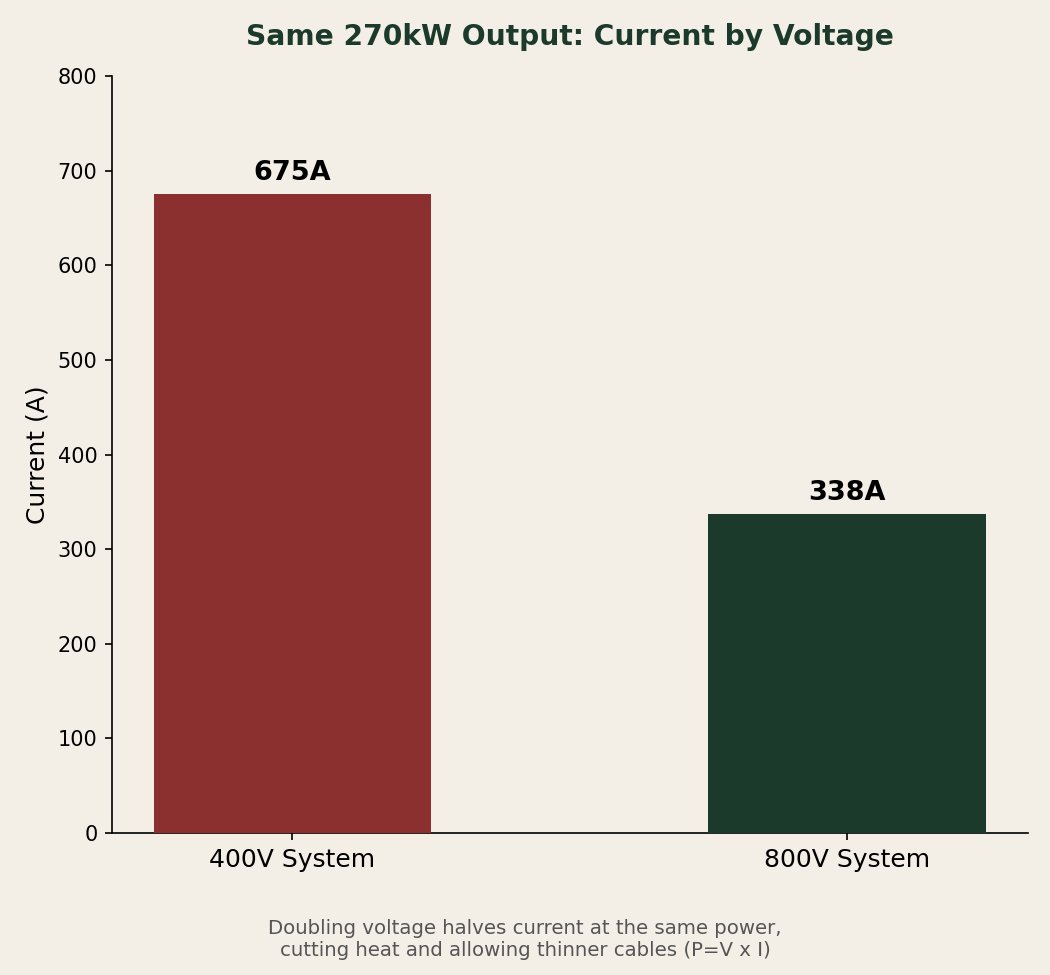
Doubling the voltage lets you cut the current in half for the same power output, which reduces heat and allows for thinner charging cables. Thanks to this architecture, the Taycan could charge at up to 270kW, going from 5% to 80% in about 22.5 minutes under ideal conditions, the fastest charging speed for a production EV at the time.
As someone who works on charging systems, I find Porsche's 800V decision on the Taycan a genuinely significant turning point. At a time when 400V was practically the default, Porsche chose to tackle the underlying heat problem head-on instead of working around it. That choice is widely seen as having influenced the rest of the industry. Hyundai Motor Group, for instance, announced in 2021 that its E-GMP platform would also adopt an 800V system.
'자동차' 카테고리의 다른 글
| Car :: From Lead-Acid to Solid-State — The Evolution of EV Battery Technology (1) | 2026.07.20 |
|---|---|
| 자동차 :: 전기차 배터리, 납축전지에서 전고체까지 기술의 변천사 총정리 (0) | 2026.07.20 |
| 자동차 :: 포르쉐의 첫차는 전기차였다? 브랜드 역사 총정리 (0) | 2026.07.18 |
| Car :: Could Your EV Charge in 20 Minutes? A Look at Megawatt Charging (MCS) (0) | 2026.07.17 |
| 전기차, 메가와트로 충전하는 시대가 온다고? 미래기술 총정리 (0) | 2026.07.17 |