2026. 7. 17. 20:48ㆍ자동차
Hello.
Today I want to talk about what many in the industry consider the next generation of EV charging: the Megawatt Charging System, or MCS.
If you drive an EV, fast charging probably feels pretty normal by now. But once you move from a passenger car to a heavy-duty truck, a bus, or even electric construction equipment like an excavator or wheel loader, the picture changes completely. Battery packs on these machines are several times larger than a passenger car's, so charging them at the same speed requires a lot more power.
That's exactly the gap the industry is trying to close with megawatt-scale charging. The name alone tells you this is a different order of magnitude.
Is EV charging really about to enter the megawatt era?
Let's dig into it.
Why Megawatt Charging Exists
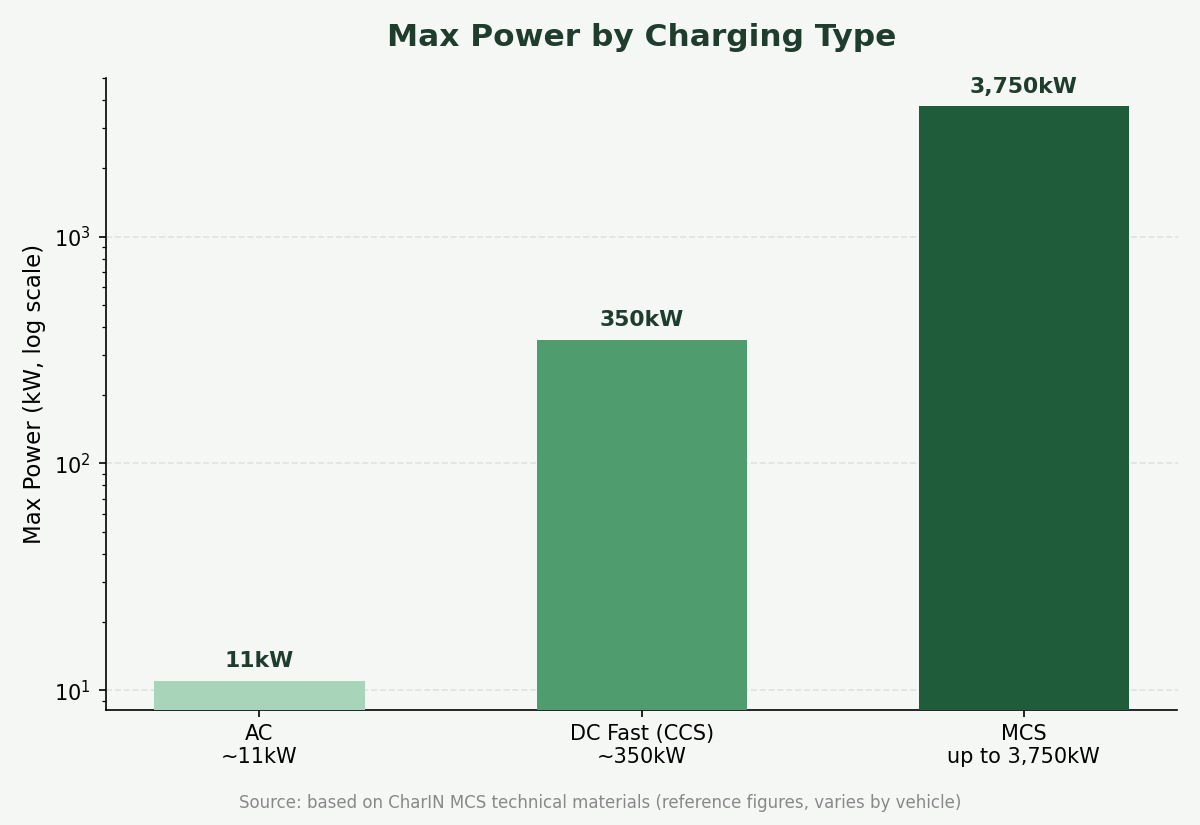
EV charging has traditionally split into two tiers: AC charging around 11kW, and DC fast charging that tops out near 350kW under the CCS standard. That's more than enough for a passenger car.
But heavy-duty electric trucks and buses can carry battery packs ranging from several hundred kWh up to nearly 1MWh. Charging one of those on a standard 350kW fast charger could take hours. For a logistics company, that's hours of downtime eating directly into the bottom line.
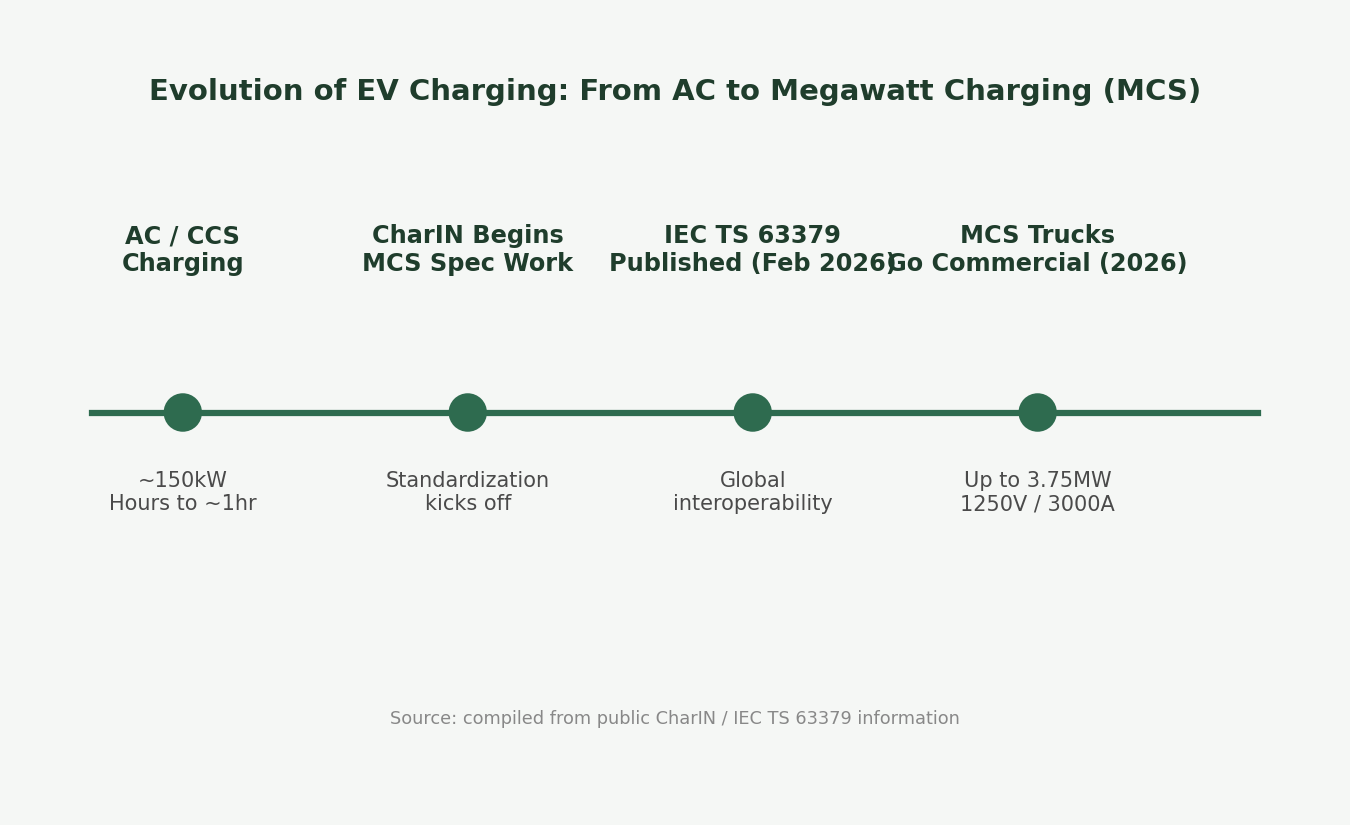
To solve that, CharIN, the international charging standards body, has been leading development of MCS. CharIN is the same organization behind the CCS connector standard most of us already know, so MCS isn't a clean-sheet redesign so much as an extension of CCS engineering principles scaled up for much higher power.
According to published technical documentation, MCS is designed to support up to 1,250V and 3,000A, putting its theoretical peak output at roughly 3.75MW. That's more than ten times a typical DC fast charger, which explains why "megawatt" ended up in the name.
How MCS Actually Works
The MCS connector uses a 7-pin design, and handling that much power safely requires a dedicated thermal management system, temperature monitoring, and multiple layers of safety interlocks. Moving 3.75MW through a cable is simply a different engineering problem than moving 150kW.
Standardization has also moved forward meaningfully. CharIN published IEC TS 63379 in February 2026, establishing global interoperability requirements so that MCS chargers and vehicles can work together anywhere in the world. A parallel standard, SAE J3271, is being formalized alongside it.
So what does that mean in practice? Industry estimates suggest a heavy-duty electric truck could go from roughly 20-30% state of charge to 80% in about 20 to 40 minutes using MCS. That's roughly ten times faster than a standard CCS fast charge, fast enough to fit within a truck driver's mandated rest break.
Commercial rollout has already begun. Scania launched MCS-capable electric trucks in early 2026, with initial connector configurations supporting up to 750kW. That's well below the theoretical 3.75MW ceiling, but it's a real, measurable jump over today's fast charging. Meanwhile, 1MW-plus charging stations are being deployed across Europe and the US to support this new generation of vehicles.
Good to Know
MCS is rolling out first for trucks and buses, but I'd argue it matters just as much for electrified construction equipment like excavators and wheel loaders. Job sites rarely have the luxury of parking a machine for hours to charge, and these machines carry even bigger battery packs than a passenger EV, so high-power charging infrastructure is arguably even more critical here.
There's movement on this front domestically in Korea too. Reports have indicated the government is considering MCS-level charging infrastructure around 2028. The exact timeline and specifications are still fluid, so it's worth treating this as a policy direction rather than a locked-in plan for now.
Handling megawatt-scale power isn't just a vehicle-side challenge, though — it demands just as much preparation on the grid and charging infrastructure side. Installing an MCS station requires a power supply comparable to an industrial park, so early deployment will likely concentrate on strategic locations like logistics hubs and highway truck rest stops before spreading further.
Bigger connectors also mean heavier cables, and the industry is addressing that with liquid-cooled cable technology to keep them manageable. Some manufacturers abroad are even exploring cable-support arms or robotic auto-connection systems so drivers don't have to wrestle with a heavy cable by hand.
'자동차' 카테고리의 다른 글
| Car :: Porsche's First Car Was Actually Electric — A Brand History (0) | 2026.07.18 |
|---|---|
| 자동차 :: 포르쉐의 첫차는 전기차였다? 브랜드 역사 총정리 (0) | 2026.07.18 |
| 전기차, 메가와트로 충전하는 시대가 온다고? 미래기술 총정리 (0) | 2026.07.17 |
| Car :: Could Your EV Charge and Pay Automatically Just by Plugging In? A Look at Plug & Charge (ISO 15118) (0) | 2026.07.16 |
| 자동차 :: 전기차, 카드 없이 꽂기만 해도 충전과 결제가 끝난다고? 플러그앤차지 신기술 총정리 (0) | 2026.07.16 |