2026. 7. 17. 12:41ㆍ자산관리

Hello.
Today I want to talk about options expiration day and something called "quadruple witching."
Why do markets often get so shaky on options expiration day?
If you follow the market, you have probably seen headlines warning that volatility could spike because "today is an options expiration day." But what an option actually is, and why expiration day shakes the market, is something many investors have never quite pinned down.
Today, let's walk through the basics of options, how expiration works in both the Korean and US markets, and the curious phenomenon known as "quadruple witching." Note that this post is educational only, not investment advice — it's meant to help you understand how options work.
What Is an Option, Anyway
An option is a derivative contract that gives you the right to buy or sell a specific asset at a fixed price on or before a set date. The right to buy is called a call option, and the right to sell is called a put option.
The key word here is "right," not "obligation." A buyer of an option can exercise that right if it's favorable, or simply let it expire if it's not. In exchange for that flexibility, the buyer pays an upfront cost called a premium.
The seller of an option, on the other hand, collects that premium but takes on an obligation — if the buyer chooses to exercise, the seller must honor the contract. That's why selling (writing) options is generally considered far riskier than buying them, since losses can theoretically be unlimited.
Options also carry significant leverage, meaning a relatively small amount of money can control a much larger position. That cuts both ways: potential gains are amplified, but so are potential losses, which is why options are considered a high-risk product.
Options Expiration and "Quadruple Witching"
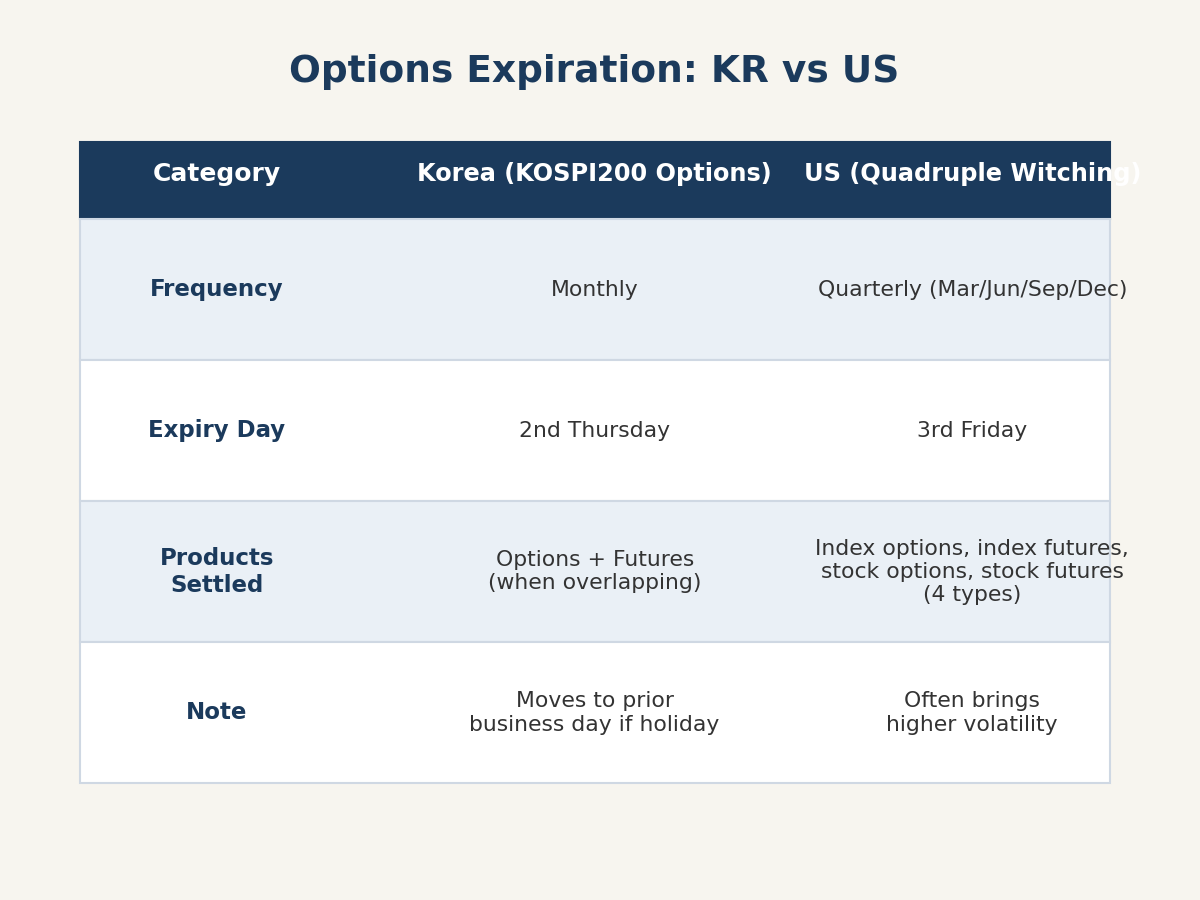
In Korea, the benchmark KOSPI200 options expire on the second Thursday of every month. If that day happens to be a market holiday, expiration moves up to the previous business day.
Unlike futures, options expire every single month, so there are twelve expiration dates a year. In months when options expiration overlaps with futures expiration, it's called a "simultaneous expiration," and these days tend to bring extra volatility.
More recently, weekly options have also started trading in Korea, adding a layer of expirations that occur every single week. The one exception is the second week of the month, when the weekly listing is skipped since it overlaps with the monthly contract's expiration.
On expiration day, large volumes of index-arbitrage and non-arbitrage program trades tied to options get unwound all at once, which can temporarily skew the supply-demand balance for certain stocks or the index as a whole. That's part of why traders treat expiration day as a notable market event.
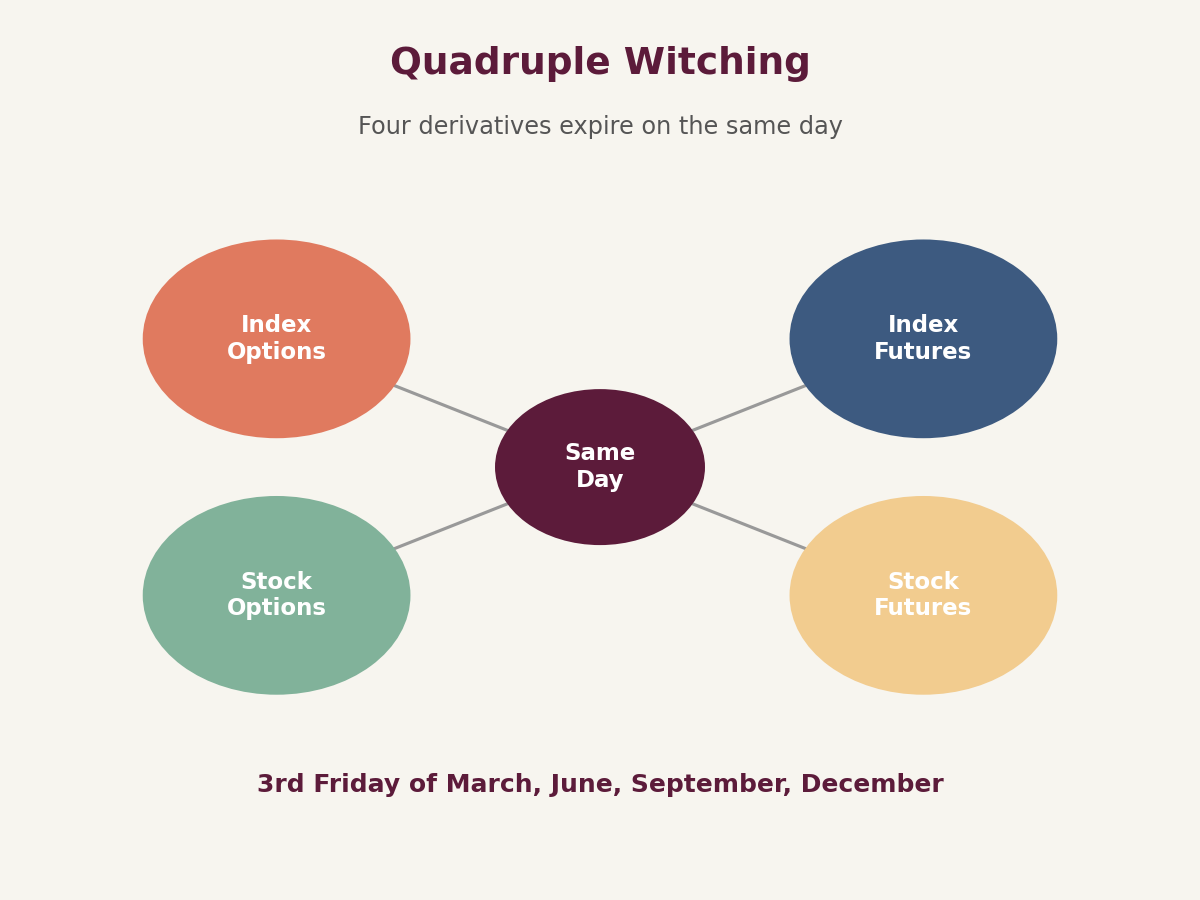
In the US market, there's a colorful term for a related phenomenon: "quadruple witching." It refers to the third Friday of March, June, September, and December, when four types of derivatives — stock index options, stock index futures, individual stock options, and individual stock futures — all expire on the same day.
The nickname reportedly dates back to the 1980s, when stock index futures and options were first introduced to US markets and analysts noticed prices swinging wildly in the final hour of trading on expiration days. Later, when monthly stock option expirations were aligned with the quarterly expiration of index futures and index options, it became known as "triple witching." When individual stock futures launched in 2002 and were folded into the same cycle, the event took on its current name: "quadruple witching."
Good to Know
Options expiration day doesn't automatically mean the market will crash or rally hard. That said, trading volume and volatility do tend to run higher than usual, so if you're considering short-term trades around this time, it's worth being extra careful.
Because options carry heavy leverage and can become worthless at expiration, trading options directly isn't something to jump into without solid understanding and risk management. If you're new to this, it's usually better to start by learning how the structure works before trading the product itself.
Some experienced traders do build strategies around expiration-day volatility, but that's typically the domain of sophisticated investors with tight risk controls. For most everyday investors, sticking to your existing plan rather than chasing short-term moves around expiration is usually the safer approach.
This post is meant purely to help explain how options and expiration work — it is not a recommendation to buy or sell any specific security or to time any trade. Any actual investment decision should be made based on your own judgment and at your own risk.

'자산관리' 카테고리의 다른 글
| Asset Management :: What Is Layer 2? How It Makes Crypto Faster and Cheaper (1) | 2026.07.18 |
|---|---|
| 코인 :: 레이어2(Layer2)란 무엇인가? 코인이 더 빠르고 저렴해지는 원리 (0) | 2026.07.18 |
| 자산관리 :: 옵션 만기일에는 왜 증시가 출렁일까? '네 마녀의 날'까지 옵션 총정리 (0) | 2026.07.17 |
| Asset Management :: Contango vs Backwardation — What Every Futures ETF Investor Should Know About Roll Costs (0) | 2026.07.16 |
| 자산관리 :: 선물시장 콘탱고와 백워데이션, ETF 롤오버 비용까지 알아보기 (0) | 2026.07.16 |