2026. 7. 14. 00:29ㆍ자산관리
Hello everyone.
Today's post is about leverage, margin, and margin calls in futures trading.
"What actually happens when your futures account suddenly gets a call demanding more money?"
Unlike buying something outright in the spot market, futures trading lets you control a much larger contract value by putting down only a fraction of it as margin. That's what makes futures capital-efficient, but it's also exactly why gains and losses can be magnified so dramatically relative to the money you actually put in.
Interest in leverage mechanics has grown recently with the rise of new products like perpetual futures, contracts with no expiry date at all. Today we'll walk through the fundamentals that sit underneath all of it: leverage, margin, and the margin call.

Understanding Leverage
Leverage is the mechanism that lets you control a position far larger than your own capital. If you post $1,000 in margin to control a $10,000 futures contract, you're effectively trading with 10x leverage.
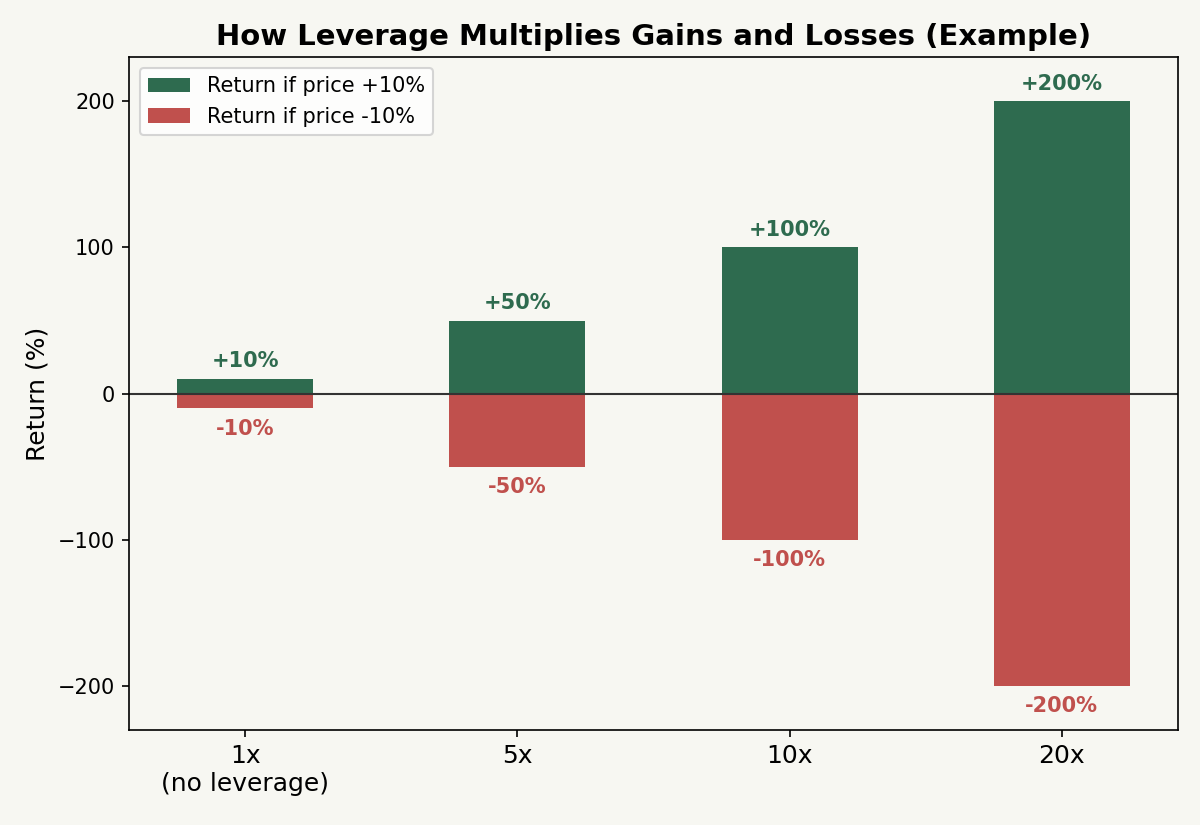
The catch is that leverage magnifies losses exactly as much as it magnifies gains. If the underlying asset moves up 10%, a 10x leveraged position returns roughly 100% on the margin posted, but if it moves down 10%, that same position can wipe out the entire margin.
The chart below shows how the swing in returns grows as leverage increases, assuming the same 10% price move in either direction. Notice how the bars grow much faster than the leverage multiple itself.
This is why traders describe high leverage as "high risk, high reward" almost in the same breath. Choosing a leverage multiple should always factor in your account size and how much drawdown you can actually tolerate.
Margin and How Margin Calls Happen
To open a futures position, you first have to post an initial margin. The required amount varies by exchange and by product, and it's typically set as a percentage of the total contract value.
While the position stays open, a maintenance margin requirement applies as well, a minimum account balance you need to keep the position alive. If unrealized losses push your balance below that maintenance level, the exchange or broker issues a margin call.
Once you receive a margin call, you have a set window to deposit additional funds and bring your margin back up. If you fail to do so in time, the exchange can force-liquidate the position on your behalf.
Because this can lock in a loss regardless of what the trader wants, the margin call is often considered the single most important risk signal in futures trading. The table below breaks down how initial margin, maintenance margin, and the margin call relate to each other.

Good to Know Before You Trade Futures
Once you understand leverage and margin, a few practical principles are worth keeping in mind before actually placing a futures trade. The most basic one is sizing your position within a loss you can genuinely afford.
It also helps to set your own stop-loss level before a margin call ever arrives. Deciding in advance at what price you'll cut a losing trade tends to prevent emotional decisions from turning a manageable loss into a much larger one.
Keeping extra cash in your account beyond the bare minimum margin is another common practice. If you fund an account right at the minimum requirement, even a small price move can trigger a margin call, so a bit of buffer goes a long way.
Futures and options are high-risk derivatives where losses can exceed your original investment. This article is written for general educational purposes to explain how futures trading works, and it is not investment advice for any specific position or product. Any trading decision should be made carefully, based on your own judgment and at your own risk.

Wrapping Up
Today we covered the core mechanics behind futures trading: leverage, margin, and the margin call. Leverage lets you control a large position with a small amount of capital, but that same structure widens your range of possible gains and losses, and margin rules exist specifically to manage that risk.
Newer products like perpetual futures keep appearing, but the underlying logic of leverage and margin hasn't really changed. If you're considering futures trading, it's worth making sure you fully understand these basics before putting real money behind a position.
#futurestrading #leverage #margin #margincall #derivatives #futuresandoptions #assetmanagement #investingbasics #riskmanagement #initialmargin #maintenancemargin #forcedliquidation #futuresmarket #derivativestrading #futuresforbeginners #tradingbasics #financeeducation #futuresleverage #stoploss #positionsizing #futuresaccount