2026. 8. 6. 16:00ㆍ육아생활

Hello everyone.
Today I'm writing about how to choose your baby's first car seat, one of the most important pieces of baby gear you'll ever buy.
From the moment you bring your newborn home from the hospital, a car seat isn't optional, it's essential. Since most families drive home right after discharge, a car seat is usually the very first item on the baby registry checklist.
But once you actually start shopping, you'll quickly notice there are dozens of models, wildly different price points, and every brand claims to have the "safest" feature. It's easy to feel overwhelmed before you've even picked one up.
Is it really okay to pick a car seat just because it looks cute?
In this post, we'll walk through why car seats matter so much, the different stages and how they should be installed, and the key checkpoints to look for before you buy one. If you're an expecting parent, I hope this gives you a clear starting point ^^

Why Do Car Seats Matter So Much?
If a child isn't properly secured in a car seat during a crash, their body can't rely on a regular seat belt for protection. Adult seat belts are designed for adult proportions, so using one alone on a small child can actually do more harm than good.
That's why car seat use is legally required for children under a certain age in many places, including South Korea, where it's mandatory up to age six, with fines for non-compliance. Even so, safety guidance generally recommends continuing to use a car seat or booster until a child reaches around 145cm in height or about age 12.
The American Academy of Pediatrics (AAP) takes a similar stance, recommending that children ride rear-facing for as long as possible, until they reach the maximum height or weight limit allowed by their specific car seat. For many families, that ends up being somewhere between age two and four.
European guidelines tend to echo this too, generally recommending rear-facing seating until at least 15 months, and noting that staying rear-facing longer is associated with better protection for a child's head, neck, and spine in a crash. So the real question isn't "when can they finally face forward," but rather "how long can we keep them rear-facing safely."
Getting the car seat right isn't just about following the law, it also brings real peace of mind behind the wheel. Knowing your child is properly secured lets you focus on the road instead of worrying ^^
Car Seat Types and Installation Direction
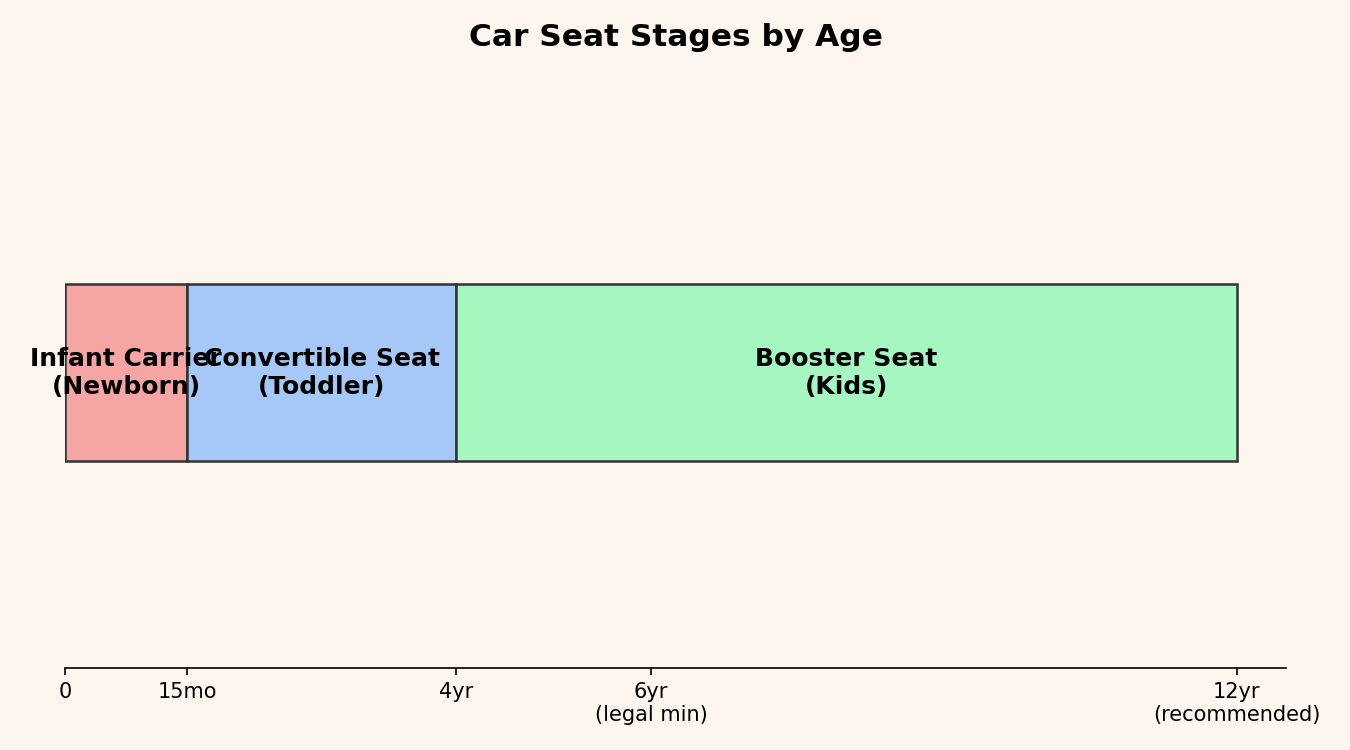
Car seats generally fall into three stages, and most families move through them in order as their child grows.
The first stage is the infant car seat, typically used from birth until around 15 months or about 13kg. Since newborns can't yet support their own head and neck, this stage must always be installed rear-facing. A big practical plus is that most infant seats detach with a carrying handle, so you can move a sleeping baby without waking them.
The second stage is the convertible car seat, generally used from around 15 months up to age four, or roughly 18kg. This is typically when many parents switch to forward-facing, but as mentioned above, it's considered safer to delay that switch for as long as the seat's rear-facing limits allow.

The third stage is the booster seat, generally used from around age four to twelve, or until a child reaches about 145cm. Boosters come in high-back and backless versions, and their main job is to raise a child up so the vehicle's adult seat belt sits correctly across their shoulder and hip rather than their neck or belly.
Across all three stages, the key factor isn't your child's exact age but their actual height and weight. Since every child grows at a different pace, it's generally better to check the specific limits printed on your current seat and stay in that stage as long as possible before moving up.
What to Check Before You Buy
First, always confirm the seat has passed relevant national safety certification for your region (in South Korea, that's the KC safety mark). A certified seat means it has been tested against recognized crash-safety standards, so skipping this check just to save money is a real risk.
Second, check compatibility with your specific vehicle. Most modern car seats and cars support the ISOFIX (or LATCH in North America) system, which locks the seat directly into built-in anchor points rather than relying solely on the seat belt, generally resulting in a tighter, more consistent install. It's worth confirming your car supports this system before you buy.
Third, do a real installation test. Try installing the seat in your actual car and check that it doesn't shift more than about an inch (2.5cm) side to side or front to back once secured. Plenty of parents order online based on reviews alone, only to find the seat doesn't fit their car well, so testing it in person whenever possible can save you a return down the line.
Finally, think twice before buying a used car seat. Seats that have been in a prior crash may have invisible structural damage that makes them unsafe to reuse, and older seats made of aging plastic and foam can also lose some of their protective performance over time.
Beyond safety basics, it's also worth thinking about everyday usability, how complicated the installation process is, whether the cover is machine washable, and whether the fabric breathes well in hot weather can all make a real difference in daily life ^^
'육아생활' 카테고리의 다른 글
| 육아 :: 우리 아이 첫 카시트, 어떻게 골라야 안전할까요? 육아용품 총정리 (0) | 2026.08.06 |
|---|---|
| Parenting :: Can Everyday Habits Really Help Your Child's Brain Development? An (0) | 2026.08.03 |
| 육아 :: 우리 아이 뇌발달, 일상 습관으로 도울 수 있을까요? 시기별 가이드 (1) | 2026.08.03 |
| Parenting :: Vitamin D and Probiotics for Kids - How Much Do They Really Need? (0) | 2026.08.02 |
| 육아 :: 우리 아이 영양제, 비타민D와 유산균 제대로 챙기고 계신가요? (0) | 2026.08.02 |