2026. 8. 3. 21:16ㆍ자동차
Hello!
Today I'd like to talk about one of the most exciting new technologies in EV charging: Vehicle-to-Grid, or V2G.
As someone who develops charging systems for electrified equipment - EVs, electric excavators, electric wheel loaders - V2G is one of the technologies I've been watching most closely lately. It represents a shift from simply filling a battery to actively exchanging energy and information with the power grid.
Until recently, EV charging was mostly about speed and capacity - how fast and how much you could charge. Now the conversation is shifting toward what happens after the battery is full: when and how that stored energy gets used again.
"What if simply parking your EV could actually earn you money?"
What Exactly Is V2G?
V2G stands for Vehicle-to-Grid, a bidirectional charging technology that lets energy stored in an EV battery flow back into the power grid. In simple terms, it turns an electric vehicle into a mobile energy storage system.
Two related concepts are V2L (Vehicle-to-Load) and V2H (Vehicle-to-Home). V2L sends power from the car to individual devices and is often used for camping or outdoor activities, while V2H sends power from the car to a home, acting as backup power during outages. V2G differs from both in scale and impact, since it connects to the power grid as a whole rather than a single device or building.
Technically, V2G comes in AC and DC variants. AC-based V2G relies on a bidirectional onboard charger (OBC) in the vehicle to convert between AC and DC, while DC-based V2G handles that conversion at the charging station itself. As someone who works on charging systems, I see the efficiency and safety design of this bidirectional conversion as one of the key challenges for widespread V2G adoption.
On the communication side, international standards like ISO 15118-20 are evolving to support bidirectional charging. Because the vehicle, the charger, and the grid operator all need to exchange information in real time, the reliability of these communication protocols largely determines the quality of V2G service.

Latest Developments at Home and Abroad
In Korea, Hyundai Motor Group continues to run an AC-based V2G pilot program. Aligned with a grid-code update proposal from Korea Electric Power Corporation (KEPCO), successful bidirectional charging tests at ordinary households suggest that many of the technical barriers have been largely resolved.
Globally, momentum is building too. Volkswagen and its subsidiary Elli plan to launch a V2G service for private customers in Germany starting in the fourth quarter of 2026, while Nissan has announced it will roll out more affordable bidirectional charging technology the same year.
Toyota Industries announced it has verified a bidirectional onboard charger based on ISO standards, and GM says more than 250,000 bidirectional-capable vehicles are already on American roads. This suggests automakers have made significant progress on the hardware side.
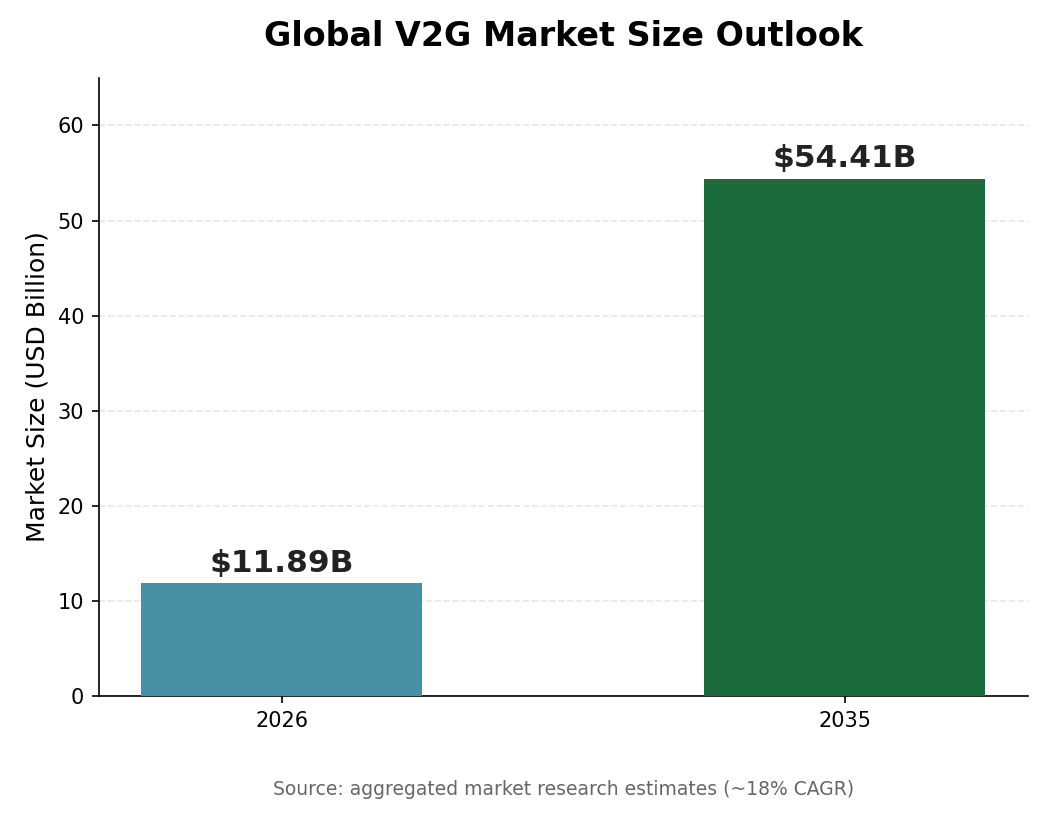
Market forecasts are striking as well. Combining estimates from several market research firms, the global V2G market is expected to grow from roughly $11.89 billion in 2026 to more than $54 billion by 2035, at an estimated annual growth rate of around 20 percent.
Good to Know
V2G is expanding beyond simple charging into a bigger picture that includes virtual power plants (VPPs) and battery aggregation. By pooling thousands of EV batteries and letting AI coordinate charging and discharging in real time, V2G can help smooth out the intermittency of renewable sources like solar and wind.
That said, there are a few things worth keeping in mind. Frequent charge-discharge cycles have long raised concerns about accelerated battery degradation. Modern battery management systems (BMS) are becoming more sophisticated at minimizing this effect, but longer-term real-world data is still needed before drawing firm conclusions.
From a charging-infrastructure developer's perspective, connector standards, communication protocols, and grid safety regulations still vary by country, and harmonizing these will be essential for V2G to scale globally. Regulations and standards in Korea are also evolving quickly, so this is a space worth watching closely over the next few years.
For everyday consumers, rather than rushing to buy a V2G-capable vehicle or sign up for a service right away, it's worth first checking whether your vehicle or charger supports bidirectional charging, and whether any pilot programs are available in your area.