2026. 8. 2. 19:06ㆍ자동차
Hello there.
Today I'm writing about the basics of EV charging.
If you've just started driving an electric vehicle, the first question that usually comes up is "how does charging actually work?" Unlike filling up a gas tank in a few minutes, EV charging comes with unfamiliar terms like slow charging and fast charging right from the start.
I work on developing charging systems for electrified equipment, and the question I get asked most often by people around me is exactly this: what's the real difference between slow and fast charging?
Do you know exactly what separates slow charging from fast charging?
Today I'll break down the answer from the ground up, starting with the basic terms so that even first-time EV drivers can follow along easily.
Slow vs. Fast Charging: What's Really Different
EV charging falls into two broad categories based on the type of current used: slow charging (AC) and fast charging (DC). With slow charging, the vehicle takes in ordinary AC power straight from a home or office outlet, and the onboard charger (OBC) built into the car converts it to DC before storing it in the battery.
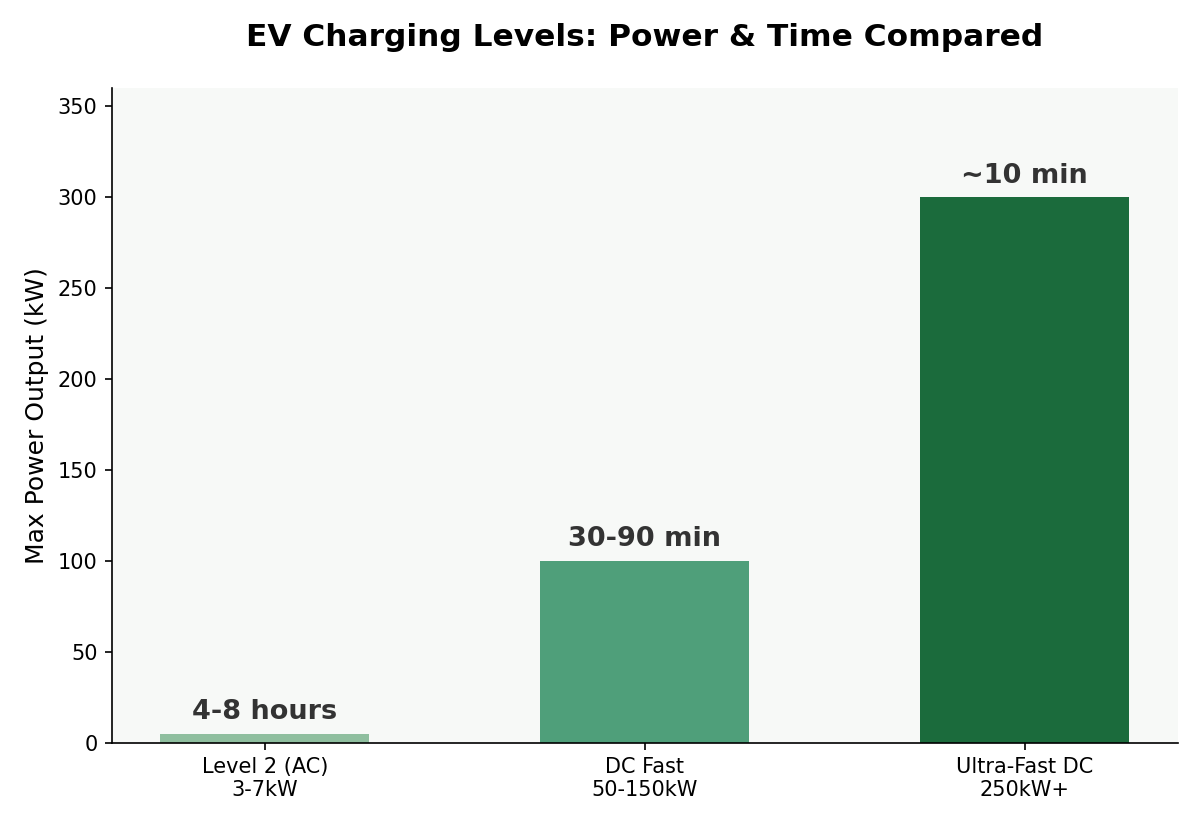
Because the conversion happens through this onboard charger, slow charging output is limited. It typically runs between 3.3kW and 7kW, and charging up to 80 percent usually takes anywhere from 4 to 8 hours. That's why slow chargers are most commonly installed in places where a car sits for a long time, like apartment garages or office parking lots.
Fast charging, on the other hand, handles the AC-to-DC conversion outside the vehicle, inside the charging station itself. Since the power electronics in the charger convert the current and feed DC directly to the battery, there's no need to go through the car's onboard charger, which allows for much higher output. Fast chargers typically deliver 50kW to 150kW, and can bring a battery close to full in 30 to 90 minutes.
More recently, ultra-fast charging has been gaining ground as the next step up. Some chargers now support output beyond 250kW, even reaching 300kW or more, and if the vehicle can accept that much power, charging to 80 percent in around 10 minutes is possible.
That said, to protect the battery, charging speed naturally slows down once the state of charge passes 80 percent, whether you're on a slow or fast charger. This is simply a safeguard to avoid stressing the battery cells, so there's no need to worry if charging suddenly feels slower near the end.
Charging Connectors and Regional Standards
If you've driven an EV in different places, you may have noticed that charging plugs don't all look the same. That's because different countries and regions have adopted different standard connectors.
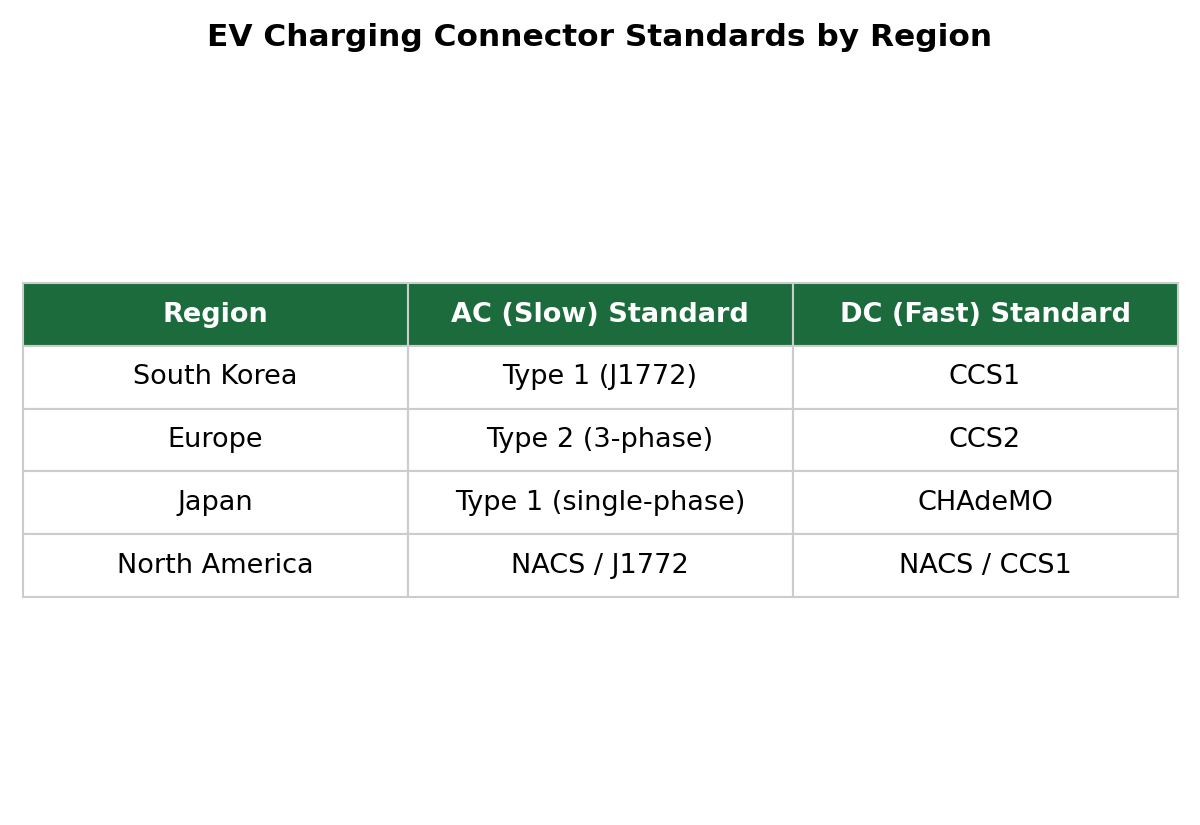
On the AC (slow charging) side, Type 1 (J1772) and Type 2 are the two most widely used formats. Type 1 uses single-phase AC and is common in North America, Korea, and Japan, while Type 2 supports three-phase AC and is the standard across Europe.
On the DC (fast charging) side, things get a bit more varied. CCS, short for Combined Charging Standard, adds a dedicated DC connector below either a Type 1 or Type 2 plug. North America and Korea use CCS1, while Europe uses CCS2. Japan has long relied on its own CHAdeMO standard, though the industry there has been gradually shifting toward CCS in recent years.
In North America, there's been a major shift as NACS, the connector Tesla originally developed for its own network, has increasingly been adopted as an industry-wide standard. With several major automakers announcing support for NACS, it looks increasingly likely to become the de facto standard across the North American market going forward.
Since standards vary so much by region, it's worth checking what connector type is used locally before renting or driving an EV abroad.
Good to Know When You Charge
If you're wondering which type of charging to rely on day to day, a good rule of thumb is to use slow charging as your default and save fast charging for long trips or when you're in a hurry. Because fast charging pushes a large current into the battery in a short burst, relying on it too often is generally understood to accelerate battery degradation somewhat faster over time.
Charging etiquette matters too. Once your car is fully charged, it's considerate to move it promptly so others can use the spot, and it's best to avoid occupying a fast charger for a long time when slow charging would have been enough.
Battery temperature also affects charging speed. In cold weather, when the battery is significantly below its ideal temperature, even a fast charger often can't deliver its rated maximum output. That's because the vehicle's battery management system (BMS) automatically limits the charging current to protect the battery cells at low temperatures.
When plugging and unplugging the connector, it's a good idea to apply a bit of firm pressure and make sure the connection is fully seated. A loose or incomplete connection can prevent charging from starting at all, or cause it to cut out partway through.
'자동차' 카테고리의 다른 글
| Car :: Can Your EV Power the Grid? A Complete Guide to Vehicle-to-Grid (V2G) Tec (0) | 2026.08.03 |
|---|---|
| 자동차 :: 전기차가 전력망을 살린다? V2G(Vehicle-to-Grid) 기술 완전정리 (0) | 2026.08.03 |
| 자동차 :: 전기차 충전, 완속과 급속은 뭐가 다를까? 충전 기초상식 총정리 (0) | 2026.08.02 |
| Car :: From DC Motors to SiC Inverters - The Evolution of EV Drive Motor Technology (0) | 2026.08.01 |
| 자동차 :: 전기차 구동모터, DC모터에서 SiC 인버터까지 기술의 변천사 (0) | 2026.08.01 |