2026. 8. 1. 15:50ㆍ자동차

Hello everyone.
Today's post looks at how EV drive motor technology has evolved over time, a topic that gets a lot less attention than battery capacity or charging speed.
When people talk about electric vehicles, the conversation usually centers on range and charging times. The motor that actually turns the wheels tends to stay in the background, even though every shift in motor technology has changed EV efficiency, size, and cost in a big way.
I work on charging systems for electrified equipment, including EVs, electric excavators, and electric wheel loaders. Designing charging infrastructure eventually pushed me to understand the motor side too, since that's where the electricity actually gets turned into motion.
Do you know what kind of motor is actually spinning inside your EV?
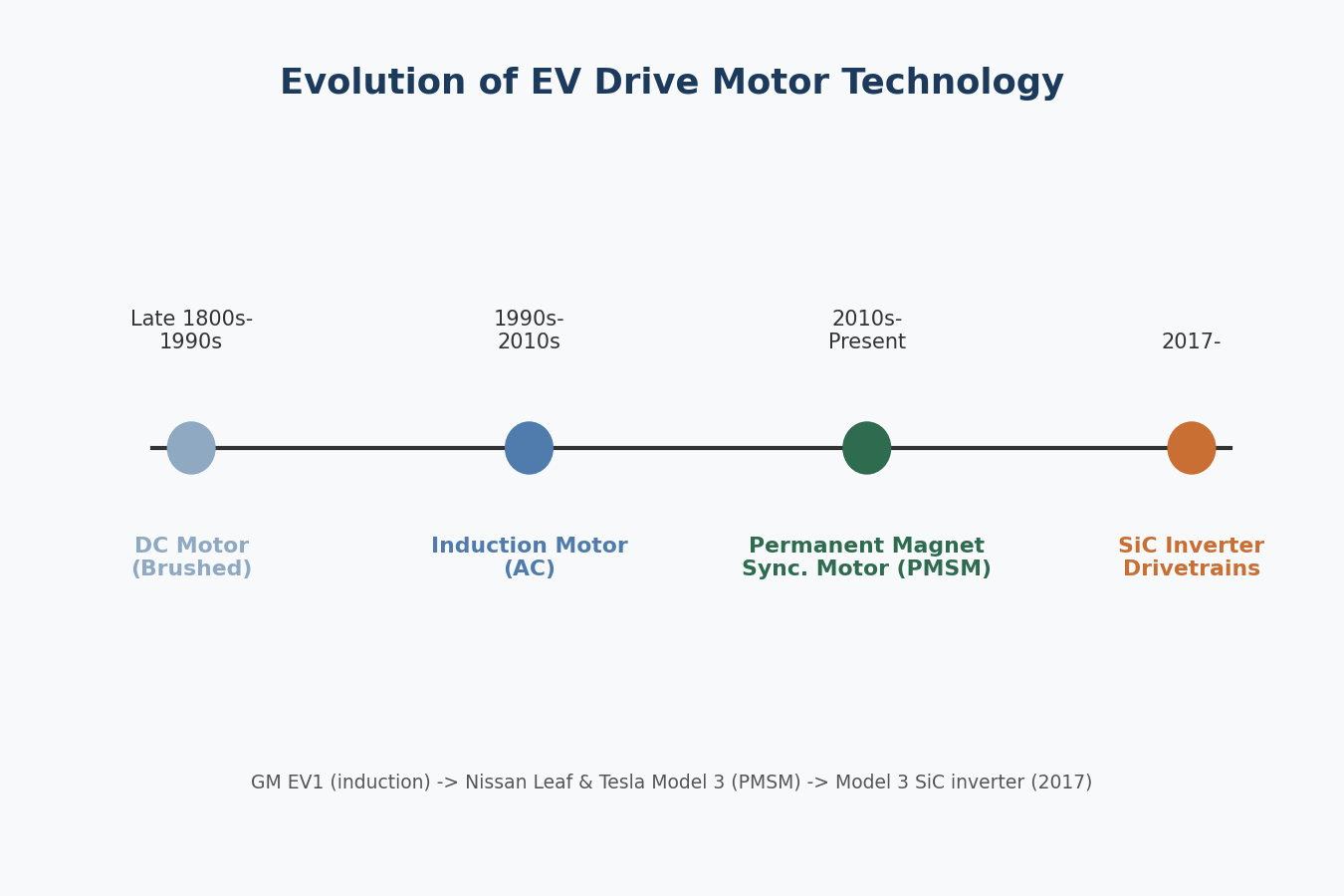
Today I want to walk through that story in order: from early DC motors, to induction motors, to today's permanent magnet synchronous motors (PMSM), and finally the SiC inverters that have been making headlines recently.

Origins
Electric vehicles are actually older than gasoline cars, according to most accounts of automotive history. The early EVs that appeared in the late 19th century mostly relied on DC (direct current) motors for power.
DC motors were a natural fit for those early cars because their structure was relatively simple and speed control was straightforward. They could also run directly on the DC electricity coming out of a battery, without needing any extra conversion hardware.
The catch was that DC motors needed brushes and a commutator, parts that constantly switch the direction of current between the rotor and stator. Because those parts physically touch and rub against each other, they were bound to wear down over time.
That meant DC motors required regular maintenance and were relatively inefficient. Power-to-weight was also weak, which was one of the reasons EVs faded from the market for decades once internal combustion cars went mainstream in the mid-20th century.
Key Facts
Starting in the 1990s, the industry began turning to induction motors to get around the limits of DC motors. The basic principle behind induction motors is generally credited to Nikola Tesla and Galileo Ferraris, who reportedly discovered it independently in the late 19th century.
Induction motors are brushless, so there's no commutator or brush wear to worry about, and they're known for being rugged and durable. GM's early production EV, the EV1, and Tesla's original Model S and Model X are reported to have used induction motors.

The pendulum swung again in the 2010s, when permanent magnet synchronous motors (PMSM) rose to become the new mainstream choice. By embedding permanent magnets in the rotor, PMSMs deliver higher efficiency along with a smaller, lighter package compared to induction motors.
The Nissan Leaf helped bring PMSM technology to the mass EV market, and Tesla itself is reported to have switched from the induction motors of the original Model S and X to PMSMs starting with the Model 3 and Model Y. For mass-market EVs that need to pack high efficiency into limited interior space, PMSM turned out to be the better fit.
Good to Know
Alongside the motor itself, the inverter has been getting a lot of attention lately. The inverter converts the battery's DC electricity into the AC power the motor needs, and the semiconductor material used inside it has been shifting from standard silicon to silicon carbide (SiC).
Tesla is widely reported to be the first automaker to fully adopt a SiC inverter, introduced with the Model 3 in 2017. Developed in partnership with STMicroelectronics, this inverter reduces power losses compared to traditional silicon components and is said to boost range by up to about 10 percent.
That move helped fuel major growth in the SiC semiconductor market. From a market worth less than 100 million dollars in 2017, it grew to roughly 1 billion dollars by 2021, and it's projected to reach around 6 billion dollars by 2027.
Working on charging systems for electrified equipment myself, I've come to see motor and inverter advances as directly tied to how we design charging infrastructure. As motors and inverters get more efficient, the same battery can go farther, which in turn changes how often and how fast drivers need to charge.
'자동차' 카테고리의 다른 글
| Car :: Slow vs Fast EV Charging - What's Actually the Difference? A Beginner's G (0) | 2026.08.02 |
|---|---|
| 자동차 :: 전기차 충전, 완속과 급속은 뭐가 다를까? 충전 기초상식 총정리 (0) | 2026.08.02 |
| 자동차 :: 전기차 구동모터, DC모터에서 SiC 인버터까지 기술의 변천사 (0) | 2026.08.01 |
| Car :: How Did Hyundai Go From the Pony to the Ioniq? A Brand History (0) | 2026.07.30 |
| 자동차 :: 현대자동차는 포니에서 아이오닉까지 어떻게 왔을까? 브랜드별 역사 총정리 (0) | 2026.07.30 |