2026. 7. 29. 15:20ㆍ자산관리

Hello!
Today's post is about stock investing, and specifically about why more and more retail investors are turning to ETFs instead of picking individual stocks.
"Can the stock I picked actually beat the market average?" That's a question most people ask themselves at some point when they start investing, and it's a good place to start today's post.
Retail brokerage account openings have surged recently, which shows just how much interest there is in stock investing right now. But along with all those new accounts comes a common problem: many first-time investors simply don't know where to start.
One trend stands out in particular. In a recent 2026 survey, more retail investors said they plan to use ETFs or ETNs than said they plan to buy individual stocks directly. In this post, we'll look at why that shift is happening, along with some basic concepts every beginner should know before getting started.
Stock Investing 101
A stock represents a small slice of ownership in a company. When you buy a share, you own a piece of that business, and if the company grows or turns a profit, you can benefit through a rising share price or dividends.
Stock markets are generally split into a primary market and a secondary market. Companies raise money by issuing new shares in the primary market, and investors then trade those existing shares among themselves on exchanges like the KOSPI or KOSDAQ, which make up the secondary market.
Share prices move based on a huge range of factors: company earnings, industry outlook, interest rates, currency swings, and the broader global economy. Because so many variables are at play, it's risky to draw conclusions about where a stock is headed from a single headline alone.
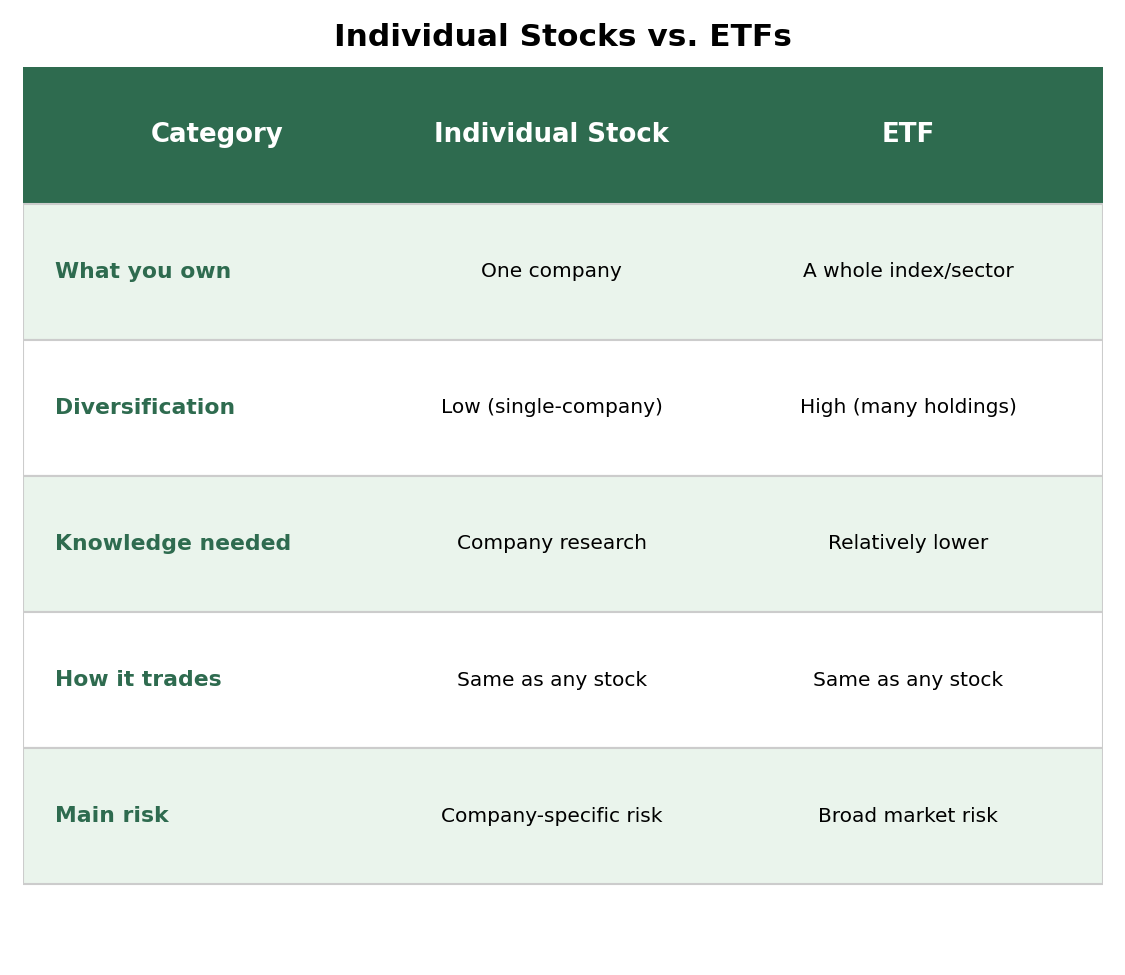
Picking individual stocks means studying one company closely and betting on its growth. If you get it right, the upside can far outpace the market average, but it also means your risk is concentrated in that single company.
Individual Stocks vs. ETFs — What's the Difference?
ETF stands for Exchange Traded Fund. It's a fund designed to track a specific index, sector, or theme, and unlike a traditional mutual fund, it trades on an exchange just like a regular stock. Buy a single KOSPI 200 ETF, for example, and you instantly get exposure to 200 of Korea's largest companies at once.
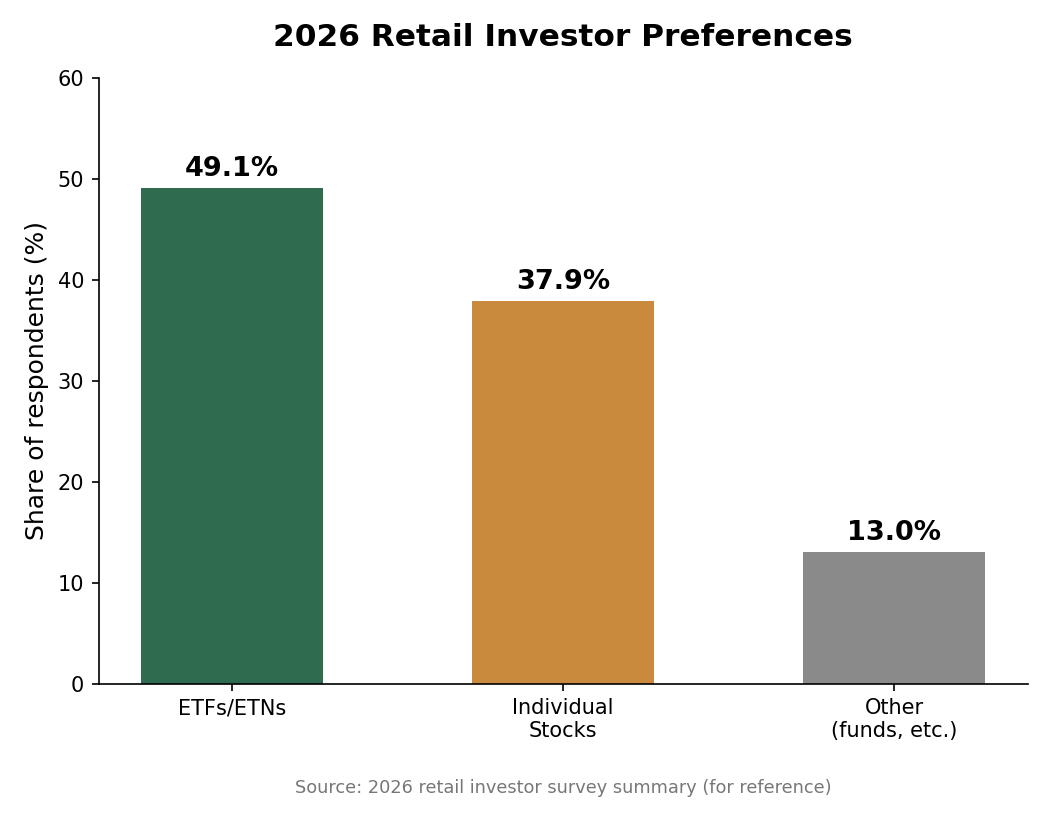
A 2026 survey of retail investors captured this shift clearly. Citing the difficulty of picking winning individual stocks, 49.1% of respondents said they planned to rely on ETFs or ETNs, compared to 37.9% who said they'd buy individual stocks directly.
With an individual stock, your returns hinge entirely on that one company's fate. An ETF spreads your money across many holdings, so bad news at any single company has a comparatively limited effect on your overall return. That said, when the broader market falls, an ETF tracking that market will fall too.
There's also a real difference in the time and effort required. Picking individual stocks means regularly digging into financial statements, industry trends, and competitor comparisons. An ETF, by contrast, already holds a diversified basket for you, which makes it a comparatively lower barrier to entry for newcomers.

Good to Know — How to Approach ETF Investing
ETFs aren't automatically "safe" just because they're diversified. A broad-market ETF like one tracking the KOSPI 200 tends to be less volatile, but sector-specific, thematic, leveraged, or inverse ETFs can swing just as much as individual stocks, sometimes more.
When choosing an ETF, it's worth checking a few things: the expense ratio (how much it costs to hold), the tracking error (how closely it actually follows its target index), and trading volume (whether you can buy and sell when you want to, at a fair price).
The ETF lineup has also expanded well beyond domestic stock indices, now covering overseas markets, bonds, and commodities. With that many options, it's worth reading the actual prospectus rather than assuming you know what's inside just from the fund's name.
You don't have to choose one approach exclusively, either. Plenty of investors use a broad-market ETF as their core holding and then add a handful of individual stocks in companies they've researched and believe in, combining both strategies.
'자산관리' 카테고리의 다른 글
| Asset Management :: What Exactly Is Futures Trading, and Why Is It Considered So (0) | 2026.07.30 |
|---|---|
| 자산관리 :: 선물거래, 대체 뭐길래 이렇게 위험하다고 할까요? 선물 투자 기초 총정리 (0) | 2026.07.30 |
| 자산관리 :: 요즘 개인투자자들, 왜 개별 종목 대신 ETF를 고를까요? 주식투자 기초 총정리 (0) | 2026.07.29 |
| Asset Management :: What Is a Real Estate Court Auction? A Beginner's Guide (1) | 2026.07.28 |
| 자산관리 :: 부동산 경매, 나도 도전할 수 있을까? 법원 경매 기초 총정리 (0) | 2026.07.28 |