2026. 7. 28. 10:28ㆍ자산관리
Hello everyone.
Today's post covers the basics of real estate court auctions, a topic under the asset management category.
Could buying a home at auction actually work for an ordinary person? It sounds intimidating, but the process follows a clear, court-supervised structure once you break it down. In this post, we'll walk through what a court real estate auction actually is, how the process works step by step, and what's happening in the market lately.
Before we start, a quick note: this post is general educational information meant to explain the concept, not investment advice or a recommendation to bid on any specific property. Any real bidding decision should be based on your own research and judgment.
What Exactly Is a Court Real Estate Auction
A court real estate auction happens when a borrower fails to repay a debt, and a creditor petitions the court to sell the property to recover what's owed. In plain terms, it's a property changing hands through the court system because the previous owner couldn't keep up with payments.
Unlike a regular sale, where a licensed agent helps negotiate a price between buyer and seller, an auction sets a date on which multiple bidders submit sealed bids, and whoever bids highest wins the property. That's exactly why auctions have a reputation for offering properties below typical market prices.
That said, chasing a low price alone can be risky. Bidders are responsible for checking the property's lien and title history themselves, as well as confirming who is actually living there — due diligence that goes well beyond what's needed in a standard purchase.
Because of this, many first-time bidders start by practicing on paper — analyzing listings without actually bidding — or studying books and courses before ever stepping into a real auction. Think of this post as a starting point for that same kind of groundwork.
The Auction Process and Key Terms to Know
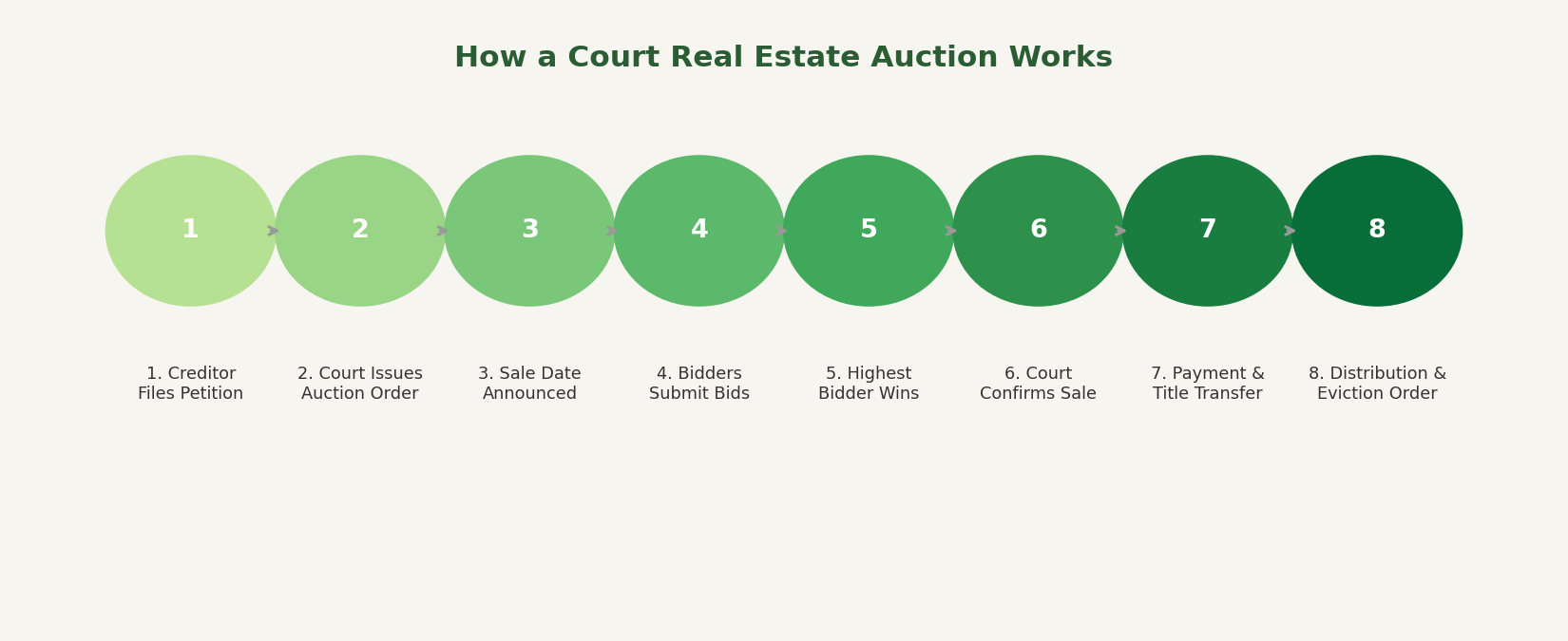
The process typically runs as follows: a creditor files a petition, the court issues an auction order, a sale date is announced, bidders submit their bids, the highest bidder is selected, the court confirms the sale, the winning bidder pays and receives title, and finally the proceeds are distributed to creditors. It looks like a lot of steps, but the core flow is simple — petition, announcement, bidding, award, payment, distribution.
To bid, you typically need to deposit around ten percent of the minimum sale price as a good-faith deposit. If you don't win, you get it back in full. But if you win and then fail to pay the remaining balance, you can lose that deposit — so having your financing sorted out ahead of time really matters.
After winning, there's still a step called eviction, or clearing the property of its current occupants — whether that's the original borrower or a tenant. Ideally this happens through a straightforward agreement, but if it doesn't, the winning bidder can request an eviction order from the court to proceed with a legal handover.
Winning the bid isn't the finish line — the property isn't truly yours until the eviction step is complete. This is one of the parts first-time bidders most often underestimate, both in terms of time and cost.

What the 2026 Auction Market Looks Like Right Now
Recent reporting suggests the 2026 auction market is seeing both rising volume and intensifying competition at the same time. Analysts point to properties being pushed into auction as owners struggle with high interest payments, and Seoul apartment auction success rates reportedly hit their highest level in four years.
What's notable is that even as overall volume increases, popular listings are drawing an outsized share of bidders — a kind of extreme polarization in the market. Investors looking to sidestep tighter government regulations on regular property purchases appear to be funneling demand into specific auction segments instead.
This trend pushes back on the common assumption that auctions are always a way to buy property cheap. In fact, popular listings are increasingly selling near or even above typical market value once competitive bidding kicks in.
Because of this, more analysts are recommending a segmented approach — looking closely at specific regions and property types rather than chasing low prices across the board. Understanding the current market mood before setting your own criteria matters more than ever right now.

How It Differs From a Regular Sale, and What to Check First
The biggest difference between a regular sale and an auction comes down to who bears the risk. In a standard sale, an agent verifies the title and ownership details, and can share some responsibility if something goes wrong. In an auction, the buyer alone is responsible for checking the property's legal status — and for any issues that surface afterward.
That's why, before bidding, it's essential to review the property registry for mortgages, liens, and lease rights, and to confirm whether any of those rights survive the sale and transfer to the new owner. This step is often called title analysis, and it's arguably the single most important skill in auction investing.
On-site inspection matters just as much. A property can look fine on paper but tell a very different story in person, and understanding who's currently living there ahead of time can save a lot of unexpected delays during the eviction process.
Above all, everything in this post is general information meant to explain how auctions work — not a recommendation to bid on any particular property. If you're seriously considering it, take the time to thoroughly review title risk and your financing plan, and consider consulting a professional where needed.
'자산관리' 카테고리의 다른 글
| Asset Management :: Why Are More Retail Investors Choosing ETFs Over Individual (0) | 2026.07.29 |
|---|---|
| 자산관리 :: 요즘 개인투자자들, 왜 개별 종목 대신 ETF를 고를까요? 주식투자 기초 총정리 (0) | 2026.07.29 |
| 자산관리 :: 부동산 경매, 나도 도전할 수 있을까? 법원 경매 기초 총정리 (0) | 2026.07.28 |
| 자산관리 :: 전세와 월세, 전월세전환율은 어떻게 계산될까요? 부동산 임대차 기초 총정리 (0) | 2026.07.26 |
| Asset Management :: What Exactly Is a Stablecoin? Crypto Basics and Korea's New (0) | 2026.07.25 |