2026. 7. 25. 19:59ㆍ취미생활/축구

Hello everyone.
Today's post is about the UEFA European Championship, the stage where Europe crowns its strongest football nation.
Have you ever heard people say the Euros are actually tougher to win than the World Cup?
Europe is home to one of the highest concentrations of strong football nations on the planet, so simply qualifying for the Euros is no small feat. Outside of a handful of South American powerhouses, most of the FIFA top-ranked teams are packed into this one continent.
That's why the Euros, even though the tournament is smaller in scale than the World Cup, are often praised for the sheer intensity of every single match. Today we'll walk through how the Euros began, which nations have reached the top, and how the tournament format has changed over the decades.
Origins and History
The story of the Euros goes back to 1960. Back then the tournament wasn't even called the European Championship yet — it launched under the name the European Nations Cup, and in the first-ever final, played in Paris, the Soviet Union defeated Yugoslavia 2-1 to become the inaugural champion.
Interestingly, when the competition was first being discussed, there was reportedly a fair amount of skepticism within UEFA itself. With the Olympic football tournament and domestic leagues already in place, some wondered whether a separate continental national-team competition was even necessary.
But Henri Delaunay, then president of the French Football Federation, kept pushing for the tournament to be created, and his name lives on today in the Euro trophy itself, known as the Henri Delaunay Cup. Delaunay passed away in 1955, before the tournament he championed was actually held, so he never got to see that first final in person.
The tournament was officially renamed the UEFA European Championship starting with the 1968 edition, and the number of participating nations kept growing from there. That first 1960 tournament was a mini four-team event after qualifying, but today's Euros have grown into a massive competition with more than 50 nations entering qualification.

Key Facts: Champions and Memorable Moments
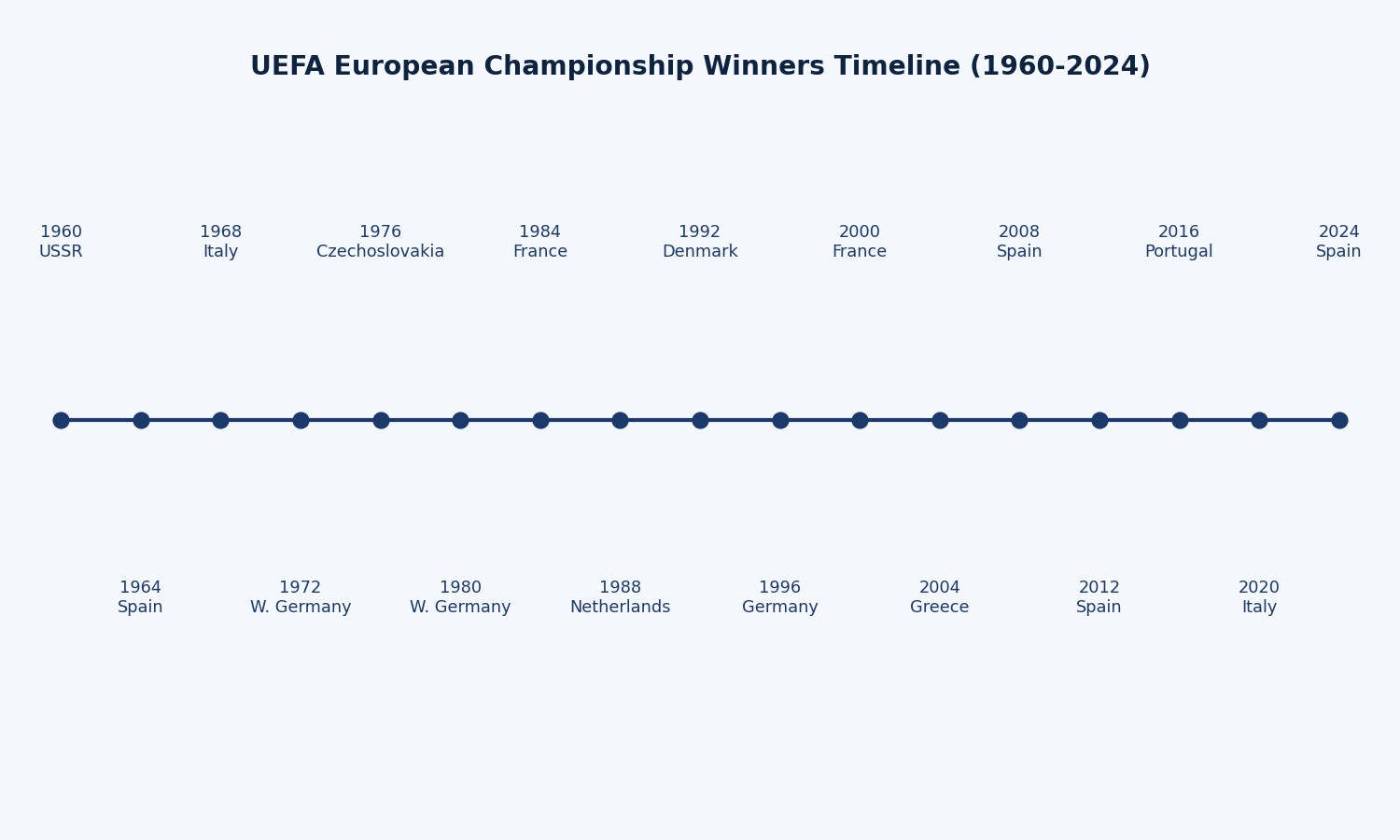
Spain holds the record for the most Euro titles in history. After their first win in 1964, they went on to lift the trophy again in 2008, 2012, and 2024 for a total of four titles, and their 2008-2012 stretch of Euro-World Cup-Euro is a feat no other nation has matched.
Germany (including the former West Germany) sits just behind with three titles, won in 1972, 1980, and 1996. France and Italy have each won twice as well, so for most of the tournament's history the trophy has stayed within Europe's traditional football powers.
But part of what makes the Euros so beloved is its history of stunning upsets. In 1992, Denmark were only added to the tournament at the last minute after Yugoslavia was disqualified due to the ongoing conflict there, yet they went on to win the entire thing — one of the most remarkable underdog stories in football history.
Greece's 2004 triumph deserves a mention too. Barely considered a contender before the tournament, Greece rode Otto Rehhagel's pragmatic tactics all the way to the final, where they beat host nation Portugal for a stunning title. These two stories are still cited today as the ultimate symbols of Euro upsets.
In 2016, Portugal finally claimed their first title behind Cristiano Ronaldo, even though Ronaldo himself was substituted early in the final due to injury — he spent the rest of the match cheering on his teammates from the sideline, a moment that's still remembered fondly by fans.

Format Changes and Good to Know
The number of teams competing in the Euro finals has grown steadily over the decades. From 1960 to 1976 only 4 nations made the finals, that expanded to 8 starting in 1980, then to 16 from 1996, and finally to the current 24-team format starting with the 2016 tournament in France.
As the field grew, qualification also became more complex. Nations now go through group-stage qualifiers, with final spots determined by group standings combined with playoffs tied to Nations League performance. That means Euro qualifying is nearly as long a journey as World Cup qualifying, stretching close to two years.
One thing that sets the Euros apart from the World Cup is how often hosting duties are shared between multiple countries rather than a single nation. Belgium and the Netherlands co-hosted in 2000, Austria and Switzerland in 2008, Poland and Ukraine in 2012, and the 2020 tournament (delayed to 2021 due to COVID-19) went even further, spreading matches across 11 different host countries.
The Euros are also often seen as more competitively dense than the World Cup. Since European clubs face each other regularly in competitions like the Champions League, national teams tend to know each other's tactics inside and out, which some analysts point to as a reason upsets happen more frequently here.