2026. 7. 23. 13:23ㆍ취미생활/골프
Hello everyone.
Today I'll be writing about how the golf handicap system actually works.
Have you ever wondered exactly how your handicap number gets calculated?
If you play golf regularly, you've probably been asked "what's your handicap?" more times than you can count, yet many players have never really looked into how that number is worked out.
Handicaps used to be calculated differently depending on the country or association, but today the whole world uses a single standard. Let's take a look at the background and how it actually works.
Origins
For a long time, handicap calculations varied widely from country to country. The US had the USGA system, the UK had CONGU, Europe had the EGA, and altogether six separate regional handicap systems were in use worldwide.
Because the standards differed, comparing handicaps across countries, or even for international competitions, was often confusing.
To solve this, golf's two governing bodies, the R and A and the USGA, reportedly began discussing a unified system back in 2011. After nearly eight years of preparation, the World Handicap System (WHS) officially launched in January 2020.
Since WHS was introduced, handicaps are calculated on the same standard no matter where in the world you play, which has reportedly made it much easier for golfers to compare their ability fairly.

Key Facts
To understand how a handicap is calculated, it helps to know a few key terms first.
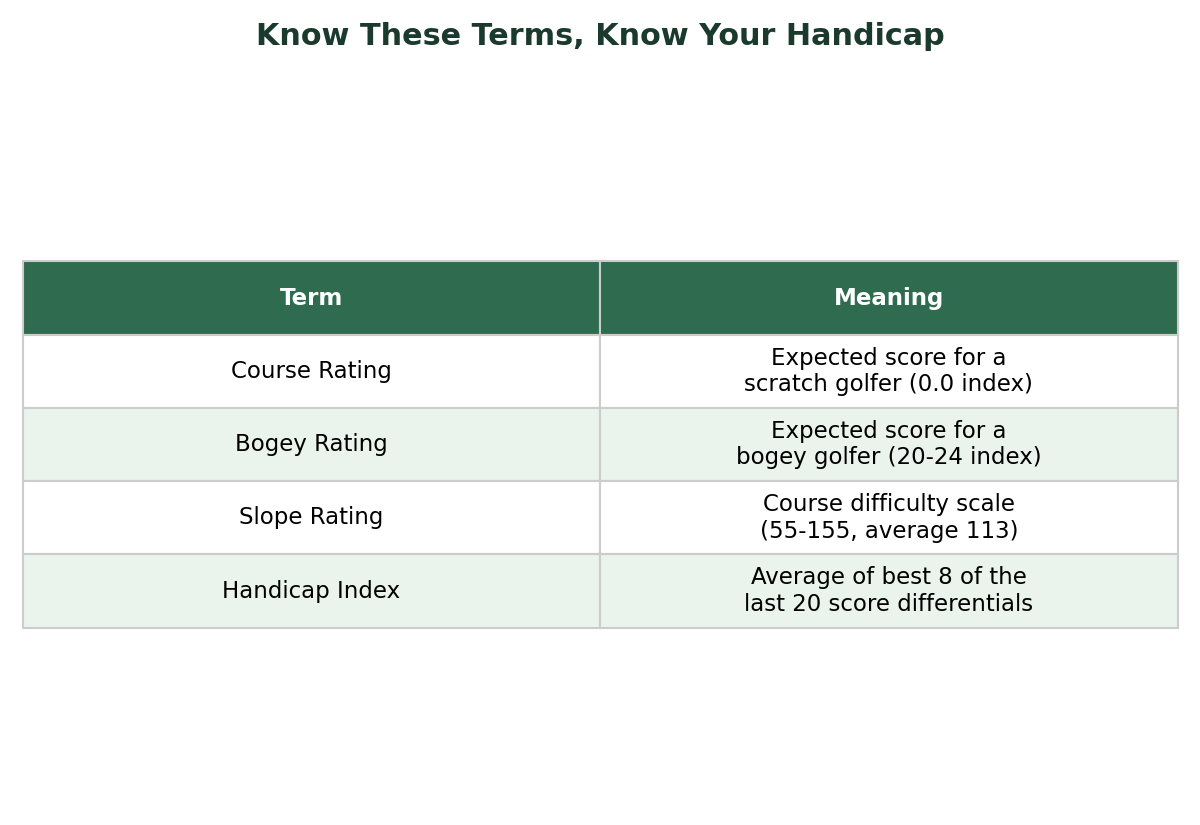
"Course Rating" is the expected score for a scratch golfer (handicap 0.0) on a given course, while "Bogey Rating" is the expected score for a bogey golfer (roughly 20.0 to 24.0 handicap).
The difference between these two numbers is used to calculate the "Slope Rating," which measures how difficult a course is relative to other courses. Slope Rating ranges from 55 to 155, with a course of standard difficulty set at 113.
Your actual "Handicap Index" is calculated as the average of your best 8 "Score Differentials" from your last 20 rounds. A Score Differential is worked out by taking your adjusted gross score, subtracting the Course Rating, and adjusting the result using the Slope Rating.
That Handicap Index is then converted into a "Course Handicap" for the specific course and tees you're playing that day, based on that course's own Slope Rating and Course Rating. Two golfers with the same Handicap Index can end up with different Course Handicaps if one course is tougher than the other.

Good to Know
A handicap isn't just a number that shows "how good you are" — it's also a mechanism that adjusts scores so that golfers of different skill levels can compete fairly against each other.
That's why amateur tournaments and casual rounds often rank players by "Net Score," which applies each player's handicap, letting golfers of very different abilities enjoy a competitive round together.
To register an official handicap, you typically need to consistently record and submit your round scores through a golf association or club. These days, more golfers are reportedly using score-tracking apps to calculate and manage their handicap more easily.
That said, the exact registration process can vary somewhat by country or association, so it's best to check with your own golf association or club for the most accurate details.
'취미생활 > 골프' 카테고리의 다른 글
| Golf :: OB, Water Hazards, and Unplayable Balls — How Are Penalty Strokes Actual (0) | 2026.07.23 |
|---|---|
| 골프 :: OB와 워터해저드, 벌타는 어떻게 계산될까? 페널티 규정 총정리 (0) | 2026.07.23 |
| 골프 :: 내 핸디캡, 어떻게 계산되는 걸까? 핸디캡 시스템 경기 규칙 총정리 (0) | 2026.07.22 |
| Golf :: True Temper — How Did One Shaft Brand Take Golf From Wood to Steel? A Br (0) | 2026.07.21 |
| 골프 :: 트루템퍼, 골프 샤프트를 나무에서 스틸로 바꾼 브랜드는? 샤프트 브랜드 역사 총정리 (0) | 2026.07.21 |