2026. 7. 23. 13:23ㆍ취미생활/골프

Hello everyone.
Today's post is about one of the most confusing parts of golf out on the course: penalty stroke rules.
Unlike most sports, golf has no referee watching every shot. Players are expected to apply the rules and keep their own score, which means every golfer has to know, on the spot, exactly how many strokes a penalty costs and where play resumes.
This is where a lot of amateur golfers slip up, sometimes taking too little penalty, sometimes too much. The Rules of Golf are jointly written by the R&A and the USGA, and they have gone through several rounds of revisions in 2019 and again in 2023.
Do you know exactly where and for how many strokes you should replay a ball that goes out of bounds? Let's walk through the penalty rules step by step today.
The Basics: Stroke and Distance
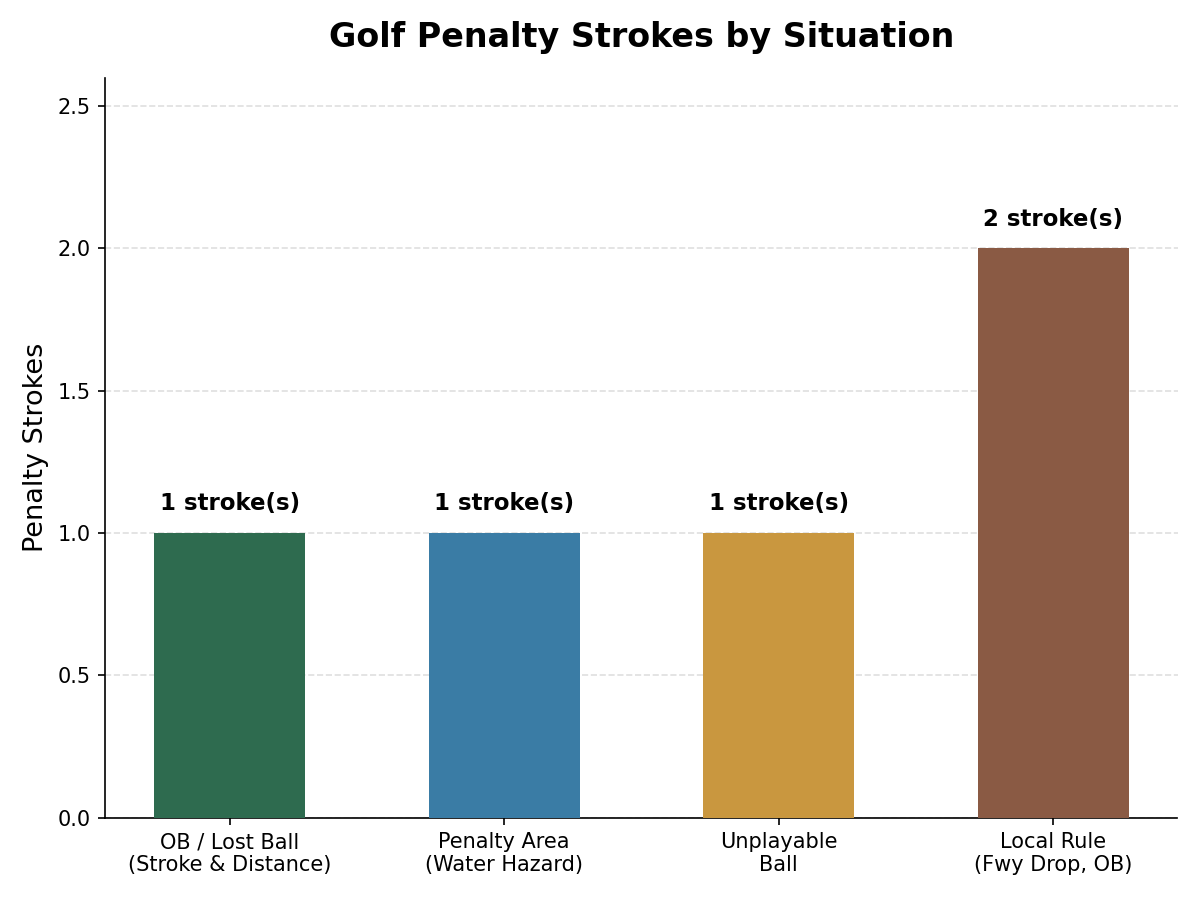
The foundation of golf's penalty system is the "stroke and distance" principle. It applies whenever a ball is lost or goes out of bounds (OB), and the name says it all: you lose both a stroke and the distance you had already gained.
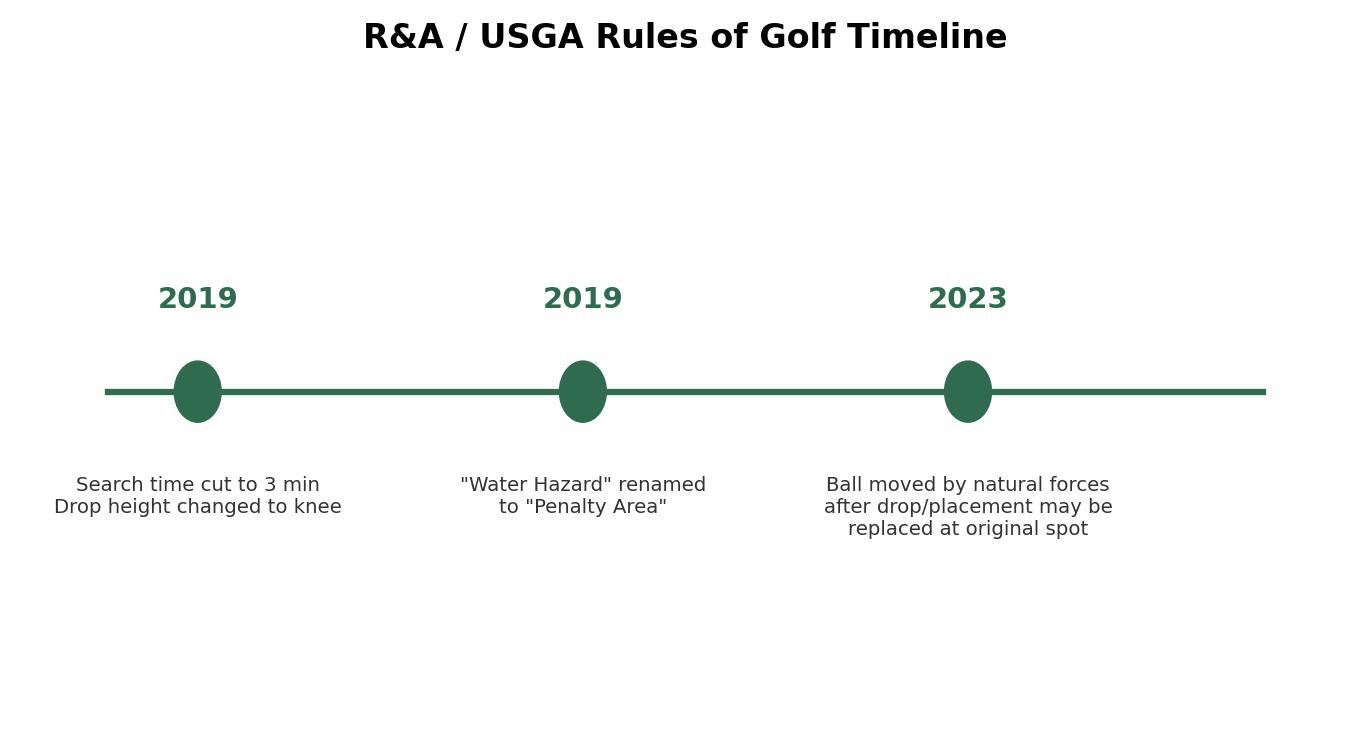
If a ball crosses an OB line, or simply cannot be found within the allotted three minutes (reduced from five minutes back in 2019), the player takes a one-stroke penalty and must go back to replay from the spot of the previous shot. A tee shot that goes OB means walking back to the tee; a fairway shot that goes OB means replaying from that same fairway spot.
This is why the penalty often feels heavier than a simple "one stroke." Between the added stroke and the fact that you're redoing a shot you already hit, the real-world cost is frequently closer to two strokes once you factor in the lost ground.
That's exactly why experienced players develop the habit of playing a provisional ball any time there's a real chance a shot might be OB or lost. We'll cover exactly how that works in the next section.
OB, Lost Balls, and Making the Most of a Provisional Ball
When a tee shot curves toward the trees, a lot of golfers just walk up and hope for the best. But if the ball turns out to be unfindable, that means a long walk all the way back to the tee, doubling your time on the hole. This is exactly the situation a provisional ball is designed for.
If your original ball might be lost outside a penalty area, or might be OB, you can announce to your group that you're playing a provisional ball and hit a second shot right away. That way, if you walk up and can't find the original, you don't have to trek all the way back — you simply continue with the provisional.
Keep in mind: if the original ball is found in bounds within the three-minute search window, you must continue play with the original ball, and the provisional is abandoned on the spot. If the original is lost or confirmed OB, you simply continue with the provisional, which already carries the one-stroke, stroke-and-distance penalty built in.
Some courses also run a local rule that allows a two-stroke penalty with a drop in the fairway area near where the ball went OB or was lost, instead of returning to the previous spot. This model local rule was introduced in 2019 specifically to speed up pace of play for recreational golfers, and it's generally not used in professional or elite amateur competitions — so it's worth checking the course's notice board before your round.
Penalty Areas, Unplayable Balls, and the Newest Rule Changes
Since the 2019 rules overhaul, the term "water hazard" has officially been replaced by "penalty area." That means the rule now covers not just ponds and streams but also deserts, jungle, or any zone a committee chooses to mark. Yellow stakes or lines mark a regular penalty area, while red stakes or lines mark a lateral penalty area.
If your ball ends up in a penalty area, you take a one-stroke penalty and choose from up to three relief options. First, replay from the spot of your previous stroke. Second, take relief by dropping on a line running back from the hole through the point where the ball last crossed the edge of the area. For a lateral (red-staked) penalty area, there's a third option: drop within two club-lengths of where the ball crossed the margin, no closer to the hole.
An unplayable ball, by contrast, is a call the player alone can make anywhere on the course except inside a penalty area. It costs one stroke, with the same three relief choices — stroke and distance, back-on-the-line relief, or two-club-length lateral relief — plus, if the ball is in a bunker, an extra option to take relief outside the bunker for a two-stroke penalty.
Dropping procedure has changed too. Since 2019, players drop from knee height instead of shoulder height, which keeps outcomes more consistent. And as of 2023, if a dropped or placed ball is moved afterward by natural forces like wind and rolls into another area or out of bounds, the player may now put it back at the spot where it originally came to rest — a rule that applies across unplayable ball relief, abnormal course condition relief in a bunker, and penalty area relief alike.
'취미생활 > 골프' 카테고리의 다른 글
| Golf :: How Did Jack Nicklaus Build His Record 18 Major Championships? A Legend's Story (0) | 2026.07.24 |
|---|---|
| 골프 :: 잭 니클라우스, 메이저 18승의 전설은 어떻게 만들어졌을까? 레전드 스타 총정리 (0) | 2026.07.24 |
| 골프 :: OB와 워터해저드, 벌타는 어떻게 계산될까? 페널티 규정 총정리 (0) | 2026.07.23 |
| Golf :: How Is Your Handicap Actually Calculated? A Look at the Handicap System (0) | 2026.07.23 |
| 골프 :: 내 핸디캡, 어떻게 계산되는 걸까? 핸디캡 시스템 경기 규칙 총정리 (0) | 2026.07.22 |