2026. 7. 20. 11:27ㆍ육아생활


Hello.
Today's post is about infant and toddler vaccinations.
Raising a baby comes with a long list of things to track, and vaccination schedules are near the top of that list. With so many vaccine names and timings to remember, it's easy for new parents to feel a bit lost.
So today, let's go over what the national immunization program covers, which vaccines are given at each stage, and what to keep in mind before and after each shot.
Do you know exactly what your baby's vaccination schedule looks like?
What Is the National Immunization Program?
In Korea, the National Immunization Program (NIP) is a government-funded vaccination system designed to protect children from a set of infectious diseases designated by the Korea Disease Control and Prevention Agency (KDCA).
It covers children from birth through age 12, and the vaccines are given free of charge at roughly 23,000 designated clinics and public health centers nationwide. The list includes BCG, Hepatitis B, DTaP, Polio, Hib, pneumococcal, rotavirus, MMR, varicella, Japanese encephalitis, Hepatitis A, and HPV, among others.
Vaccines generally fall into two categories: live attenuated vaccines, which use a weakened form of the live pathogen, and inactivated vaccines, which use a killed pathogen or just a piece of it. This distinction affects dosing intervals and whether a vaccine can be safely given alongside others.
Parents in Korea can track their child's vaccination history through the KDCA's immunization support website or app, which makes it much easier to stay on top of upcoming doses.
The Vaccination Timeline, Stage by Stage
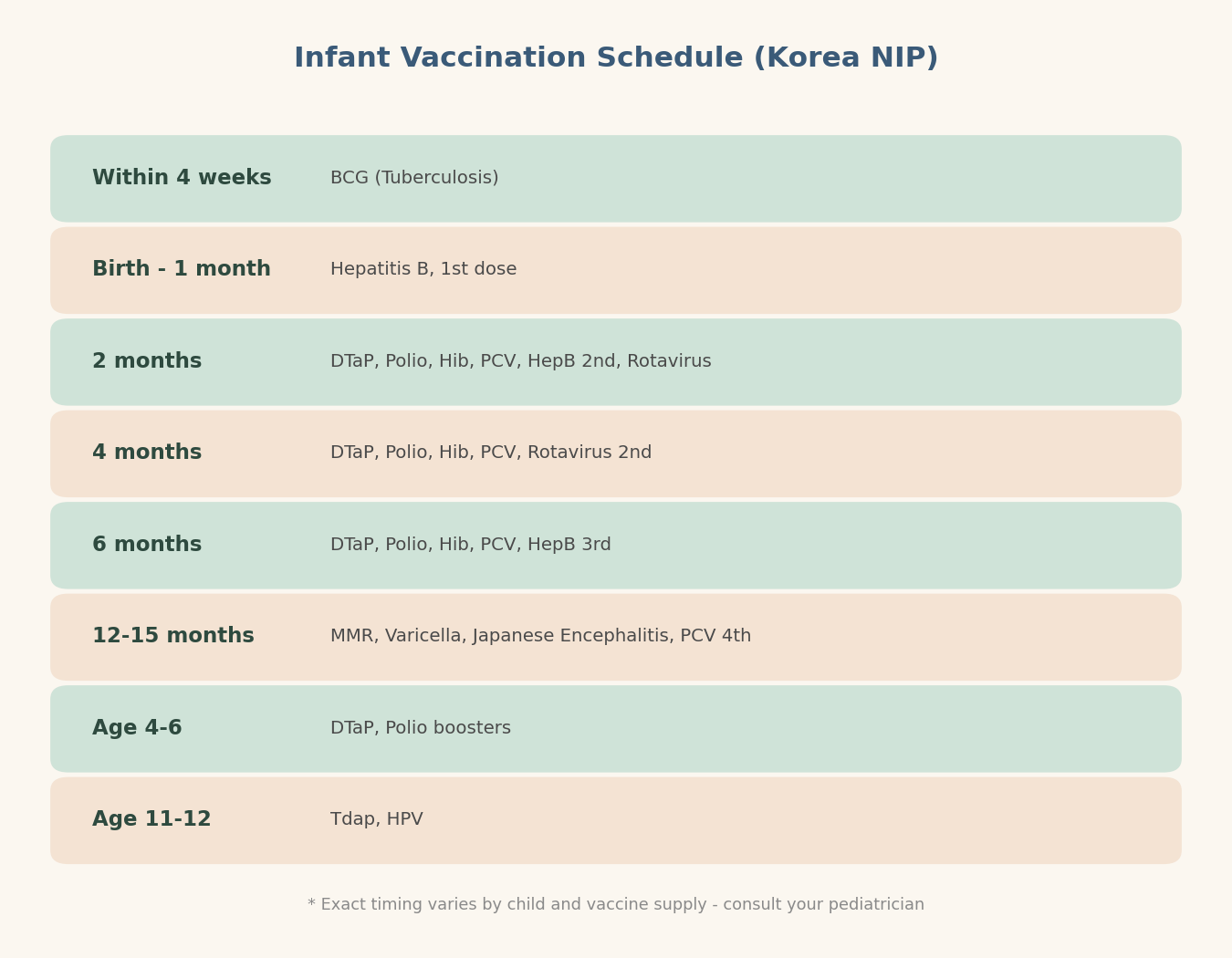
The very first vaccine most babies receive is BCG, ideally within the first four weeks of life. It protects against tuberculosis.
Starting at 2 months, babies begin receiving several vaccines at once, including DTaP, polio, Hib, pneumococcal, and rotavirus. This is often the stretch parents find most overwhelming, since visits become frequent and each visit can involve multiple shots.
Around 12 to 15 months, MMR (measles, mumps, rubella), varicella, and Japanese encephalitis vaccines are introduced. By this point, most of the primary series is complete and the focus shifts toward booster doses.
At ages 4-6 and again at 11-12, children receive DTaP/polio boosters and then Tdap/HPV respectively — a good reminder that vaccination isn't just an infant-stage task, but continues well into the school years.
Good to Know: Before and After the Shot
Before a scheduled vaccination, check your baby's condition first. If there's a fever or cold symptoms, it's safer to postpone and talk to your pediatrician.
On the day of the visit, bring the vaccination record and insurance card, and mention any past reactions to previous shots so the doctor can plan accordingly.
After the shot, it's recommended to stay at the clinic for 15-20 minutes so staff can watch for acute reactions like anaphylaxis. Over the following 24-48 hours, keep an eye out for fever or rash.
If a high fever persists, or if seizures or significant swelling occur, seek medical attention right away. Most reactions are mild and pass quickly, but staying alert for the rare serious ones is worth the extra attention.
Is Getting Multiple Shots at Once Really Safe?
Many parents worry about co-administering several vaccines in a single visit. Health authorities like the KDCA and pediatric associations generally state that following the recommended schedule, including combined visits, is safe — and that delaying vaccines can actually increase a child's window of exposure to disease.
That said, depending on a child's health status or medical history, the order or spacing of certain vaccines may need to be adjusted. If you have any concerns, it's always best to discuss them directly with your pediatrician.
'육아생활' 카테고리의 다른 글
| Parenting :: Do Babies Really Need Vitamins? A Guide to Vitamin D, Iron, and Pro (0) | 2026.07.21 |
|---|---|
| 육아 :: 우리 아이 영양제, 꼭 챙겨야 할까요? 비타민D·철분·유산균 가이드 (0) | 2026.07.21 |
| 육아 :: 영유아 예방접종, 시기별로 언제 맞춰야 할까요? 예방접종 총정리 (0) | 2026.07.20 |
| Parenting :: How Should You Choose the Right Stroller for Your Baby? A Buying Guide (0) | 2026.07.19 |
| 육아 :: 유모차 고르기, 어떤 기준으로 봐야 할까요? 육아용품 총정리 (0) | 2026.07.19 |