2026. 7. 17. 12:40ㆍ취미생활/축구
Hello everyone.
Today's post is about the brand history of one of the most legendary clubs in football: Real Madrid.
Did you know the word "Real" wasn't actually part of the club's original name? It was added later, and the story behind it involves the Spanish royal family.
Real Madrid competes in La Liga, Spain's top football division, and holds the record for the most European Cup/Champions League titles in history. Over more than a century, the club has moved through highs and lows, gradually building the image of a footballing dynasty.
Let's walk through Real Madrid's history, from its founding to its record 15th Champions League title.
Origins and the Royal Title
Real Madrid's story begins in 1902. A group of football enthusiasts, including Juan Padros, officially founded the club under the name Madrid Football Club.
At the time, the club didn't yet carry the word "Real," meaning "Royal" in Spanish. That title was granted in 1920 by King Alfonso XIII, giving the club its now-famous name, Real Madrid CF.
Carrying the royal name gave the club both symbolic weight and prestige, which is often credited with helping it expand its influence beyond Spain and across Europe in the decades that followed.
However, the club's early years weren't filled with glory. During the Spanish Civil War (1936-1939), its home ground, the Chamartin stadium, was heavily damaged, and the club went through a genuinely difficult period.

The Bernabeu Era and Five Straight European Cups
The most important turning point in the club's history came in 1943, when Santiago Bernabeu became club president. He would go on to lead Real Madrid for 35 years, transforming it into a global powerhouse.
Bernabeu rebuilt the stadium and training facilities destroyed during the civil war, and signed some of the era's greatest players, including Alfredo Di Stefano, Ferenc Puskas, and Raymond Kopa, forming a star-studded lineup that's often seen as the original blueprint for the modern Galacticos.
The results were extraordinary: Real Madrid won the European Cup (today's UEFA Champions League) five years in a row, from 1956 to 1960. That record has never been matched by any club since.
In 1955, the club's newly built stadium was renamed Estadio Santiago Bernabeu in his honor, a name still in use today.

The Galacticos Era and Real Madrid Today
In the 2000s, club president Florentino Perez revived the star-studded strategy of the Bernabeu era in a modern form. Under his so-called "Galacticos" policy, the club signed a string of global superstars including Luis Figo, Zinedine Zidane, Ronaldo, and David Beckham.
This period also marked significant commercial growth, cementing Real Madrid's position as one of the most followed clubs in the world. In the years that followed, stars like Cristiano Ronaldo and Karim Benzema continued to lead the club to consistent success.
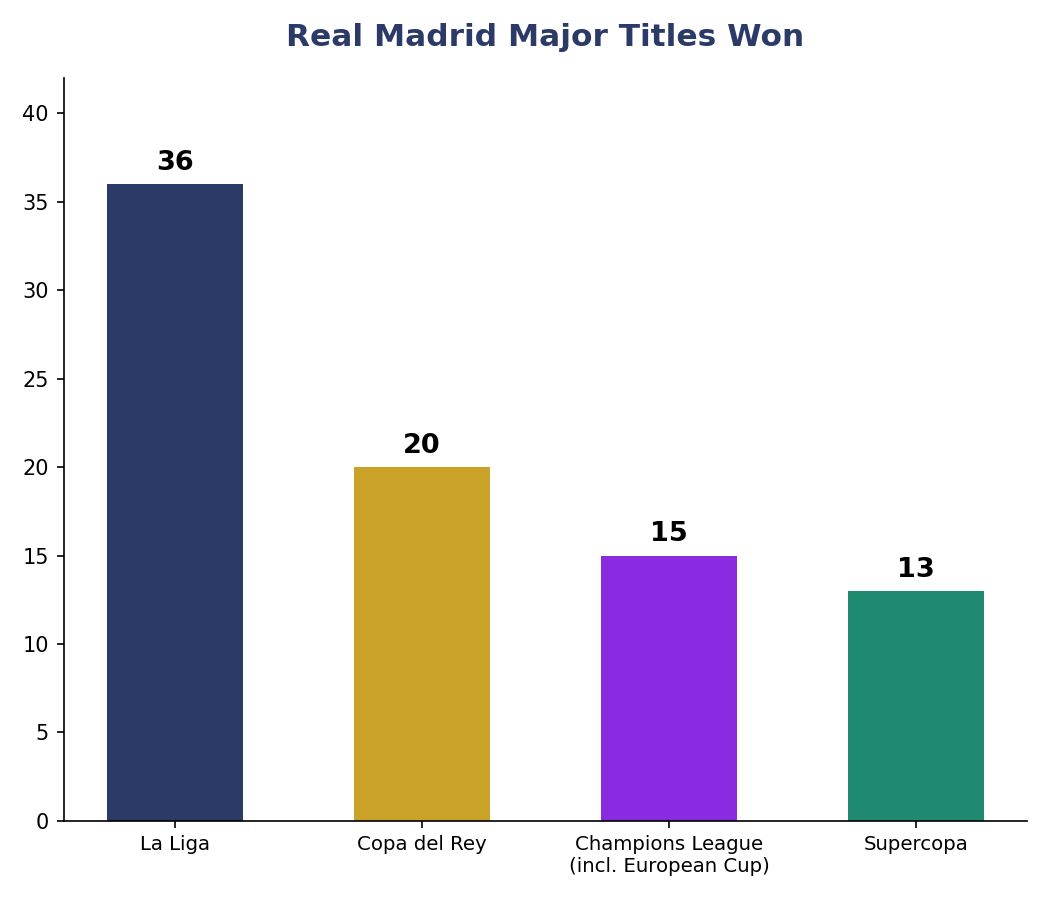
Between 2016 and 2018, Real Madrid won three consecutive UEFA Champions League titles, and in 2024, the club lifted its 15th European title overall, extending its record as the most successful club in the competition's history.
In domestic competition, Real Madrid also holds the record for the most La Liga titles, with 36 championships, along with 20 Copa del Rey titles.
Good to Know
Real Madrid's trophy count is often compared to other historic clubs. In particular, its 15 European Cup/Champions League titles put it well ahead of any other club in the competition's history.
The club is also known as one of the few in Spanish football to have never been relegated from the top division since its founding, maintaining its place among the elite for over a century.
The club's nickname, "Los Merengues," is widely believed to come from its all-white kit, said to resemble the color of meringue. That white kit has remained the club's core identity with little change since its earliest days.