2026. 7. 16. 09:34ㆍ취미생활/축구
Hi everyone.
Today's post is about one of the biggest international soccer competitions on the planet: the FIFA World Cup.
Did the very first World Cup look anything like the massive 48-team tournament we know today? The answer might surprise you.
The World Cup isn't just a soccer competition. Over nearly a century, it has grown and changed alongside major shifts in world history.
The tournament has even been cancelled outright because of war, and its number of participating teams has grown from just 13 to 48. Let's walk through how that happened.

Origins: The First World Cup in 1930
The first FIFA World Cup was held in 1930 in Uruguay, in South America. Unlike today, there was no regional qualification process. FIFA simply invited a number of national teams to take part.
Uruguay was chosen as host for good reason. The Uruguayan national team had won back-to-back Olympic soccer titles in 1924 and 1928, and the country was also celebrating the 100th anniversary of its independence, making it a fitting moment for a major international event.
In the end, only 13 teams took part in that inaugural tournament. Many European teams were reluctant to make the long ocean crossing to South America, so the field ended up dominated by teams from the Americas.
The final was an all-South American affair between host Uruguay and neighboring Argentina, with Uruguay winning 4-2 to become the first-ever World Cup champion. That victory helped establish the tradition of holding the tournament every four years.
How the Tournament Grew Over Time
The 1934 World Cup in Italy introduced a major change: a qualification stage. As more nations wanted to compete, FIFA needed a system to narrow the field before the tournament itself.
Interestingly, defending champion Uruguay didn't even show up in 1934. The story goes that Uruguay was still upset over the poor European turnout at their own tournament in 1930, and to this day, it remains the only time a defending champion skipped the following World Cup.
The World Cup also went through a dark period. World War II forced the cancellation of the 1942 and 1946 tournaments entirely, and the competition didn't resume until 1950 in Brazil. That edition marked England's first-ever World Cup appearance, worth remembering as well.
For decades after that, the tournament stuck with a 16-team format, until the 1982 World Cup in Spain became the first to expand to 24 teams. More teams meant more groups and more matches overall.
The expansion didn't stop there. Starting with the 1998 World Cup in France, the tournament grew to 32 teams, a format that remained unchanged for 24 years all the way through the 2022 Qatar World Cup, becoming the version most fans today grew up watching.
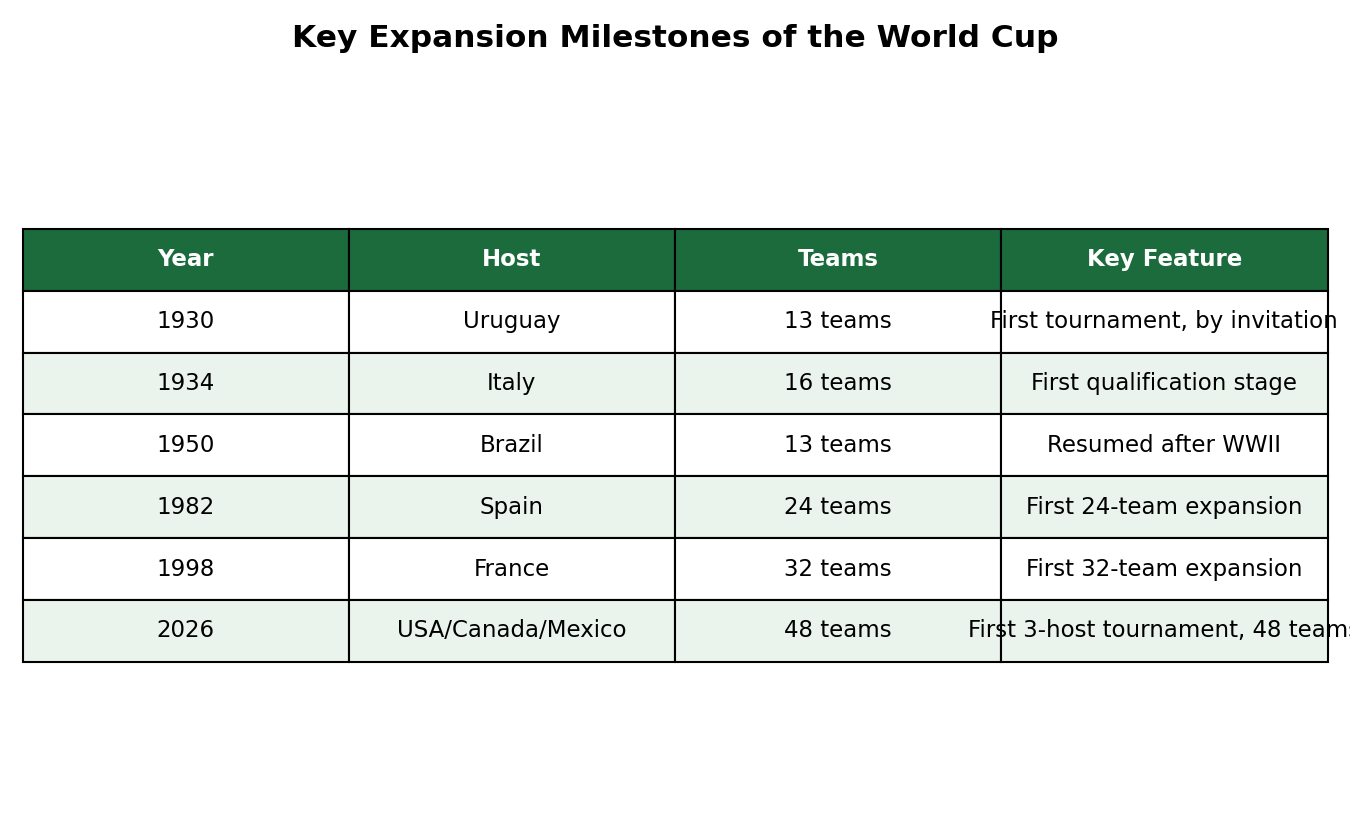
And in 2026, the World Cup expands once again, this time to a historic 48 teams. This edition also sets a new record as the first World Cup to be jointly hosted by three countries: the United States, Canada, and Mexico.
Good to Know
The road to the World Cup finals is a long one. More than 200 national football associations take part in qualifying matches across Asia, Europe, Africa, South America, North and Central America, and Oceania, and this process usually takes close to two years. In other words, the tournament we watch is really the end result of years of competition around the globe.
Hosting a World Cup also leaves a lasting mark on a country's economy and infrastructure. New or renovated stadiums, expanded transportation networks, and other improvements are often built specifically for the tournament, and these facilities frequently continue to serve local sports culture long after the final whistle.
As the number of teams has grown, the tournament format has been repeatedly adjusted as well. The familiar 32-team format used eight groups followed by a round of 16, but the 2026 edition with 48 teams is set to introduce a new group stage structure with 12 groups instead.
The sheer scale of global viewership is hard to overstate. The final alone is reported to draw hundreds of millions of viewers worldwide, making the World Cup, alongside the Olympics, one of the most widely shared sporting events on the planet. Exact viewership figures vary by source, so it's best to treat any single number with some caution, but the scale itself is well documented.

Wrap-Up
The FIFA World Cup began in 1930 as a small 13-team event, and through the introduction of qualifying rounds, a wartime hiatus, and expansions to 24 and then 32 teams, it has steadily grown into the 48-team tournament we'll see in 2026. Each step along the way reflects both the growth of global soccer and the broader currents of world history.
The 2026 tournament, co-hosted by the United States, Canada, and Mexico, will set a new record for the most participating nations ever, and the new group stage format combined with more matches should bring plenty of fresh storylines. It'll be worth keeping an eye on how the World Cup continues to evolve from here.
#WorldCup #FIFAWorldCup #Soccer #WorldCupHistory #InternationalTournament #Uruguay #1930WorldCup #WorldCupTeams #2026WorldCup #NorthAmericaWorldCup #SoccerHistory #SportsTrivia #NationalTeam #WorldCupQualifiers #QatarWorldCup #WorldCupExpansion #SoccerFans #SportsEvent #FootballHistory #InternationalCompetition #WorldCupFacts #SoccerCulture
'취미생활 > 축구' 카테고리의 다른 글
| 축구 :: 레알 마드리드는 어떻게 축구 역사상 최고 명문 구단이 됐을까? 브랜드별 역사 총정리 (0) | 2026.07.17 |
|---|---|
| 축구 :: 월드컵은 어떻게 13개 팀에서 48개 팀 대회로 커졌을까? 국제대회 총정리 (0) | 2026.07.16 |
| Soccer :: How Did Messi Become the Greatest Legend in Football History? (0) | 2026.07.13 |
| 축구 :: 메시는 어떻게 축구 역사상 최고의 자리에 올랐을까? 레전드 스타 총정리 (0) | 2026.07.13 |
| Soccer :: Maradona — How Did the Hand of God and the Goal of the Century Happen in the Same Match? (0) | 2026.07.12 |