2026. 7. 16. 20:04ㆍ육아생활
Hello.
Today I want to talk about early brain development in babies and toddlers, in the Parenting category.
How fast is your baby's brain actually growing right now? It's a question that crosses many parents' minds, especially once the newborn stage passes and your little one starts reacting faster, smiling more, and showing new expressions almost every week. Today I'd like to walk through what's actually happening inside a young child's brain during this stage, and what parents can realistically do about it day to day.
Brain development isn't decided by one magic supplement or one clever toy. It's generally understood as a combination of sleep, nutrition, play, and interaction working together. So in this post, I'll cover the basic science behind early brain development, then move into concrete daily habits you can actually build into your routine.
Origins: Why the First Three Years Matter
Many child development resources describe the period up to around 36 months of age, roughly the first three years, as a particularly important stage for brain development. During this window, a child's brain is said to grow rapidly, with sensory and motor areas developing especially quickly.
This period is often referred to as a "critical period" or "golden window," because the experiences a child has during this time are believed to shape how neural circuits get organized going forward. That said, this doesn't mean missing something during this window causes irreversible harm. The brain continues developing well beyond age three — this stage is better understood as a period of heightened sensitivity to experience, rather than a strict deadline.
A chart can make this easier to visualize. As shown in the image below, synaptic density, meaning the number of connections between brain cells, is generally described as rising sharply in early childhood before gradually being refined over time. Understanding this pattern can help parents feel a bit more relaxed about each developmental stage.

Key Facts: Synapse Formation and Pruning
According to neuroscience resources, early childhood is marked by an explosive period of synapse formation between neurons, sometimes called synaptogenesis. During this stage, every sight, sound, and touch a child experiences is thought to contribute to forming new neural connections.
Interestingly, not all of these synapses stick around. Around age two to three, synapse numbers are said to peak, after which a process called "pruning" begins — frequently used connections are strengthened, while rarely used ones are gradually weakened and removed. This is often summarized with the phrase "use it or lose it."
Understanding this principle helps explain why repetition and varied stimulation matter so much. A child repeating the same game or hearing the same words again and again might look boring from the outside, but that repetition may actually be reinforcing important neural connections.
It's also worth remembering that this process plays out differently for every child, so there's no need to compare your child's pace against others. Developmental speed naturally varies from child to child.
Good to Know: Daily Habits That Support Brain Development
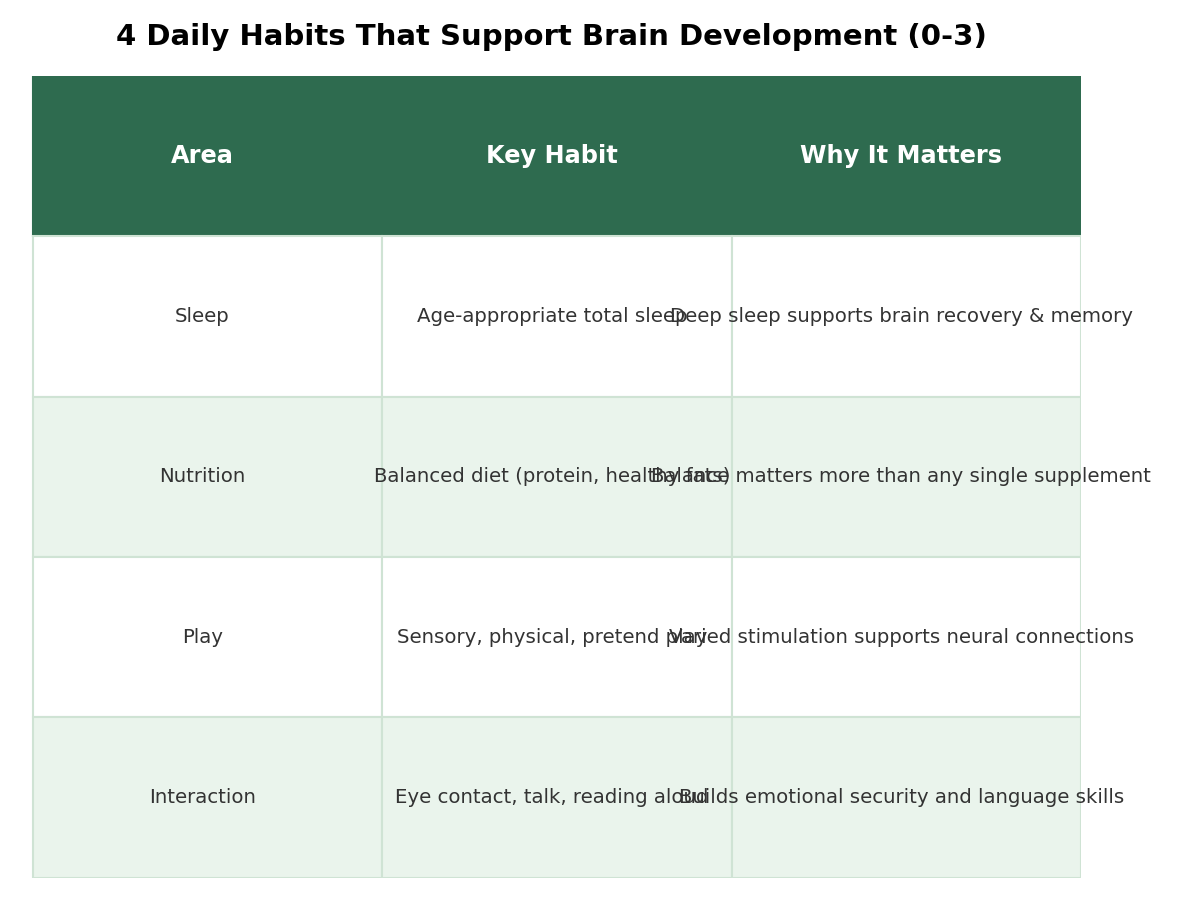
So what can parents actually do day to day? Experts consistently emphasize basic daily habits over specialized programs or expensive tools. First is sleep. Getting enough age-appropriate sleep is said to play an important role in helping the brain process and consolidate the day's experiences.
Second is nutrition. Rather than chasing any single supplement marketed as a brain booster, a balanced diet with adequate protein and healthy fats is the more solid foundation. During the weaning and toddler food stages, exposing your child to a wide variety of foods is generally considered helpful.
Third is play. Sensory play, physical play, and pretend play are each thought to stimulate different areas of the brain. You don't need expensive toys — stacking and knocking down blocks, or simply moving around and being active, can provide plenty of stimulation.
Finally, interaction. Making eye contact, talking, and reading aloud are said to support not just emotional security but also the foundations of language development. I've summarized these four areas in the table below.
Good to Know: A Few Cautions Worth Remembering
One thing worth emphasizing is just how much individual variation exists in child development. Parenting information often comes with rigid milestones like "your child should be doing X by this month," but these benchmarks are general tendencies, not strict rules.
If you have concerns about your child's development, or notice a difference compared to peers that feels significant, it's worth speaking with a pediatrician rather than relying only on information found online. Regular well-child checkups are also a good opportunity to catch any developmental concerns early.
You'll also come across plenty of exaggerated marketing claims — products promising to boost your child's IQ or transform their brain overnight. It's worth staying skeptical of any single product claiming dramatic effects on intelligence or development. Consistent, basic daily habits tend to matter far more in the long run.
'육아생활' 카테고리의 다른 글
| Parenting :: How Does a Child's Height Actually Grow? Growth Plates, Growth Hormone, and Daily Habits Explained (0) | 2026.07.17 |
|---|---|
| 육아 :: 아이 키, 어떻게 자랄까? 성장판과 성장호르몬, 생활습관까지 총정리 (0) | 2026.07.17 |
| 육아 :: 0~3세 뇌발달 골든타임, 아이 뇌 속에서는 무슨 일이 일어날까? 뇌발달 총정리 (0) | 2026.07.16 |
| Parenting :: 3 Must-Have Newborn Essentials — What Should You Look For? (0) | 2026.07.14 |
| 육아 :: 신생아 필수 육아용품 3가지, 고르는 기준은? 육아용품 총정리 (0) | 2026.07.14 |