2026. 7. 13. 07:21ㆍ자동차
Hello everyone.
Today's post is about one of the more exciting pieces of EV future technology: wireless charging.
What if you could charge your EV just by parking, with no cable at all?
As someone who works on charging systems for electrified equipment, I've been keeping an eye on how close wireless charging actually is to real-world deployment. Let's go over how it works and where the standards stand today.
How does wireless charging actually work
EV wireless charging generally falls into two categories. The first is inductive coupling, which transfers power through closely spaced coils, similar in principle to how a phone charges wirelessly.
The second is magnetic resonance, which uses a specific resonant frequency to transfer power even when alignment isn't perfect. Because it tolerates parking misalignment better, magnetic resonance has become the leading approach for automotive applications.

SAE J2954, the standard shaping the industry
The most frequently referenced standard in this space is SAE J2954. It defines interoperability, electromagnetic compatibility, safety, and testing requirements for wireless power transfer (WPT) in light-duty EVs.
Today it defines three power classes, from WPT1 (about 3.7 kW) up to WPT3 (about 11 kW), with discussions reportedly underway to extend future revisions toward 22 kW. A separate track, SAE J2954/2, is also being developed for heavier vehicles like buses and commercial trucks.

Beyond parked charging: charging while driving
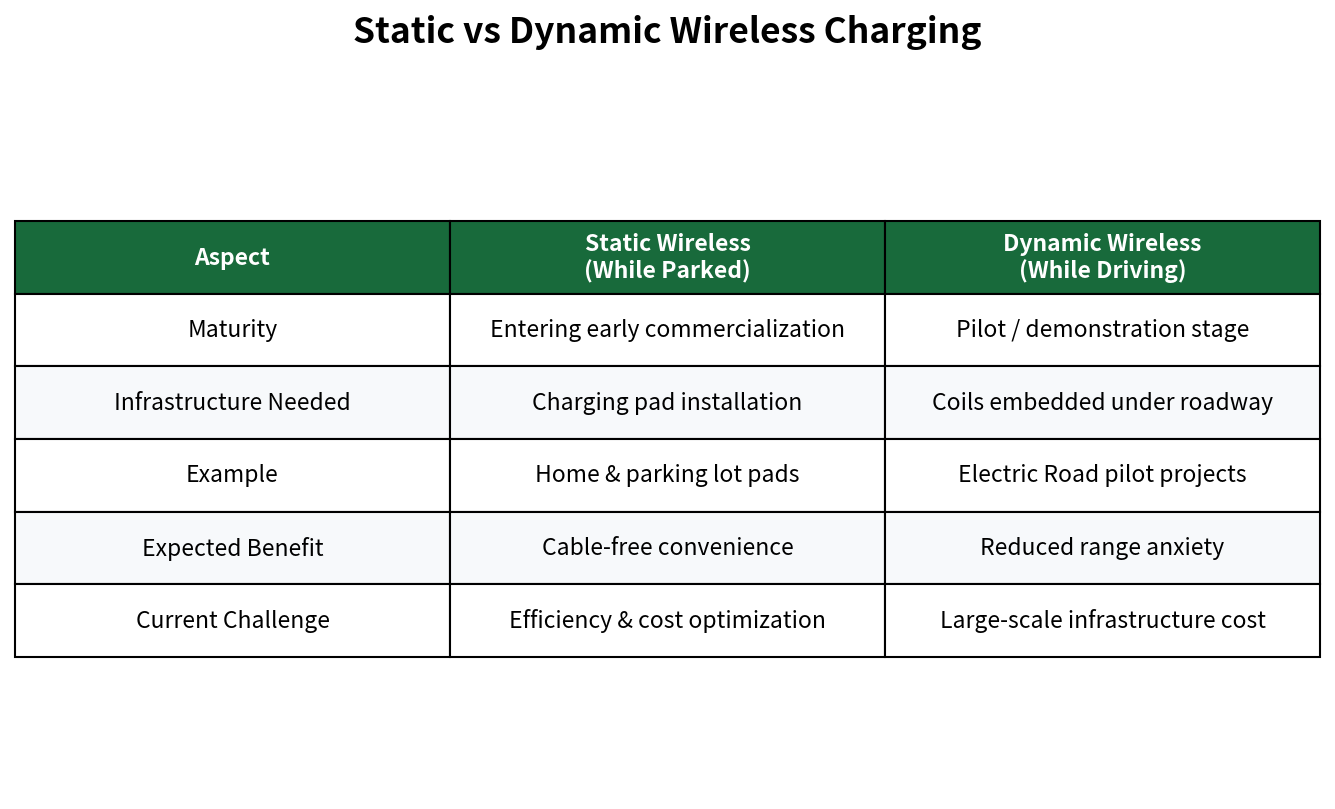
Most of what's entering early commercialization today is "static" wireless charging — charging while the car is parked on top of a pad. Pilots are underway in home garages and public parking spaces.
Looking further ahead, "dynamic" wireless charging embeds coils under the roadway so vehicles can charge while actually driving. Electric Road pilot projects are reportedly underway in parts of Europe and North America, though large-scale infrastructure cost remains a major hurdle at this stage.
What still needs to be solved
The challenges are clear too — improving power conversion efficiency compared to wired charging, and bringing down installation and maintenance costs. Still, the convenience of cable-free charging just by parking is a genuinely appealing vision of the future ^^
Wrap-up
EV wireless charging is advancing on two fronts, inductive and resonant coupling, guided by international standards like SAE J2954. Static charging is entering early commercial use, while dynamic in-motion charging remains at the pilot stage. A fully cable-free future may still be some way off, but the direction of this technology is unmistakably clear.
#ElectricVehicle #WirelessCharging #EVCharging #SAEJ2954 #InductiveCharging #MagneticResonance #WPT #EVChargingInfrastructure #Electrification #DynamicWirelessCharging #StaticWirelessCharging #ElectricRoad #EVFutureTech #ChargingPad #EVTechnology #Battery #Mobility #FutureOfCars #ChargingSystems #GreenVehicles
'자동차' 카테고리의 다른 글
| Car :: Could Your EV Sell Electricity Back to the Grid? A Look at V2G (0) | 2026.07.13 |
|---|---|
| 자동차 :: 전기차, 충전만 하지 않고 전기도 팔 수 있을까? V2G 미래기술 총정리 (0) | 2026.07.13 |
| 자동차 :: 전기차 무선충전, 케이블 없이도 충전될 수 있을까? 미래기술 총정리 (0) | 2026.07.13 |
| Car :: CCS, CHAdeMO, NACS — What's the Difference Between EV Charging Connectors? (0) | 2026.07.11 |
| 자동차 :: 전기차 커넥터 종류, CCS·CHAdeMO·NACS 뭐가 다를까? 기초 상식 총정리 (0) | 2026.07.11 |