2026. 7. 12. 07:20ㆍ취미생활/야구
Hello!
Today's post is about one of the trickiest rules for new baseball fans to understand: the infield fly rule.
Have you ever wondered why the umpire suddenly throws up a hand and shouts "Infield fly!" the moment a pop-up goes up with runners on first and second?
It's a call that doesn't come up in every game, so it's easy to miss what's actually happening if you don't know the rule. It turns out this is one of the more interesting rules in baseball, created specifically to stop defenses from gaming the system.
An infield fly is a fair fly ball (excluding line drives and bunt attempts) that could be caught by an infielder with ordinary effort, while runners are on first and second base (or the bases are loaded) with fewer than two outs. Once the umpire makes the call, the batter is automatically out, whether or not the ball is actually caught.
That might sound like a lot to take in at once, so let's break down the exact conditions below.
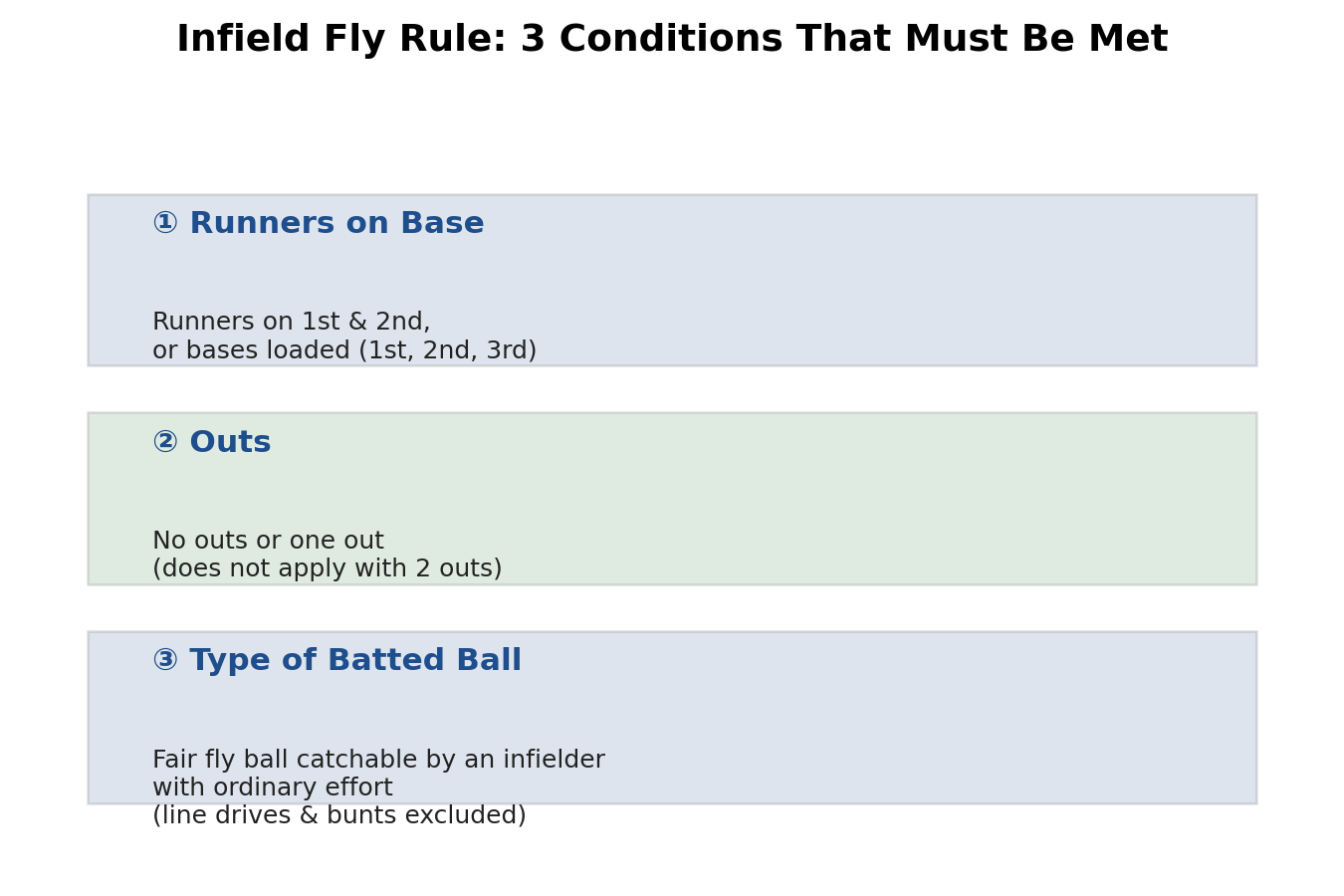
Let's go through each condition. First, ① the runners on base: there must be runners on first and second, or the bases must be loaded (first, second, and third all occupied). If there's only a runner on first, there isn't much of a double-play threat, so the rule doesn't apply.
② The out count matters too. The rule only applies with zero or one out. If there are already two outs, the inning ends the moment the batter is out anyway, so the rule becomes unnecessary.
③ The type of batted ball is part of the equation as well. It has to be a fair fly ball that an infielder could catch with ordinary effort — fast-moving line drives and bunt attempts are excluded, since the defense has much less opportunity to intentionally drop those.
So why does this rule exist at all? Without it, an infielder could deliberately let a pop-up drop, then turn a double play or even a triple play against runners who are pinned close to their bases, afraid the ball might actually be caught. The infield fly rule exists purely as a fairness measure to shut down that kind of sneaky defensive play.
Let's take a quick look at how this rule evolved into the form we know today.

The infield fly rule is said to have been introduced by the National League back in 1895. At that time it only applied with one out, and it's reported to have settled into a form close to today's version around 1901.
Later, in 1904, fast-moving line drives were excluded from the rule, and in 1920 bunt attempts were excluded as well — rounding out the version of the rule we know today. It's a rule that's been refined over more than a century.
So when does it actually apply in a real game, and when doesn't it? Here's a quick situational breakdown.
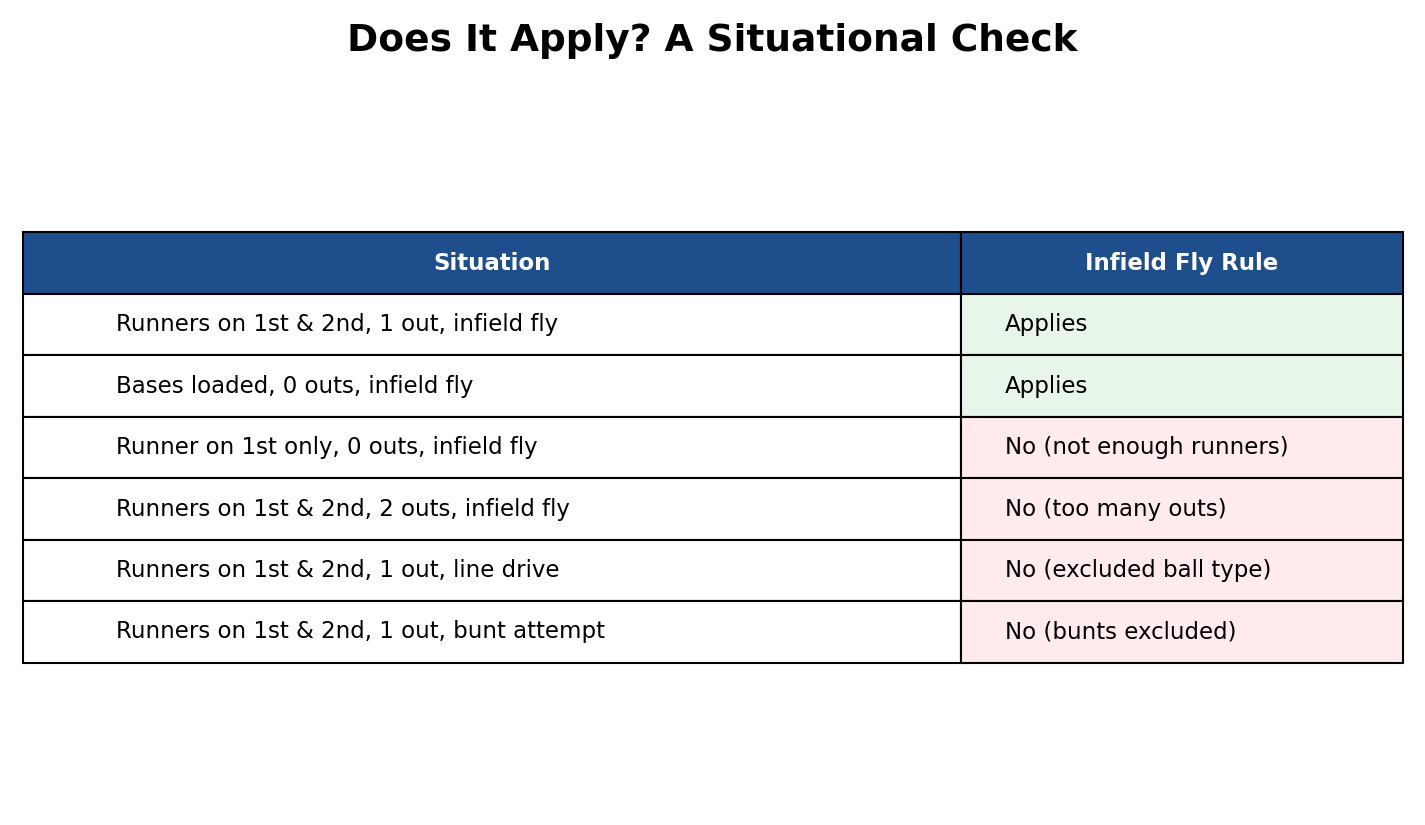
As the table shows, if any one of the three conditions is missing, the infield fly rule isn't called. It's worth remembering that line drives and bunts can look similar to a routine infield pop-up at first glance, but they're explicitly excluded under the rule.
In an actual game, the umpire signals the call by raising a hand the moment the ball goes up. From that point on, the batter is already out, so the runners don't have to worry about a double play and can focus on advancing more freely on the next play.
Summary
The infield fly rule might sound complicated at first, but it really comes down to one simple purpose: stopping the defense from intentionally dropping a ball to turn a double or triple play. Just remember the three conditions — runners on first and second (or bases loaded), zero or one out, and a fair fly ball catchable by an infielder — and the next time you see this call in a game or broadcast, it'll make a lot more sense.
#baseballrules #infieldfly #infieldflyrule #baseball101 #baseballbasics #MLBrules #baseballforbeginners #baseballexplained #baseballhistory #sportsrules #MLB #KBO #doubleplay #tripleplay #baseballfan #learnbaseball #baseballguide #baseballterms #umpirecall #baseballknowledge #baseballeducation
'취미생활 > 야구' 카테고리의 다른 글
| Baseball :: Struck Out, But Not Out? The Uncaught Third Strike Rule Explained (0) | 2026.07.12 |
|---|---|
| 야구 :: 낫아웃, 스트라이크 아웃인데 왜 아웃이 아닐까요? 규칙 총정리 (0) | 2026.07.12 |
| 야구 :: 인필드 플라이, 1·2루에 주자가 있을 때만 적용되는 이유는? 규칙 총정리 (0) | 2026.07.12 |
| Baseball :: What Exactly Triggers a Balk Call? (0) | 2026.07.10 |
| 야구 :: 보크(Balk), 정확히 어떤 상황에서 선언되는 걸까요? (1) | 2026.07.10 |