2026. 7. 9. 15:24ㆍ자산관리
Hello.
Today's post breaks down how an option's premium is actually built up and what drives it.
"Isn't an option's price just set by market sentiment?"
In the last post we covered the basics of call and put options. Today we're going one level deeper into what actually makes up that price tag called the "premium" - a concept that trips up a lot of people new to options.
An option's premium can be split into two parts: intrinsic value and time value. Intrinsic value is what you'd actually gain if you exercised the option right now. Time value is the extra amount priced in for the chance that things move in your favor before expiration.

Looking at the chart above, you can see that as expiration approaches, time value's share of the total premium keeps shrinking. Intrinsic value, on the other hand, is set purely by the gap between the underlying price and the strike price, so it stays put right up until expiration day.
For a call option, intrinsic value equals "underlying price minus strike price," and if that number is negative, intrinsic value is simply treated as zero. In other words, intrinsic value can never go below zero.
So what exactly drives time value? Here's a breakdown.
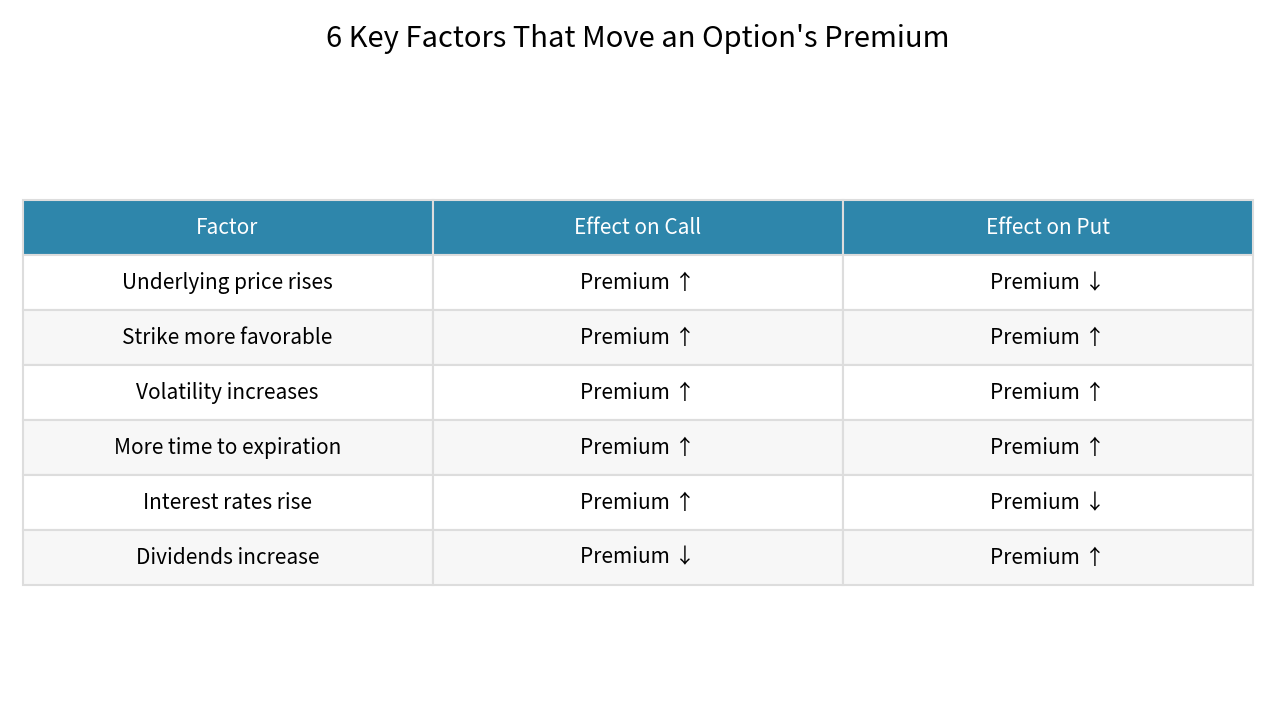
As the table shows, calls and puts often move in opposite directions in response to the same factor. When the underlying price rises, a call's premium goes up while a put's premium goes down. Volatility and time to expiration, though, push premiums higher for both calls and puts - worth remembering.
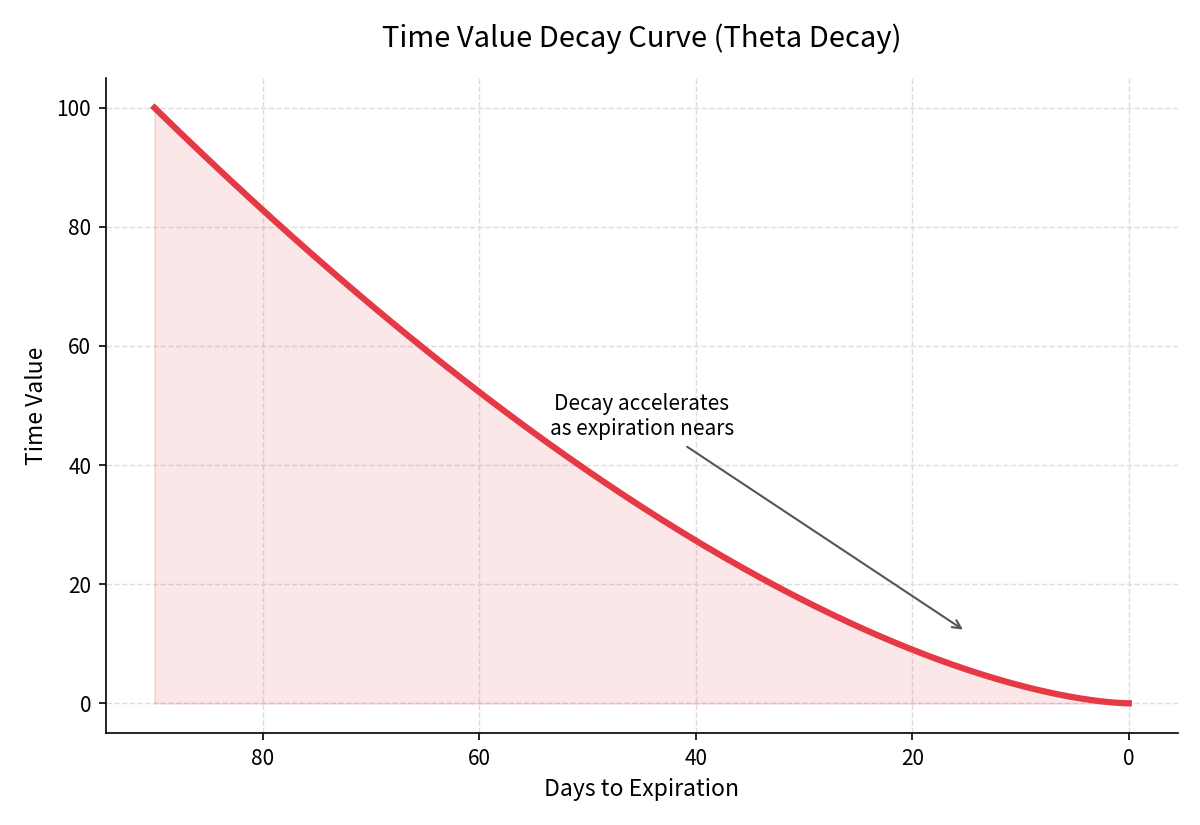
Time value decays especially fast as expiration gets closer, a phenomenon known as "theta decay" or "time decay." The curve below should give you a good feel for it.
Options are leveraged products - a relatively small amount of margin controls a much larger position - and because of time decay, an unexpected move can wipe out the full premium or more. This post is meant as background on how option pricing works, not investment advice on any specific trade or timing. Please make your own investment decisions carefully, based on your own research and, where appropriate, a conversation with a licensed professional.
Wrap-Up
Once you split an option's premium into intrinsic value and time value, the pricing makes a lot more sense. Intrinsic value reflects what the option is worth right now, while time value reflects the odds of favorable movement before expiration - and that time value erodes faster and faster as expiration approaches. Hopefully this gives you a more structural way to think about how options are priced.
#options #optionpremium #calloption #putoption #intrinsicvalue #timevalue #theta #timedecay #greeks #optionstrading #derivatives #optionsstrategy #shortoptions #longoptions #expiration #strikeprice #volatility #investing #stockmarket #futuresandoptions #personalfinance #financialliteracy #wealthmanagement #optionsbasics
'자산관리' 카테고리의 다른 글
| Asset Management :: Crypto 101 — What to Know Before You Invest in Coins (0) | 2026.07.10 |
|---|---|
| 자산관리 :: 코인 투자, 시작 전에 꼭 알아야 할 기본 개념 (0) | 2026.07.10 |
| 자산관리 :: 옵션 프리미엄, 내재가치와 시간가치로 나눠보면? (0) | 2026.07.09 |
| Futures Trading 101 :: What Is It and Why Is It So Risky? (0) | 2026.07.08 |
| 자산관리 :: 선물거래란 무엇일까요? 개념과 리스크 정리 (0) | 2026.07.08 |