2026. 7. 9. 03:31ㆍ자동차
Hello everyone.
Today I want to talk about one of the hottest topics in EV charging right now: the Megawatt Charging System, or MCS.
Why does a heavy-duty electric truck take so much longer to charge than your average EV?
Passenger EV chargers usually top out in the tens to low hundreds of kW. But heavy trucks, buses, and off-highway electrified equipment like excavators and wheel loaders carry far bigger battery packs, so conventional fast charging left them sitting for hours to reach a full charge.
MCS was built to solve exactly that problem. It was developed by CharIN, the same international consortium behind the CCS standard, and was formally published as IEC TS 63379 version 1.0 in February 2026.

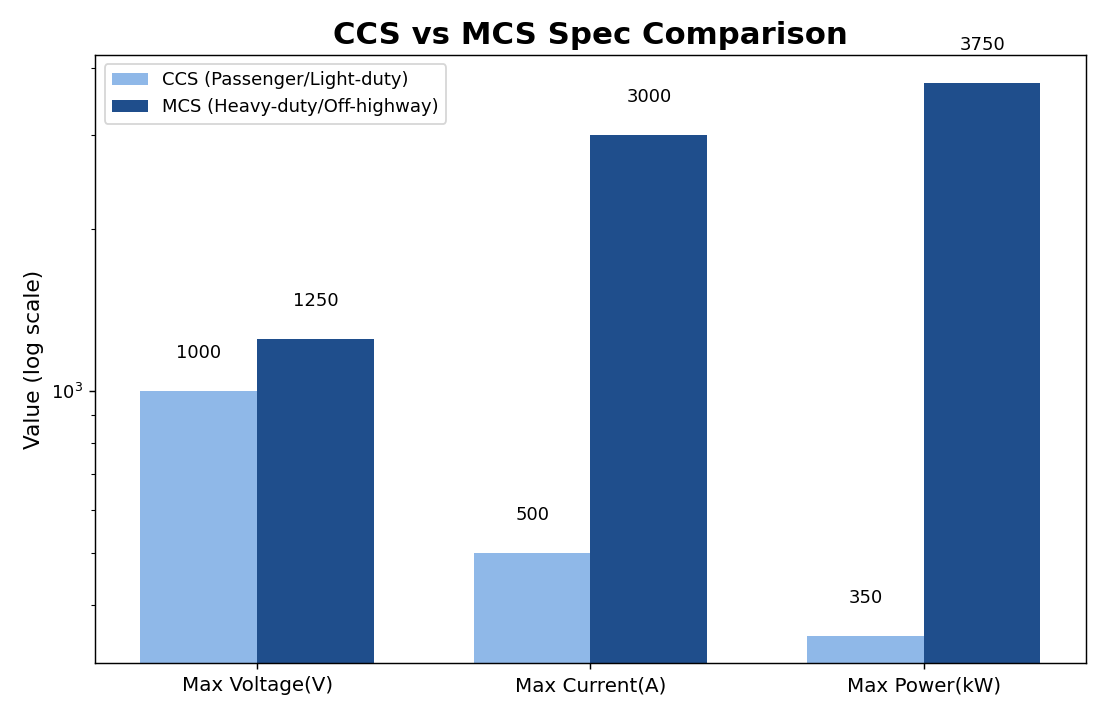
The numbers make the leap pretty clear. MCS supports up to 1,250V and 3,000A, enabling a theoretical output of around 3.75MW. That's what makes a 20-40 minute full charge realistic for a heavy-duty battery pack.
EV charging standards have kept evolving over time. CCS was first established in 2011, and fast charging went mainstream for passenger cars soon after. As trucking and off-highway equipment needed a new answer for their much larger batteries, CharIN took on MCS, and it became an official standard in 2026.

The gap versus CCS becomes even clearer side by side. CCS for passenger cars and light-duty commercial vehicles tops out around 1,000V, 500A, and 350kW. MCS pulls ahead across voltage, current, and power.
What's especially worth watching is off-highway equipment. Electric excavators and wheel loaders on construction sites drain their batteries fast due to heavy hydraulic work, and long charging waits directly hurt uptime on site. Once MCS-grade ultra-fast charging infrastructure spreads, this kind of heavy equipment could get back to work almost as quickly as a passenger EV does today.
Takeaways
MCS marks a real turning point, extending EV charging technology that grew up around passenger cars into heavy commercial trucks and construction equipment. Starting with the 2026 IEC standard release, charging infrastructure for trucks, buses, and off-highway machines like electric excavators and wheel loaders should keep evolving right alongside it. Working in electrified charging systems myself, this is a technology I'll be watching closely going forward.
#car #ev #electrictruck #megawattcharging #MCS #fastcharging #chargingInfrastructure #electricbus #electricexcavator #electricwheelloader #offhighway #CCS #IEC63379 #CharIN #battery #chargingtechnology #electrification #greenvehicle #carbonneutral #newtechnology #constructionequipment #commercialEV
'자동차' 카테고리의 다른 글
| Car :: Could Your EV Become a Power Plant? A Guide to V2G (Bidirectional Charging) (0) | 2026.07.10 |
|---|---|
| 자동차 :: 전기차가 발전소가 된다? V2G(양방향 충전) 기술 총정리 (1) | 2026.07.09 |
| 자동차 :: 메가와트 충전(MCS), 전기트럭 완충 시간을 확 줄이는 신기술 (0) | 2026.07.09 |
| Car :: How Did EV Charging Connectors Get Here? The Evolution of Charging Standards (0) | 2026.07.08 |
| 자동차 :: 전기차 충전 커넥터, 표준의 변천사 (0) | 2026.07.08 |