2026. 7. 8. 04:30ㆍ자동차
Hello.
Today I'm writing about how EV charging connector standards evolved into what we see now.
"Do you actually know which plug your EV needs?"
I develop charging systems for electrified equipment (EVs, electric excavators, electric wheel loaders, and the like), and one of the most common questions I get is, "why are there so many different charging connectors?" Today I want to walk through that story.
In the early days of EVs, charging methods varied widely by manufacturer and by country. Power grid infrastructure differed from nation to nation, and automakers were each pushing their own proprietary designs.
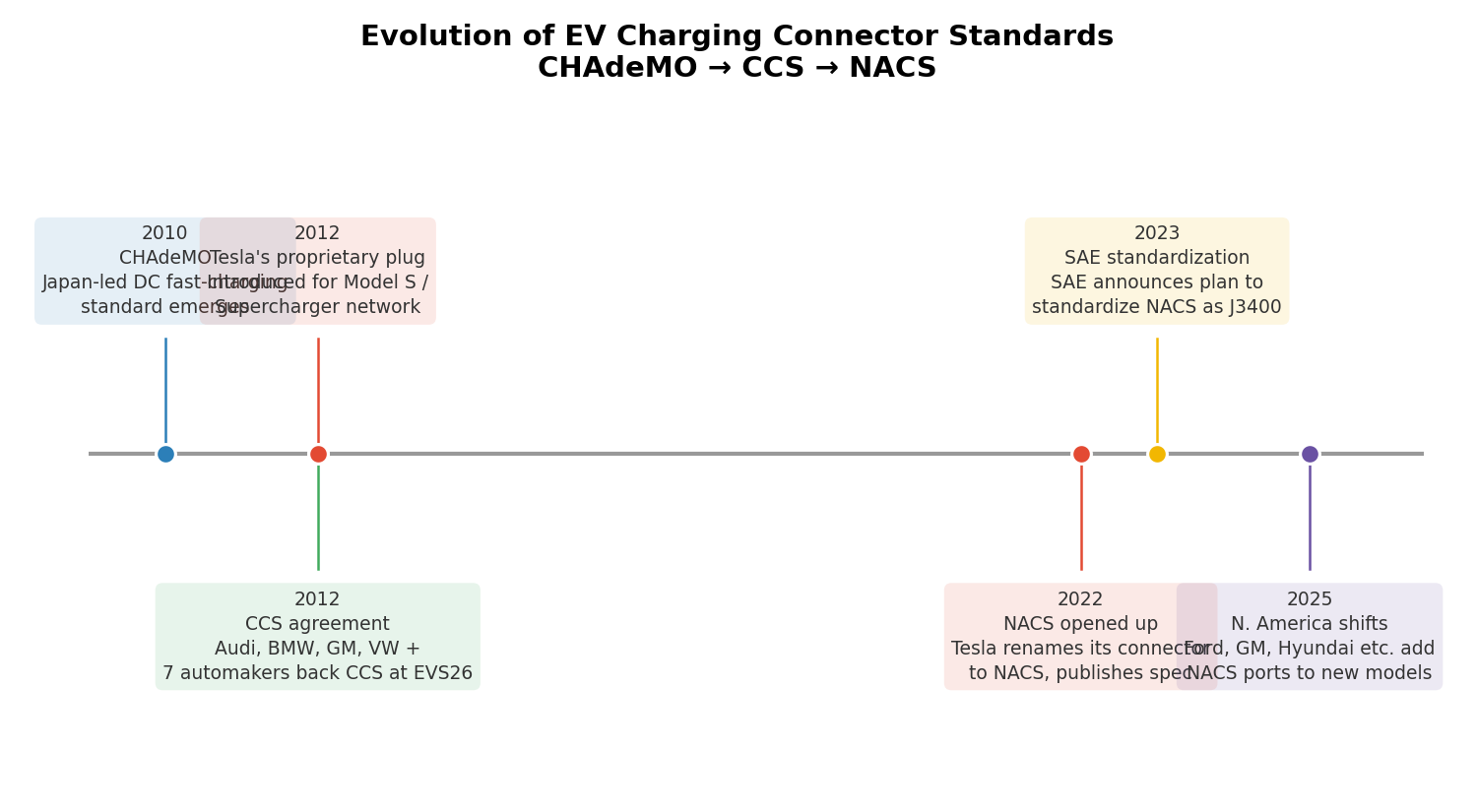
Let's walk through this timeline step by step. In the late 2000s, Japan-led CHAdeMO emerged as a leading DC fast-charging standard. Then in 2012, at the 26th International Electric Vehicle Symposium, eight automakers, including Audi, BMW, Chrysler, Daimler, Ford, GM, Porsche, and Volkswagen, agreed to back a new standard called CCS.
Coincidentally, Tesla also introduced its own proprietary connector in 2012 for the Model S and its Supercharger network. At the time, it was a closed format used only on Tesla vehicles.
Regional standards eventually settled into place: CCS1 in the US and Korea, CCS2 in Europe, CHAdeMO in Japan, and GB/T in China. Then in November 2022, Tesla renamed its connector to NACS, the North American Charging Standard, and opened up the specification, and the landscape started to shift.
In June 2023, SAE International announced plans to formally standardize NACS as J3400. Soon after, major automakers including Ford, GM, Rivian, and Volvo announced they would adopt NACS ports on their North American EVs starting around 2025.
According to the U.S. Department of Energy, the number of charging connectors supporting NACS has already surpassed the combined total of CCS and CHAdeMO connectors. A single connector being renamed ended up reshaping an entire industry's standard within just a few years.
From the perspective of someone who builds charging systems for a living, these shifts are never just about the shape of a plug. Communication protocols, authentication methods, and power delivery capacity all have to be validated together whenever a new standard appears. My expectation is that charging standards will keep consolidating over time.
Takeaway
To sum up, EV charging connectors went from a patchwork of regional formats, to consolidation around CCS, to the opening and rapid spread of Tesla's NACS. Full unification will still take time, but the momentum in North America is clearly shifting toward NACS. If you're shopping for a new EV, it's worth checking which charging standard it supports.
#EV #ChargingConnector #CCS #CHAdeMO #NACS #TeslaCharging #EVCharging #ChargingStandard #Electrification #EVCharger
'자동차' 카테고리의 다른 글
| Car :: Megawatt Charging (MCS) — The New Tech Cutting EV Truck Charging Times (0) | 2026.07.09 |
|---|---|
| 자동차 :: 메가와트 충전(MCS), 전기트럭 완충 시간을 확 줄이는 신기술 (0) | 2026.07.09 |
| 자동차 :: 전기차 충전 커넥터, 표준의 변천사 (0) | 2026.07.08 |
| 전기차 완속충전 vs 급속충전, 언제 어떻게 써야 배터리에 좋을까 (0) | 2026.07.07 |
| KIA :: EV9 티저 이미지 공개 (0) | 2021.11.11 |