2026. 8. 6. 19:22ㆍ자산관리
Hello.
Today's post is about futures trading, continuing our asset management series.
Stocks feel fairly familiar to most people, but the word "futures" tends to sound a lot more intimidating. Every time a headline mentions an index future dropping sharply, it's easy to wonder what's actually happening behind that number.
What exactly is futures trading, and why does everyone say it's complicated?
In this post, we'll walk through the basics of futures trading and then look at a new trend that's been making headlines in the US market recently. Please note this article is general educational information, not investment advice.
What Is Futures Trading
A futures contract is, in simple terms, an agreement to buy or sell something at a set price on a specific future date. Unlike spot trading, where you exchange an asset immediately, a futures contract is agreed today but settled later, on its expiration date.
Futures trading is widely understood to have originated in agricultural markets. A farmer could lock in a selling price for a harvest months in advance, protecting against a price drop, while a buyer could protect against a price increase. This risk-reducing function is known as hedging.
Today, futures contracts exist on a much wider range of underlying assets: stock indices like the KOSPI 200, commodities such as gold and oil, interest rates, currencies, and even crypto assets like Bitcoin. Individual retail traders, however, often use futures less for hedging and more to speculate on price direction.
The key thing to understand is that a future is a contract, not ownership of the underlying asset itself. You're not holding shares the way you would with a stock — you're holding a promise to transact at a set price on a set date, which can feel like a fairly abstract concept at first.
How Futures Work: Margin and Leverage
The biggest structural difference between futures and stocks is the margin system. To buy $1,000 worth of stock, you generally need the full $1,000. With futures, you only need to post a fraction of the contract's value as margin.
For example, if the margin requirement is 10%, a $10,000 contract could be opened with just $1,000. This ability to control a large position with a relatively small amount of capital is called leverage, and it's both the main appeal and the main risk of futures trading.
Leverage cuts both ways. When the price moves in your favor, your returns relative to the capital you put in are magnified. When it moves against you, losses are magnified just as much. With stocks, the worst case is generally losing your full investment; with leveraged futures, losses can exceed the amount you originally put up.
Most traditional futures contracts also carry an expiration date. If a position isn't closed out beforehand, it's settled automatically, either through physical delivery of the underlying asset or, more commonly for products like index futures, through a cash settlement.

Risk and Liquidation
One concept every futures trader needs to understand is liquidation. If losses exceed the margin posted, the exchange or broker issues a margin call requesting additional funds. If that call isn't met, the position can be force-closed, or liquidated.
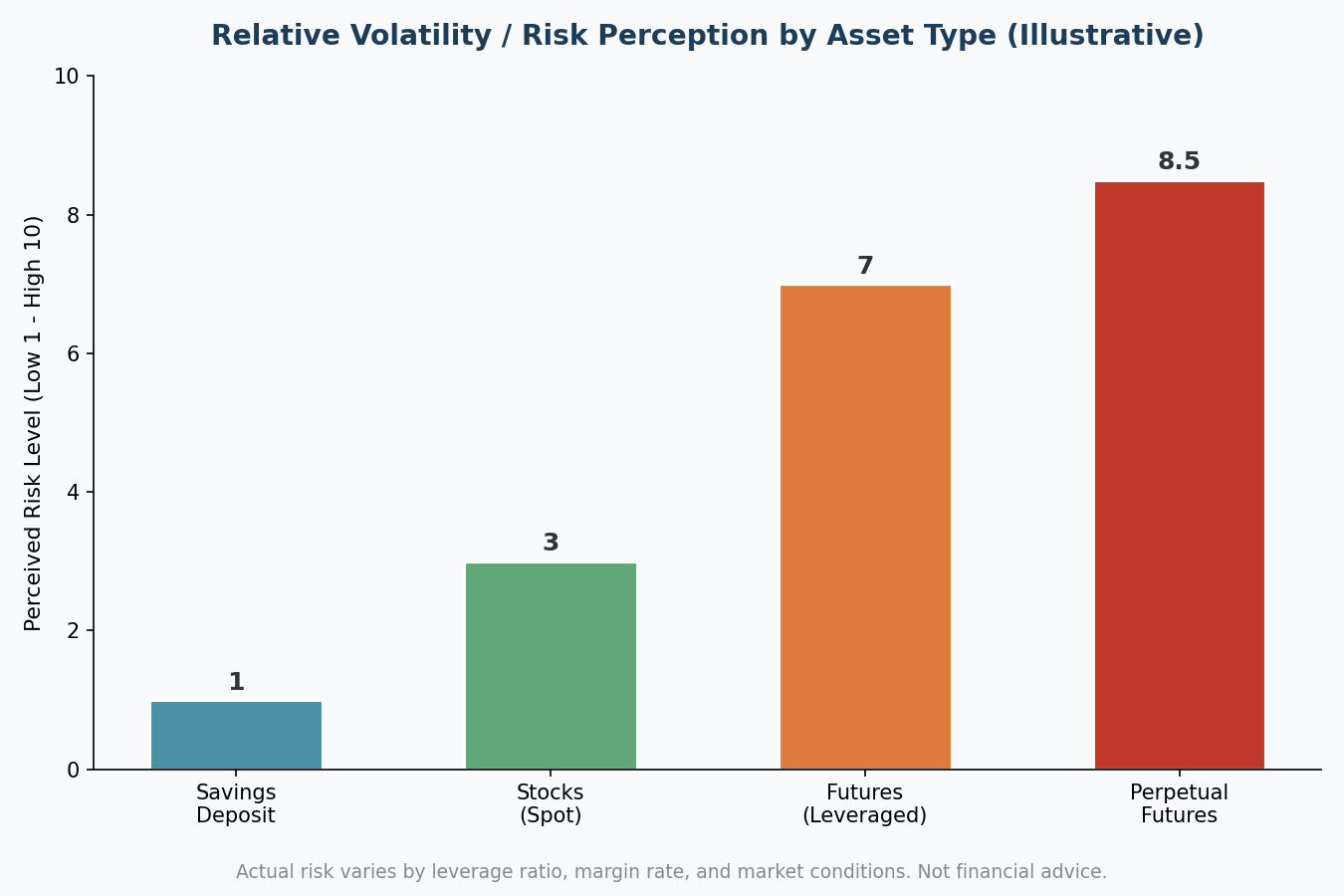
The higher the leverage, the smaller the price move needed to trigger liquidation. With 10x leverage, for instance, roughly a 10% move against your position could wipe out your entire margin. This is why futures are generally classified as a high-risk, high-reward instrument.
This risk becomes even more pronounced in volatile markets. Crypto futures in particular, where the underlying asset itself can swing sharply in short periods, have seen large waves of liquidations within hours. Deciding in advance how much loss you can tolerate is an important step before opening any leveraged position.
Because of this risk profile, futures trading is generally not recommended for beginners without proper preparation. In South Korea, for example, individual investors are required to complete prior education and simulated trading before they're permitted to trade futures and options with real capital.
A Recent Trend: Perpetual Futures
One trend that has been drawing attention in the US futures market recently is the perpetual future. As the name suggests, this type of contract has no expiration date, meaning a trader can hold a position indefinitely unless they choose to close it.
In May 2026, the prediction market platform Kalshi reportedly received approval from the US Commodity Futures Trading Commission (CFTC) to launch what is described as the first CFTC-regulated Bitcoin perpetual futures contract available to US retail traders. The lineup has since expanded to include other crypto assets such as Ethereum, Solana, and XRP, and the move has reportedly sparked competitive and legal disputes with existing exchanges.
Because perpetual futures have no expiration date, many of these products use a periodic "funding rate" mechanism to keep the contract price from drifting too far from the underlying spot price. While this removes the hassle of managing an expiration date, it can also make it easier to hold a leveraged position for a long time, which means prolonged exposure to leverage risk.
This product isn't formally available in every market yet, so it may still feel unfamiliar to many readers. Even so, understanding how derivatives regulation and product structures are evolving abroad can be a useful part of building broader financial literacy.
Good to Know Before You Start
If you're new to futures, it's worth spending real time in a simulated or paper trading account first. Getting a feel for how margin, liquidation price, and leverage interact is essential before any real capital is on the line.
Rather than maxing out leverage, it's generally safer to size your positions conservatively, within a loss range you can genuinely tolerate. Spreading exposure across positions instead of concentrating everything in a single direction is another basic risk management habit worth building early.
Futures products vary widely in their expiration terms, margin requirements, and contract sizes, so it's worth reading the actual product terms and exchange notices before trading anything specific. This article is meant as general educational information, not a recommendation to buy or sell any particular product.
'자산관리' 카테고리의 다른 글
| 자산관리 :: 선물거래, 대체 뭐길래 다들 어렵다고 할까? 개념부터 최근 트렌드까지 총정리 (0) | 2026.08.06 |
|---|---|
| Asset Management :: What Are PER and PBR? A Beginner's Guide to Stock Valuation Metrics (0) | 2026.08.05 |
| 자산관리 :: PER과 PBR이 뭐길래? 주식 가치평가 지표 기초 총정리 (0) | 2026.08.05 |
| Real Estate :: Why Is Everyone Suddenly Talking About Court Auctions? A Beginner's Guide (0) | 2026.08.04 |
| 자산관리 :: 요즘 왜 다들 경매로 몰릴까? 부동산 경매 기초부터 절차까지 총정리 (0) | 2026.08.04 |