2026. 7. 31. 14:01ㆍ취미생활/축구
Hello!
Today's post is about the brand most people picture the moment they think of football boots: Adidas.
Did you know that two of the world's biggest sportswear brands were born from a single family that fell apart?
Adidas and Puma, which together dominate a huge share of the football boot market, actually started as one company. A small workshop in a small German town eventually split into two rival empires, and that rivalry still shapes the boots players wear today.
If you've ever played or watched football, chances are you've come across a pair of Adidas or Puma boots. Once you know the two brands share the same roots, you may never look at them quite the same way again.
In this post, we'll walk through the brothers' falling out, the dramatic 1954 World Cup final where football boots arguably decided a championship, and how that legacy carries on today.
Origins: One Family, One Small Town
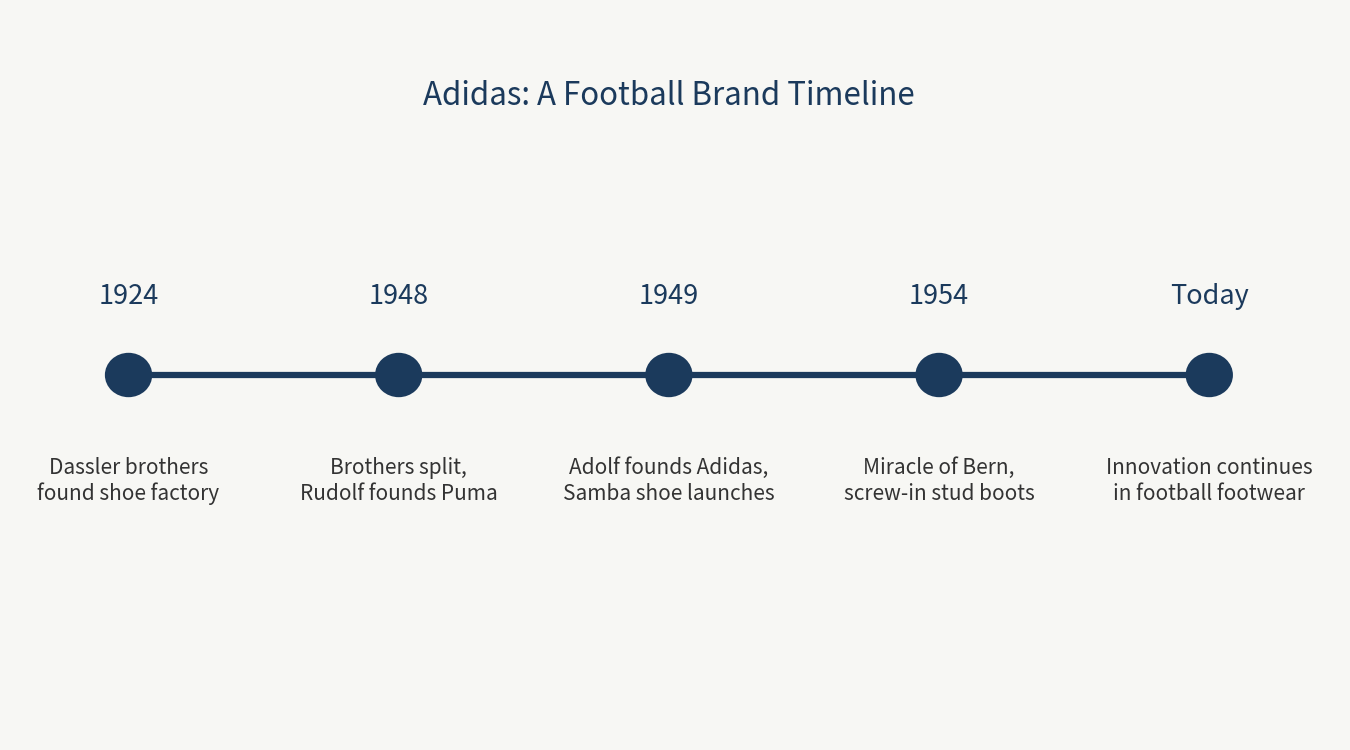
The story starts back in 1924, in the small German town of Herzogenaurach. Brothers Adolf ("Adi") and Rudolf Dassler opened a shoe factory together, called Gebrüder Dassler Schuhfabrik, or "Dassler Brothers Shoe Factory." The company quickly built a reputation in athletic footwear.
One of its most famous early moments came at the 1936 Berlin Olympics, where sprinting legend Jesse Owens is said to have worn shoes made by the Dassler brothers on his way to four gold medals. Given the racist political climate in Germany at the time, the brothers' decision to personally offer their shoes to a Black American athlete says a lot about how much they cared about performance over politics.
But the brothers' partnership didn't last. A mix of business disagreements and personal conflict slowly pulled them apart, and by 1948 the company split in two. The brothers divided the business along the Aurach River that runs through town, and each went his own way.
Adolf combined his nickname "Adi" with his surname "Dassler" to found Adidas in 1949. Rudolf briefly used the name "RUDA" before rebranding the same year as Puma. According to most accounts, the brothers never spoke to each other again for the rest of their lives.
The rivalry didn't stay contained to the boardroom. Most residents of Herzogenaurach worked for one company or the other, and the town split along those lines — different bakeries, different pubs, and reportedly even resistance to marrying across company lines. It's no exaggeration to say the brothers' feud became the town's defining social divide for decades.
The Miracle of Bern and the Screw-In Stud
Adidas's breakout moment on the world stage came at the 1954 World Cup final in Switzerland. West Germany faced Hungary's legendary "Mighty Magyars," a team so dominant it was widely expected to win comfortably.
Adi Dassler's secret weapon was a boot with screw-in studs. Most boots at the time had fixed studs, but Dassler's design let players swap in different stud lengths depending on the pitch conditions — essentially the ancestor of every modern interchangeable-stud boot.
On final day, rain poured down on the Wankdorf Stadium pitch in Bern, turning the ground into mud. Dassler advised the West German players to switch to longer studs, giving them far better traction and the ability to change direction quickly. Hungary's players, in heavier, water-logged leather boots, visibly struggled to keep up.
West Germany pulled off a stunning 3-2 win, a result still remembered in German football history as the "Miracle of Bern." The match showed the world, in dramatic fashion, just how much a piece of equipment could influence the outcome of a game — and it cemented Adidas's identity as a brand built on technical innovation rather than just manufacturing.
The boots worn that day are commonly referred to as the "Argentina" model, and that single match became a symbolic starting point for the entire Adidas football boot lineup that followed. It's a striking example of how one match, one decision, can reshape a brand's entire history.

From the Samba to Today: Innovation Continues
The same year Adidas was founded, 1949, Dassler also released a shoe called the Samba. It was originally designed to give players reliable grip on frozen winter pitches, but today it's far more famous as a casual sneaker than as a football boot — a rare example of a design that has stayed relevant across generations.
From there, Adidas kept pushing football boot technology forward with nearly every World Cup cycle. Early leather boots gave way to synthetic materials and lighter construction, and more recently the company has moved toward manufacturing techniques tailored to individual players' foot shapes.
Puma, coming from the same roots, never fell behind in the technology race either. The two brands still compete fiercely today through athlete endorsements and national team sponsorships, and some observers argue that rivalry is exactly what accelerated football boot innovation over the decades.
One interesting footnote: decades into the feud, employees from both companies eventually played a friendly football match together in Herzogenaurach around the 60th anniversary of the split, a symbolic gesture of reconciliation. A rivalry that began with two brothers refusing to speak has, over time, softened into something a little more human.
'취미생활 > 축구' 카테고리의 다른 글
| Soccer :: When Exactly Is a Player Offside? The Offside Rule Explained (0) | 2026.08.01 |
|---|---|
| 축구 :: 오프사이드, 정확히 언제 선언되는지 알고 계신가요? 경기 규칙 총정리 (0) | 2026.08.01 |
| 축구 :: 형제의 갈라섬이 낳은 축구화 전쟁, 아디다스는 어떻게 시작됐을까? 브랜드별 역사 총정리 (0) | 2026.07.31 |
| Soccer :: How Did the FIFA World Cup Become the World's Biggest Sports Festival? (0) | 2026.07.30 |
| 축구 :: FIFA 월드컵은 어떻게 지구촌 최대 축제가 됐을까? 국제대회 총정리 (0) | 2026.07.30 |