2026. 7. 10. 06:21ㆍ취미생활/축구
Hello.
Today's post is about one of soccer's most confusing rules: offside.
Do you know exactly where the offside line is drawn? Anyone who's watched a match has seen it: the linesman raises the flag, and half the stadium immediately starts arguing.
It's a rule that's surprisingly hard to explain on the spot, so let's break down exactly where the line is.
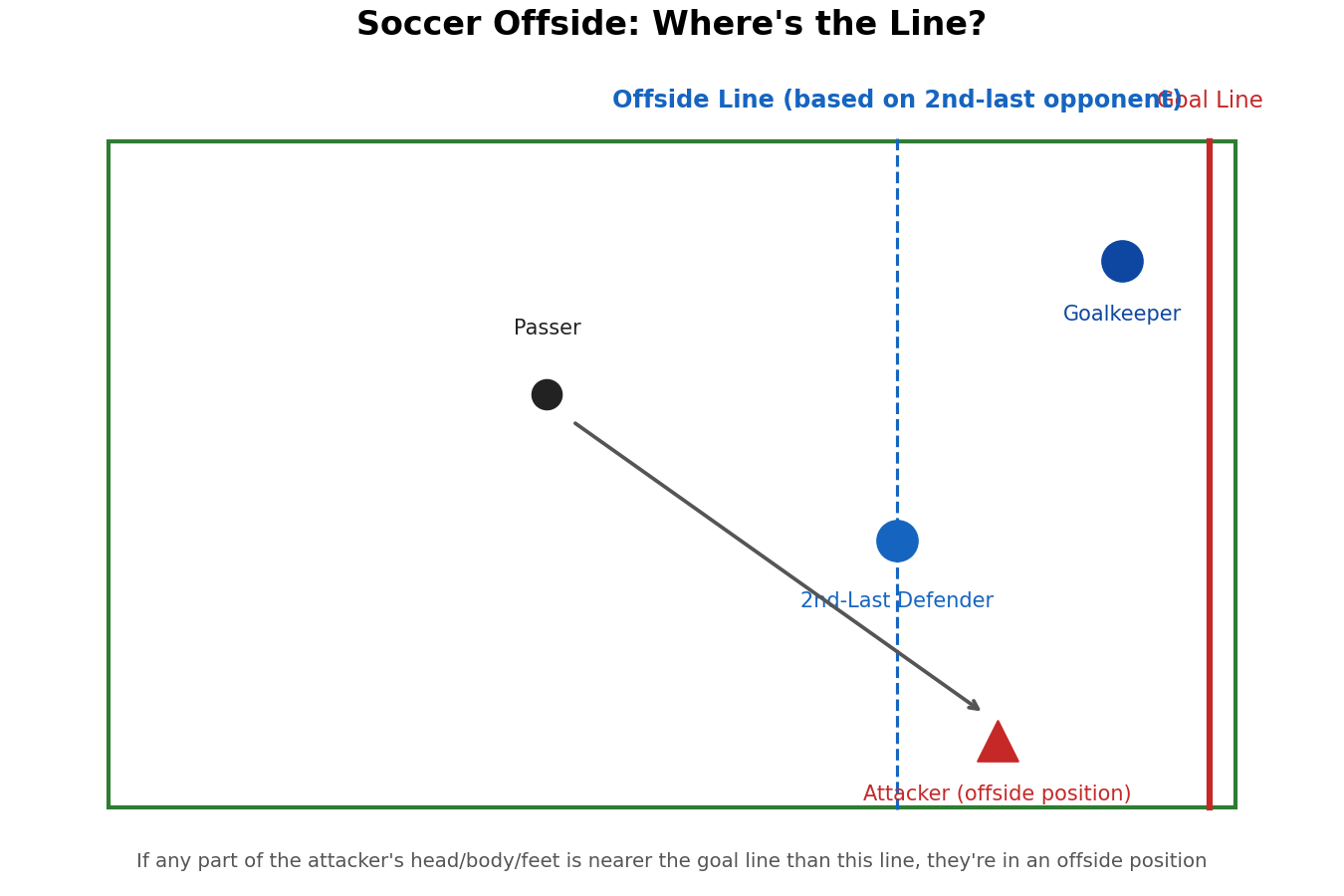
Here's the part people often get wrong: simply standing in an offside position is not an offence by itself. The player only gets penalized if they become actively involved in play — by touching the ball, interfering with an opponent, or gaining an advantage from that position.
One more detail worth knowing: hands and arms don't count. The upper boundary is the bottom of the armpit, so a player whose arm is ahead of the line but whose body and feet are level is still onside.

These days, VAR lets broadcasters (and fans at home) freeze the exact moment the ball is played and draw those razor-thin lines across the pitch. That precision has sparked its own debate — should a goal really be chalked off because a toe was a few centimeters ahead of a defender's knee?
That frustration is exactly why IFAB is currently trialing a new interpretation proposed by former Arsenal manager Arsene Wenger, nicknamed the "daylight rule." It flips the usual logic: instead of any part of the body being enough, there needs to be a clear, visible gap between the attacker and the defender for it to count as offside — tilting close calls in the attacker's favor.
The trial kicked off in the Canadian Premier League (CPL) starting with the 2026 season, and it is not yet an official law used worldwide. IFAB will review the results of the trial before deciding whether to adopt it more broadly.
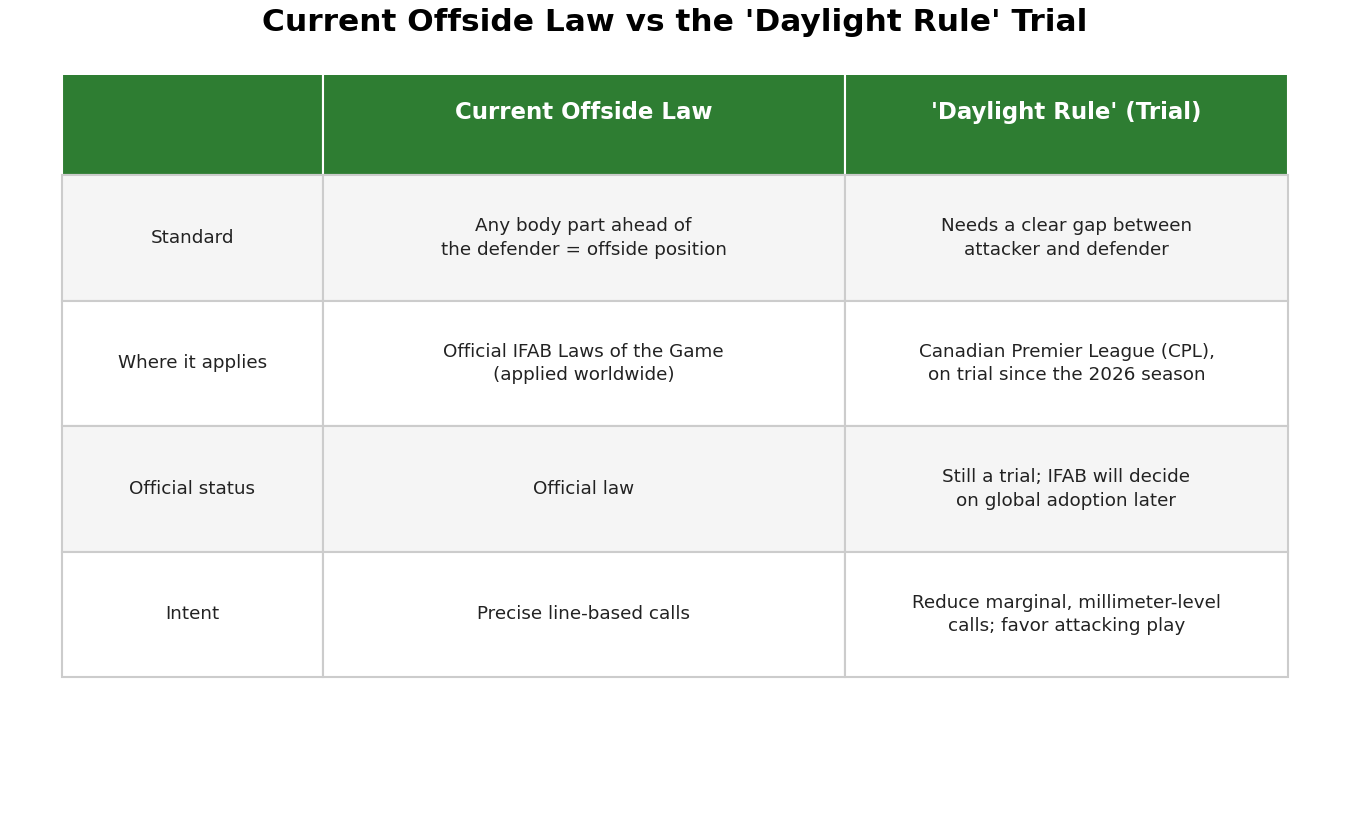
Summary
Offside really comes down to two questions: was the player ahead of the ball and the second-last defender, and did they actually get involved in the play from that position? Both have to be true for it to be an offence. With VAR pushing the rule toward millimeter-level precision, new ideas like the "daylight rule" trial are worth watching as the sport figures out where that line should really be.
#soccer #football #offside #offsiderule #footballrules #VAR #videoassistantreferee #IFAB #daylightrule #arsenewenger #canadianpremierleague #CPL #footballterms #sportsbasics #soccerforbeginners #lawsofthegame #soccerrules #internationalfootballassociationboard #premierleague #worldcup #footballfans #soccertips #soccerexplained #sportsrules
'취미생활 > 축구' 카테고리의 다른 글
| Soccer :: Does Any Hand Touch Count as a Handball Foul? The Real Rules (0) | 2026.07.12 |
|---|---|
| 축구 :: 핸드볼 반칙, 손에 닿으면 무조건 반칙일까요? 규칙 총정리 (0) | 2026.07.12 |
| 축구 :: 오프사이드, 어디까지가 반칙인지 정확히 알고 계신가요? (0) | 2026.07.10 |
| Soccer :: How Did adidas Become the Byword for Football Boots? (0) | 2026.07.09 |
| 축구 :: 아디다스는 어떻게 축구화의 대명사가 됐을까? 브랜드 역사 정리 (0) | 2026.07.09 |