2026. 8. 16. 22:55ㆍ자동차
Hi everyone.
Today I want to talk about one of the more futuristic ideas in EV charging: battery swapping.
What if, instead of plugging in and waiting, you could just swap your entire battery pack in about a minute?
I work on charging systems for electrified equipment, including EVs, electric excavators, and electric wheel loaders, and battery swapping has become one of the hottest topics in the industry lately. No matter how fast DC fast charging gets, there's a physical limit to how quickly you can push energy into a battery. Swapping takes a completely different approach: instead of waiting for a charge, you skip the wait altogether.
China's NIO and battery giant CATL are leading this space, and recently the same idea has started showing up in construction equipment too, not just passenger cars. In this post, I'll walk through where battery swapping came from, how it actually works, and where it might be headed next.
**Origins and Background**
Battery swapping itself isn't a brand-new idea. Back in the early 2010s, an Israeli startup called Better Place tried building swap stations for passenger EVs, but the business eventually folded. Tesla also demonstrated a battery swap for the Model S in 2013, though it never turned into a real commercial service at the time.
The idea got a real second life when China's NIO started operating actual swap stations back in 2018. NIO has steadily expanded its network since then, and reports suggest it now runs close to 4,000 stations across China.
CATL, the world's largest battery maker, has also jumped in with its own "Choco-Swap" branded stations, reportedly aiming for more than 2,500 stations by the end of 2026. It's notable that this isn't a car manufacturer building charging infrastructure, it's a battery company doing it directly.
What's interesting is that this idea is now expanding beyond passenger cars into construction equipment. Chinese equipment maker SANY recently unveiled the SY375E electric excavator, which comes with a swappable 550 kWh battery pack. In job sites where waiting hours for a heavy battery to charge just isn't practical, swapping can be a much more realistic option.

**Key Facts and Recent Developments**
Could a battery swap really take under two minutes, faster than filling up a gas tank?
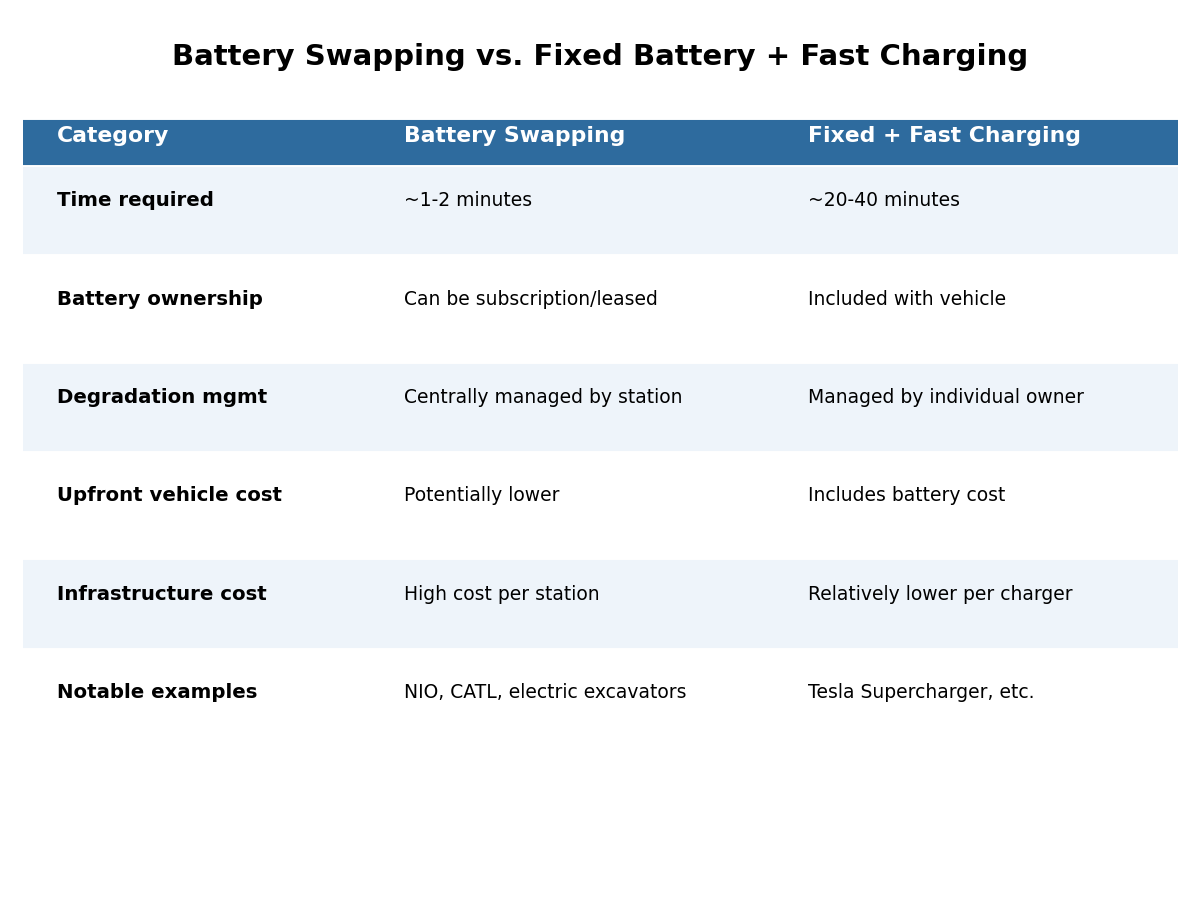
The mechanics behind battery swapping are actually fairly straightforward. A vehicle pulls into a station, a robotic arm detaches the battery pack from underneath the car, swaps in a pre-charged one, and locks it back in place. CATL says its Choco-Swap stations can complete this in roughly 70 to 80 seconds, with a claimed success rate of 99.99%. Those numbers come from the manufacturer, so it's worth keeping in mind they're self-reported.
One thing worth noting is how differently battery ownership works in this model. In a lot of swap setups, the battery isn't owned by the driver at all, it belongs to the station operator. Drivers subscribe to or lease battery access instead, while the operator handles degradation, thermal management, and overall battery health centrally. This can also lower the upfront price of the car itself, since the battery cost is decoupled from the vehicle purchase.
NIO has reported that its swap network delivered around 16% of all EV charging energy in China over a recent five-day stretch. That's a pretty strong signal that this isn't just an experimental gimmick anymore, it's become a real part of how a meaningful number of drivers charge day to day.
**Compared to Fast Charging: Good to Know**
Battery swapping isn't a silver bullet. The biggest obstacle is infrastructure cost. A station needs to keep multiple charged batteries in reserve, plus precise robotic arms and alignment hardware, which makes it far more expensive to build than a typical fast charger. That's a big reason it's still mostly concentrated around specific brands and regions rather than being widespread.
Standardization is another real challenge. Battery pack sizes and mounting mechanisms differ from one manufacturer to another, so it's hard for a single station to serve vehicles from multiple brands. That's quite different from AC or DC fast charging, where as long as the connector standard matches, most vehicles can use the same charger.
Even so, swapping makes a lot of sense in areas where waiting hours to charge a heavy battery just isn't practical, commercial fleets and construction equipment being good examples. For taxis, delivery trucks, or excavators that need to keep running throughout the day, being able to go from empty to full in a couple of minutes can translate directly into higher uptime.
From where I sit as someone who works on charging systems, battery swapping feels less like a competitor to fast charging and more like a complementary technology aimed at a different use case. I expect passenger EVs to keep leaning on an increasingly dense fast-charging network, while commercial vehicles and heavy equipment, where uptime really matters, may be where swapping grows the fastest. It's a space worth watching as standardization discussions continue.
[Image 3: Comparison table — Battery Swapping vs. Fixed Battery + Fast Charging - data_en_2.png]
[Image 4: BATTERY SWAP badge symbol - badge_en_1.png]
**Final Thoughts**
Battery swapping has moved from a niche experiment to a real charging option, driven largely by NIO and CATL in the passenger EV market, and now expanding into construction equipment like the 550 kWh swappable excavator from SANY. The core appeal is speed, a swap in one to two minutes, plus a shift in who owns and manages the battery. That said, real hurdles remain: station costs are high, and standardization across manufacturers is still a work in progress.
From my perspective as someone who builds charging systems, I don't see swapping and fast charging as rivals so much as two tools suited to different jobs. Passenger EVs will likely keep benefiting from an ever-denser fast-charging network, while fleets and heavy equipment, where uptime is everything, may be where swapping really takes off. It'll be worth keeping an eye on how the standardization conversation develops from here.
'자동차' 카테고리의 다른 글
| Car :: How Did Hyundai Motor Begin? A Brand History From Pony to IONIQ (0) | 2026.08.18 |
|---|---|
| 자동차 :: 현대자동차는 어떻게 국산차 시대를 열었을까? 브랜드별 역사 총정리 (0) | 2026.08.18 |
| 자동차 :: 배터리를 통째로 갈아 끼운다? 전기차 배터리 스와핑 미래기술 총정리 (1) | 2026.08.16 |
| 자동차 :: 전기차 충전 방식, 어떻게 지금 모습이 됐을까? 기술의 변천사 총정리 (0) | 2026.08.15 |
| Car :: Plug In and It's Done? Inside ISO 15118 Plug & Charge, EV Charging's New Auto-Authentication Tech (0) | 2026.08.10 |