2026. 8. 16. 20:33ㆍ취미생활/축구
Hello.
Today I'm writing about VAR (Video Assistant Referee), one of the most talked-about rule changes in modern soccer.
Have you ever watched a referee's on-field call get completely reversed the moment the replay screen came up?
For most of its history, soccer relied entirely on the referee's split-second judgment. With players moving at high speed, calling offside or fouls by the naked eye alone inevitably led to controversial mistakes, some of which changed the outcome of major matches.
That's where VAR comes in. By using video footage to support the referee's decisions, the system faced fierce resistance when it was first proposed, but it has since become a standard fixture at nearly every major competition.
In this post, we'll look at how VAR got started, exactly which situations it can step into, and what has changed since it was introduced.
**Origins: How VAR Got Its Start**
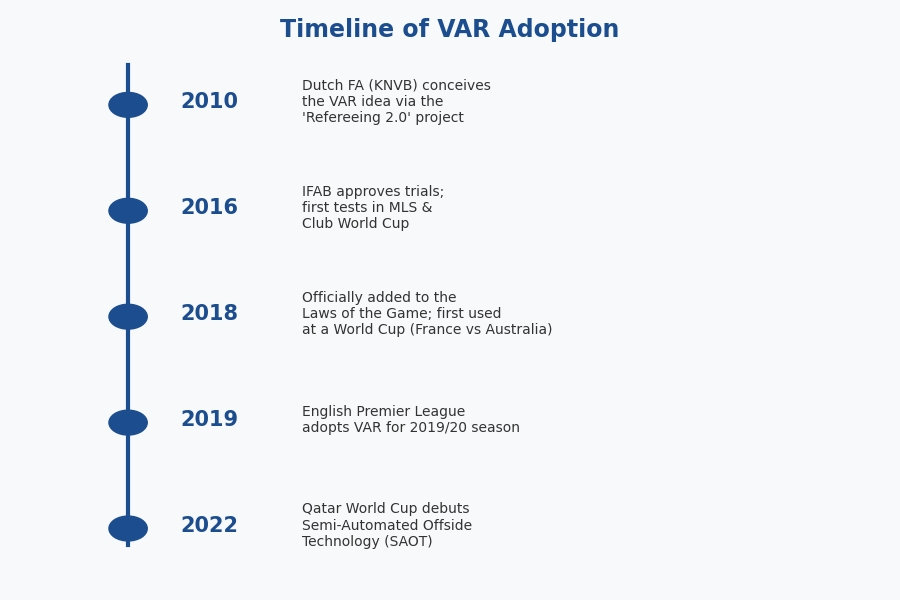
The idea behind VAR goes back further than most fans realize. In 2010, the Royal Netherlands Football Association (KNVB) began developing the concept as part of a project called "Refereeing 2.0," aimed at improving the accuracy of officiating.
In 2016, the International Football Association Board (IFAB) approved live trials, and VAR was first tested in Major League Soccer (MLS) and the FIFA Club World Cup.
By 2018, VAR was officially written into the Laws of the Game. That same year, it made its World Cup debut at the tournament in Russia, first used in the group-stage match between France and Australia, drawing global attention.
The English Premier League followed a bit later, adopting VAR for the 2019/20 season after clubs voted unanimously in favor — a notably cautious rollout compared to some of Europe's other top leagues.
**Key Facts: The Four Situations VAR Can Review**
VAR doesn't get involved in every decision. IFAB limits its scope to four specific situations: whether a goal should stand, penalty kick decisions, straight red card incidents, and cases of mistaken identity when a card is shown to the wrong player.
This narrow scope exists because VAR is designed to correct only "clear and obvious errors," not to micromanage every close call. If VAR stepped in for every borderline situation, matches would be interrupted far too often.

The actual review process happens in two stages. First, the VAR official in the video operations room checks the replay. If there's no clear error, a quick message is sent to the referee and play continues — this is known as a "silent check."
If the decision might need to change, the referee walks over to a pitch-side monitor to review the footage personally, a process called an "on-field review." The final call always rests with the referee — VAR is designed strictly as a support tool, never a replacement for the human official.
**Good to Know**
According to IFAB, the error rate on key decisions was around 7% before VAR, dropping to roughly 1.1% after its introduction. These are figures released by IFAB itself, so how accurate the system feels can vary by league and competition.
At the 2022 Qatar World Cup, an even more advanced tool made its debut: Semi-Automated Offside Technology (SAOT). Multiple cameras mounted around the stadium roof track player body positions dozens of times per second, allowing offside calls to be made far more quickly and precisely.
Thanks to this technology, the average time needed to make an offside call dropped significantly, and reports from the tournament noted noticeably fewer complaints about offside decisions compared to previous World Cups.
That said, VAR still draws plenty of criticism. Longer review times can break up the flow and excitement of a match, and determining the exact offside line still involves a degree of subjective judgment that technology hasn't fully eliminated.
**Final Thoughts**
VAR hasn't eliminated soccer's long-standing problem of referee error, but it has clearly reduced the number of clear, game-changing mistakes at the most critical moments. From an idea sketched out in 2010 to the semi-automated offside technology of 2022, the system keeps evolving.
Efforts to speed up reviews and sharpen the criteria for decisions are likely to continue. Technology may never produce a perfect referee, but it does seem to be bringing the sport closer to calls that fans can actually accept.
'취미생활 > 축구' 카테고리의 다른 글
| Football :: How Did Pelé Win Three World Cups? A Legend's Story (0) | 2026.08.17 |
|---|---|
| 축구 :: 펠레는 어떻게 월드컵을 세 번이나 들어올렸을까? 레전드 스타 총정리 (0) | 2026.08.17 |
| 축구 :: VAR, 축구는 왜 이 기술을 도입하기로 했을까? 경기 규칙 총정리 (0) | 2026.08.16 |
| Football :: How Did Adidas, Nike's Eternal Rival, Rewrite Soccer Boot History? A Brand History (0) | 2026.08.15 |
| 축구 :: 나이키의 라이벌, 아디다스는 어떻게 축구화 역사를 새로 썼을까? 브랜드별 역사 총정리 (1) | 2026.08.15 |