2026. 7. 25. 12:48ㆍ취미생활/골프
Hello everyone.
Today's post is about one of golf's biggest international team events: the Ryder Cup.
Golf is usually known as an individual sport, where each player competes alone against the course and the scoreboard. But there is one event that completely flips that idea on its head, pitting continent against continent in a team format.
Have you ever seen professional golfers hug each other and burst into tears after a putt, even though there's no prize money on the line?
If you've ever watched Ryder Cup coverage, that scene probably looks familiar. Today, let's take a closer look at how this tournament began and the history it has built over the decades.

Origins
The tournament began in 1927, after a British seed merchant named Samuel Ryder donated the trophy that still bears his name. In its early years, it was a biennial friendly match between teams representing the United States and Great Britain.
For several decades, the competition was lopsided, with the deep American roster overwhelming the British side again and again. At one point, the event's popularity even seemed to be fading because the outcome felt too predictable.
Everything changed in 1979. The British-only side was expanded into a full "Team Europe," bringing in players from across the continent, including Ireland. The wider talent pool immediately made for far more competitive matches.
The arrival of Spain's Seve Ballesteros on the newly formed European team was a turning point in particular. From that point on, the Ryder Cup grew into the closely fought US-versus-Europe rivalry we recognize today.
The format itself is also worth noting. Rather than stroke play, where every shot on the card counts toward a cumulative total, the Ryder Cup uses match play, where each hole is its own contest. That makes momentum and team chemistry matter just as much as raw scoring.
Key Facts
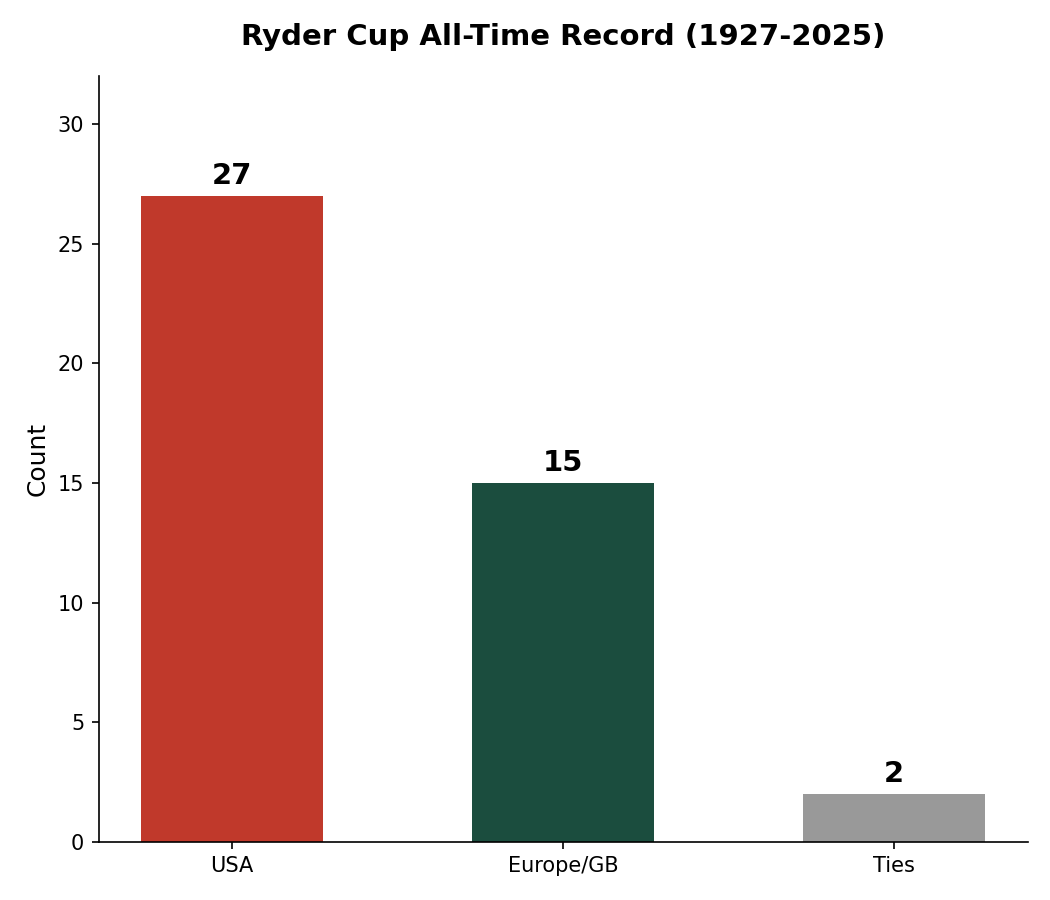
As of 2025, the United States leads the all-time Ryder Cup record with 27 wins, while Europe (including its earlier Great Britain era) has 15 wins, and 2 matches have ended in a tie. So in terms of total history, the US is still ahead.
But recent trends tell a different story. Europe has not lost a single Ryder Cup played on home soil since the 1997 edition in Spain, making its home-course record remarkably strong over the past few decades.
At the 2023 edition in Rome, Italy, Europe won convincingly by a score of 16.5 to 11.5. The team reportedly built an early lead from the very first day and never let the momentum slip away.
The most recent edition, held in 2025 at Bethpage Black in New York, produced another surprise. Despite struggling in Sunday's singles matches, Europe held on to win 15-13, securing back-to-back titles and its first away win on American soil in 13 years.
So while the US still leads in the overall historical count, many observers point out that Europe's momentum over roughly the last decade has been hard to ignore.
Good to Know
The Ryder Cup runs for three days and features 28 total matches. The first two days consist of foursomes (two players sharing one ball, alternating shots) and four-ball matches (two players each playing their own ball, with the better score counting), while the final day is a series of 12 singles matches, one-on-one.
One interesting detail is that there is no prize money at stake at all. Some of the highest-earning golfers in the world play purely for team pride, which makes the Ryder Cup unlike almost any other event on the golf calendar.
The Ryder Cup isn't the only major international team event in golf. The Presidents Cup pits the US against an International Team drawn from countries outside the US and Europe, and the Solheim Cup follows a similar match-play format for the women's game.
The tournament is held every two years, alternating between the US and Europe, always in an odd-numbered year. Since 2025's edition was held in the US, the next Ryder Cup is scheduled for 2027 in Europe, and it will be worth watching whether Europe can extend its unbeaten home streak once again.
'취미생활 > 골프' 카테고리의 다른 글
| 골프 :: 디오픈 챔피언십, 왜 골프에서 가장 오래된 메이저일까? 메이저 대회 총정리 (0) | 2026.07.26 |
|---|---|
| 골프 :: 마스터스 토너먼트, 그린재킷의 전설은 어떻게 시작됐을까? 메이저 대회 총정리 (0) | 2026.07.26 |
| 골프 :: 라이더컵, 미국과 유럽은 왜 100년 가까이 싸우고 있을까? 국제대회 총정리 (0) | 2026.07.25 |
| Golf :: How Did Jack Nicklaus Build His Record 18 Major Championships? A Legend's Story (0) | 2026.07.24 |
| 골프 :: 잭 니클라우스, 메이저 18승의 전설은 어떻게 만들어졌을까? 레전드 스타 총정리 (0) | 2026.07.24 |